Il y a une raison pour laquelle les douleurs cervicales surprennent souvent. Contrairement à une entorse à la cheville ou à une fracture du poignet, elles ne débutent généralement pas par une blessure évidente. Elles s'installent insidieusement dans le quotidien. On peut ressentir une légère raideur en faisant une marche arrière, une gêne après une journée passée sur son ordinateur portable, ou une douleur lancinante qui apparaît chaque soir et disparaît après une nuit de sommeil. La plupart des gens n'y prêtent pas attention. Ils changent d'oreiller, appliquent un gel anti-douleur, s'étirent le cou à plusieurs reprises et reprennent leurs activités. Mais au bout d'un certain temps, la même gêne revient. Tourner la tête est plus difficile que d'habitude. Regarder son téléphone pendant quelques minutes suffit à ressentir une lourdeur dans la nuque. Certains ressentent même une douleur irradiant vers l'épaule. À ce stade, le problème ne se limite généralement plus à la simple fatigue musculaire. La nuque est soumise à des tensions répétées depuis des semaines, des mois, voire des années.
Aujourd'hui, les douleurs cervicales sont devenues l'un des troubles les plus fréquents, tous âges confondus. Les longues heures passées devant l'ordinateur, l'utilisation continue du téléphone portable, une mauvaise posture, le stress et l'usure liée à l'âge y contribuent. Chez certaines personnes, ces changements restent limités aux muscles. Chez d'autres, ils affectent progressivement les articulations et les disques du cou, pouvant mener à une spondylose cervicale. Identifier la cause de vos symptômes est la première étape pour choisir le traitement adapté. Traitement ayurvédique des douleurs cervicales.
Pourquoi a-t-on mal au cou ?
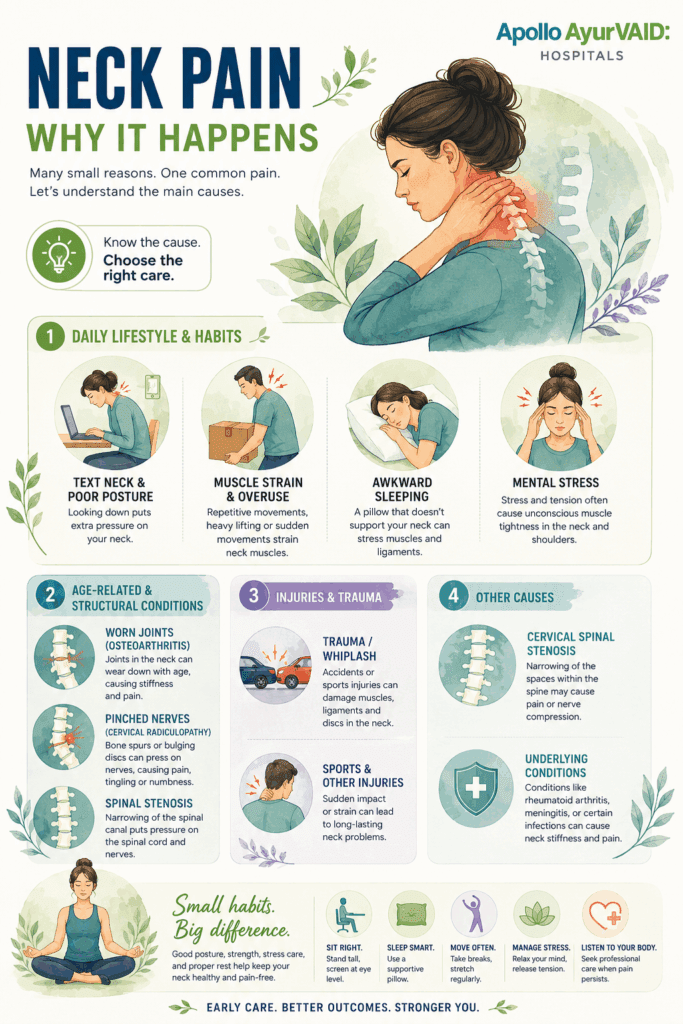
La nuque est sollicitée presque constamment. Elle soutient le poids de la tête, permet de regarder autour de soi, de se pencher, de conduire, de lire et de travailler. Pourtant, la plupart d'entre nous n'y pensent guère jusqu'à ce qu'une douleur se manifeste. En pratique clinique, les douleurs cervicales ont rarement une cause unique. Le plus souvent, plusieurs petits problèmes s'accumulent au fil du temps. Voici quelques-unes des causes les plus fréquentes de douleurs cervicales :
- Passer de longues heures le nez collé à un ordinateur portable ou un téléphone portable. Cette posture penchée en avant à répétition est l'une des raisons pour lesquelles le syndrome du cou technologique (ou « tech neck ») et les traitements ayurvédiques sont devenus un sujet de recherche si fréquent.
- Une mauvaise posture assise, les épaules arrondies et la tête penchée vers l'avant exercent une pression constante sur les muscles et les articulations du cou.
- Dormir avec un mauvais soutien de la nuque. Un oreiller trop haut ou trop bas, ou dormir sur le ventre, peut maintenir la nuque dans une position inconfortable pendant des heures.
- Le stress émotionnel peut aussi affecter la nuque. Nombreux sont ceux qui ne réalisent pas qu'ils accumulent des tensions jusqu'à ce que leurs épaules se raidissent ou que leur nuque commence à les faire souffrir après une longue journée.
- Les modifications dégénératives liées à l'âge constituent une autre cause fréquente. Tout comme les genoux ou les hanches, les articulations du cou s'usent avec le temps. Chez certaines personnes, ces modifications deviennent l'une des causes courantes de la spondylose cervicale.
- Des blessures antérieures comme des chutes, des blessures sportives, un coup du lapin ou même un traumatisme cervical suite à un accident peuvent parfois continuer à affecter le cou longtemps après la guérison de la blessure elle-même.
- Dans certains cas, des affections telles que la sténose cervicale, qui est un rétrécissement du canal rachidien, ou la radiculopathie cervicale, où un nerf est comprimé dans le cou, peuvent également faire partie du tableau clinique.
Les douleurs cervicales ne se manifestent pas de la même façon chez tout le monde. Un jeune informaticien peut souffrir principalement de tensions musculaires dues à une mauvaise posture, tandis qu'une personne plus âgée peut présenter des symptômes liés à la dégénérescence des articulations cervicales. Bien souvent, les deux sont présents simultanément. C'est pourquoi une évaluation approfondie est essentielle. Le traitement doit cibler la cause de la douleur, et non se limiter au symptôme.

Quelles sont les sensations liées à la douleur cervicale ?
La douleur cervicale ne se limite pas toujours à une simple douleur dans le cou. Elle peut parfois se manifester par une douleur sourde à la base du crâne. Parfois, les épaules sont tendues en fin de journée. Certaines personnes se réveillent avec une difficulté à tourner la tête confortablement. Lorsque les muscles et les articulations sont principalement touchés, vous pouvez constater :
- Une douleur lancinante et constante autour du cou
- Raideur en regardant sur le côté
- Sensation de tension au niveau des épaules
- Maux de tête commençant à l'arrière de la nuque
- Douleur qui s'aggrave après de longues heures en position assise
Si un nerf est irrité, les symptômes changent souvent. Au lieu de rester localisée au niveau du cou, la douleur peut se propager à l'épaule ou au bras. Des picotements, un engourdissement, une sensation de brûlure ou une faiblesse de la main peuvent également apparaître.
Comment l'Ayurveda appréhende-t-elle la douleur cervicale ?
En Ayurveda, les douleurs cervicales ne sont pas considérées comme une affection unique et figée. Deux personnes peuvent présenter les mêmes symptômes, mais pour des raisons sous-jacentes totalement différentes. En Ayurveda, la spondylose cervicale est associée au Manyastambha, dont les principaux symptômes sont la raideur et la limitation des mouvements. Ceci est généralement lié à une aggravation de…Vata, parfois mélangé avec Kapha également.
Des facteurs comme la position assise prolongée, une mauvaise posture, les voyages fréquents, les repas irréguliers et même le vieillissement sont considérés comme des facteurs perturbant progressivement Vata. Avec le temps, cela se manifeste par des tensions, des douleurs et une diminution de la souplesse au niveau de la nuque. Certaines personnes ressentent davantage une lourdeur qu'une douleur aiguë. Dans ces cas-là, Kapha est généralement considéré comme dominant, ce qui explique cette sensation de lourdeur et de léthargie.
Il existe aussi des situations où la douleur se manifeste par une sensation de chaleur, d'inflammation ou de brûlure. C'est là que… Pitta intervient, souvent en même temps que Vata, indiquant une inflammation.
Dans les cas chroniques impliquant l'usure des vertèbres cervicales, cette affection est souvent liée à un déséquilibre Vata (Greeva Sandhigata). Les traitements ayurvédiques sont alors adaptés aux symptômes du patient, à sa constitution et au stade d'évolution de la maladie.
Traitement ayurvédique des douleurs cervicales
Il n'existe pas de remède ayurvédique unique contre les douleurs cervicales qui convienne à tous. Deux personnes souffrant des mêmes douleurs au cou peuvent nécessiter des traitements totalement différents. C'est pourquoi l'Ayurveda privilégie une évaluation approfondie plutôt qu'une prescription standard. Le praticien examine vos symptômes, leur durée, la nature inflammatoire ou dégénérative de la douleur, l'implication des doshas Vata et Kapha, votre digestion, votre sommeil, votre mode de vie et votre état de santé général avant de définir le traitement. L'objectif est simple : non seulement soulager la douleur, mais aussi permettre au cou de retrouver une mobilité confortable tout en ralentissant la progression des lésions.
Thérapies Panchakarma
En cas de raideur et de douleur importantes, des thérapies Panchakarma soigneusement sélectionnées peuvent être conseillées. Au début, notamment en présence de douleur aiguë, de lourdeur ou d'inflammation, l'objectif principal est généralement de réduire l'inconfort, de soulager les spasmes musculaires et de corriger les déséquilibres. Dans ces situations, les approches basées sur le Rukshana peuvent être privilégiées en premier lieu afin de réduire l'Ama et l'excès de Kapha-Vata. Une fois les symptômes aigus apaisés, des thérapies nourrissant et soutenant la région cervicale sont envisagées.
L'abhyanga est un massage thérapeutique utilisant des huiles chaudes médicinales qui contribue à détendre les muscles tendus du cou et des épaules. Il est souvent suivi de swedana, une forme de thermothérapie contrôlée, utilisée pour soulager les raideurs et améliorer la mobilité.
L'un des traitements les plus connus pour les douleurs cervicales chroniques est le Greeva Vasti. Fréquemment mentionné en médecine traditionnelle pour les affections caractérisées par une raideur et une fatigue de la région cervicale, ce procédé consiste à appliquer délicatement de l'huile médicinale chaude sur la nuque à l'aide d'un masque en farine de pois chiche noir, et à la laisser en place pendant une durée déterminée. La chaleur contribue à détendre les muscles, tandis que l'huile est censée soutenir les tissus environnants. Utilisée de manière appropriée, en fonction de l'affection et du stade de la maladie, cette technique est réputée améliorer la souplesse et réduire l'inconfort.
Selon les cas individuels, un médecin peut également suggérer le Nasya, qui consiste à administrer de l'huile médicinale par voie nasale sous surveillance médicale.
Le choix du Panchakarma n'est jamais automatique. Il dépend des symptômes du patient, du stade de la maladie, de son âge, des maladies associées et des observations cliniques.
Médicaments internes
Nombreuses sont les personnes qui recherchent en ligne le meilleur remède ayurvédique contre les douleurs cervicales. En réalité, l'Ayurveda considère qu'il n'existe pas de remède universel. Le choix des médicaments repose uniquement sur la compréhension du déséquilibre sous-jacent. Selon le diagnostic, des préparations peuvent être choisies pour apaiser le Vata aggravé, réduire la raideur, favoriser la santé des articulations et nourrir les tissus affectés. Les meilleurs résultats sont généralement obtenus lorsque les médicaments, le Panchakarma, la rééducation et les modifications du mode de vie sont combinés plutôt qu'utilisés séparément.
Changements de style de vie
Après un traitement, beaucoup se sentent mieux, mais retombent peu à peu dans leurs vieilles habitudes. L'ordinateur portable retrouve sa place sur la table à manger. Le téléphone revient sur les genoux. Des heures passent sans qu'on se lève de sa chaise. Progressivement, la raideur réapparaît. C'est pourquoi les habitudes quotidiennes sont tout aussi importantes que le traitement. Quelques changements simples peuvent réduire les tensions exercées sur la nuque :
- Si possible, placez votre écran d'ordinateur à hauteur des yeux. Évitez de baisser la tête vers votre téléphone pendant de longues périodes. Si vous travaillez assis, il est conseillé de vous lever et de bouger un peu toutes les 30 à 45 minutes, même une ou deux minutes suffisent.
- Le sommeil est aussi plus important qu'on ne le pense. Un oreiller qui soutient correctement la courbe naturelle de la nuque peut faire une différence notable au fil du temps.
- Si votre médecin ou votre physiothérapeute vous a prescrit des exercices pour le cou, il est généralement préférable de continuer à les faire même après que la douleur se soit atténuée, plutôt que d'arrêter trop tôt.
Du point de vue de l'Ayurveda, la routine quotidienne est tout aussi importante. Des repas réguliers, un sommeil réparateur, une réduction du stress et des aliments fraîchement préparés sont autant d'éléments considérés comme bénéfiques pour maintenir l'équilibre de Vata et favoriser la guérison.
Quand devriez-vous consulter un médecin ?
Une légère contracture cervicale après une journée particulièrement chargée disparaît souvent avec du repos. Une douleur persistante est différente. Si la douleur revient régulièrement, s'étend à l'épaule ou au bras, ou si vous ressentez des picotements, un engourdissement ou une faiblesse musculaire, il vaut mieux ne pas l'ignorer. C'est souvent à ce moment-là que l'on se dit « ça va passer tout seul », mais c'est précisément dans ces situations qu'un examen médical est le plus utile. Un diagnostic précoce peut faire toute la différence pour ralentir la progression de la maladie et améliorer le pronostic à long terme.
Une douleur intense et soudaine après un accident, des difficultés à marcher, une perte d'équilibre ou une faiblesse dans les bras ou les jambes doivent toujours être considérées comme une urgence médicale.
Réflexions finales
La douleur cervicale ne se manifeste généralement pas d'un coup. Elle s'installe souvent progressivement, et la plupart des gens ont tendance à l'ignorer au début car elle semble passagère. Mais lorsque la raideur revient régulièrement ou que les mouvements les plus simples deviennent difficiles, c'est généralement le signe que la nuque a besoin d'être examinée. Qu'il s'agisse d'une contracture musculaire ou d'une affection comme la spondylose cervicale, le traitement est généralement plus efficace lorsqu'il s'attaque à la cause profonde plutôt que de simplement masquer la douleur temporairement.
Un plan de traitement ayurvédique personnalisé pour les douleurs cervicales peut combiner différentes thérapies, des médicaments ayurvédiques spécifiques soigneusement sélectionnés, des séances de Panchakarma, des corrections de mouvements et de simples modifications du mode de vie. L'objectif n'est pas seulement de soulager la douleur, mais aussi d'améliorer la mobilité, de soutenir les tissus de la région cervicale et de réduire les risques de récidive. Commencer le traitement précocement permet généralement d'accélérer la guérison et de préserver une meilleure santé cervicale à long terme.