ಪರಿಚಯ
There are days when everything seems normal from the outside but something inside does not feel right. You may be sleeping but not feeling rested. Eating, but without much appetite. Going about your work but finding it difficult to concentrate. Perhaps you are constantly thinking, worrying about the future, replaying conversations in your head, or feeling unusually irritable and exhausted.
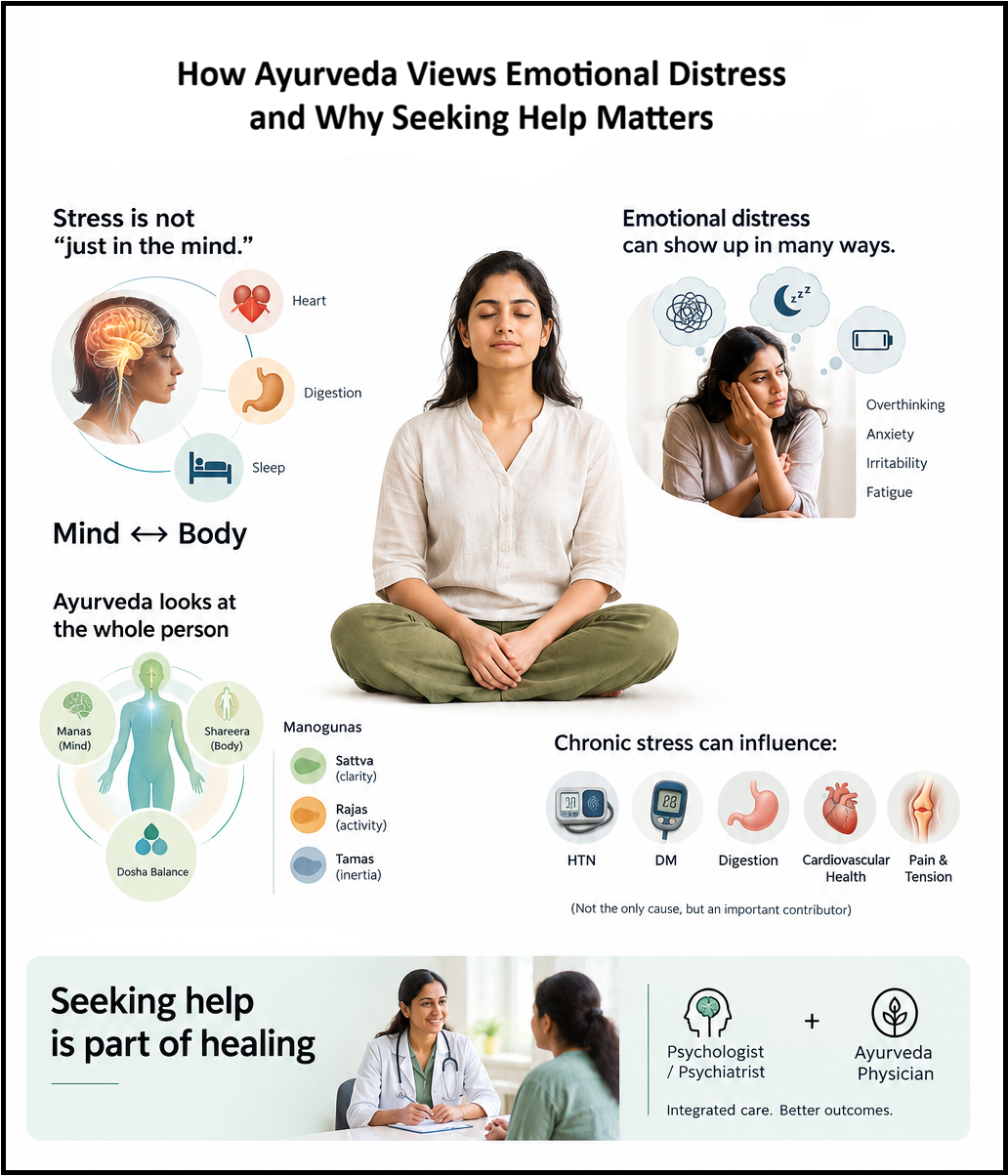
Mental health is not limited to a psychiatric diagnosis. Emotional stress can influence sleep, digestion, appetite, energy, immunity, pain perception and metabolic health. Modern medicine increasingly recognises this complex mind–body relationship, while Ayurveda has described the interconnectedness of mental and physical wellbeing for centuries.
On World Mental Health Day observed every year on October 10, the focus is not only on mental illness but also on making mental healthcare more accessible. The 2026 WHO theme, “Lived experiences heard: real voices, real change,” reinforces the importance of listening to people and making mental healthcare more person-centred.
Ayurveda offers another important perspective: emotional distress is not a weakness, and the body should not be treated as though it exists separately from the mind.

Ayurveda and the Mind–Body Connection
In Ayurveda, health is understood through the harmonious functioning of Manas (mind), Shareera (body), Indriyas (senses) and Atma.
The classical texts describe three mental qualities or Manogunas:
- Sattva – clarity, stability, awareness and balance
- Rajas – excessive activity, restlessness and constant stimulation
- Tamas – heaviness, inertia, withdrawal and dullness
When Rajas and Tamas become excessive, mental balance can be disturbed.
Ayurveda also looks at functional aspects of the ದೋಶಗಳು in relation to mental activity. Pranaವಾತ is associated with mental activity, perception and regulation; Sadhakaನವರಂಗಗಳು with emotional processing and understanding; and other Dosha functions influence circulation, energy and physiological stability.
But perhaps one of the most relevant Ayurveda observations for today’s world is the effect of constant thinking and worry.
A classical reference states:
“रस वाहीनि दुष्यन्ति चिन्त्यानां च अति चिन्तनात्”
In simple terms, Ayurveda recognises that excessive worry and overthinking can disturb Rasavaha ಸ್ರೋಟಾಸ್—the channels associated withರಸ ಧಾತು, which represent the body’s primary nourishing fluid.
This idea feels remarkably relevant today.
When stress becomes a constant companion, the body may begin to show subtle signs—Aruchi (loss of appetite), Avipaka (indigestion), Gaurava (heaviness), fatigue and disturbed sleep.
When such stress continues, Ayurveda sees the ಧಾತು system progressively affected, reducing nourishment and strength.
When Stress Starts Speaking Through the Body
Have you noticed your stomach feeling unsettled before an important presentation or your sleep becoming lighter during a stressful phase? Have you noticed how headaches, neck tension, palpitations, or fatigue can worsen when the mind is overwhelmed?
These are examples of the mind–body connection that many people experience every day.
Modern medicine uses terms such as psychophysiological or psychosomatic disorders to describe conditions in which emotional factors can influence physical symptoms and physiological functioning.
This does not mean that every physical illness is “all in the mind”.
ಸಾಕಷ್ಟು ವಿರುದ್ಧ.
Hypertension, type 2 diabetes, cardiovascular disease, obesity, gastrointestinal disorders such as IBS and many chronic conditions have multiple causes. But chronic psychological stress can become an important contributor to disease risk, disease progression or difficulty in maintaining control.
For example, chronic stress has been associated with hypertension through changes in cardiovascular and neuroendocrine regulation. Research also supports associations between prolonged psychological stress and type 2 diabetes, including pathways involving cortisol, insulin resistance, inflammation and changes in behaviour.
So, increasingly, the question in chronic disease care is not only:
“What is happening to the body?”
ಅದು ಕೂಡ:
“What is happening in the person’s life, mind, sleep, routines and emotional environment?”
This is particularly important when conditions such as hypertension, diabetes, digestive disorders, chronic pain or recurrent headaches are accompanied by prolonged stress, anxiety, poor sleep or emotional exhaustion.
How Emotional Distress May Manifest
Ayurveda also recognises that emotional distress may look different for everyone.
When Vata is predominant
There may be excessive worry, racing thoughts, fear, restlessness, panic-like symptoms, poor concentration and broken sleep.
When Pitta is predominant
There may be irritability, anger, frustration, impatience, perfectionism and a tendency to be excessively self-critical.
When Kapha is predominant
A person may experience heaviness, low motivation, lethargy, withdrawal, reduced interest and a feeling of being emotionally “stuck”.
These are Ayurveda patterns, not psychiatric diagnoses. They are useful as part of an individualised assessment, while persistent or severe symptoms still require appropriate psychological or psychiatric evaluation.
Sattvavajaya Chikitsa: Strengthening the Mind
Ayurveda’s approach to mental wellbeing is not limited to medicines.
One classical approach is Sattvavajaya Chikitsa, which focuses on strengthening the mind and gradually moving away from unhelpful thoughts, impulses and emotional patterns.
In today’s language, some elements may resemble counselling, mindful awareness, cognitive reframing, behavioural support and reflective practices.
The objective is not simply to tell someone to “think positively”.
Sometimes a person does not need more advice.
They need to feel heard.
They need space to understand what they are going through, recognise patterns, rebuild routines and develop healthier ways of responding to stress.
This process becomes particularly important in Ayurveda for grief and trauma. Grief cannot be rushed, and trauma cannot be resolved through lifestyle advice alone. Psychological safety, appropriate counselling and specialised trauma-informed care may be essential. Ayurveda can improve sleep, nourishment, routine, relaxation and overall resilience.
From Rasa to the Rest of the Body
When nourishment is disturbed, Ayurveda does not consider one tissue in isolation. The Dhatus are understood as interconnected stages of nourishment and tissue development.
Thus, prolonged stress and poor nourishment may eventually be reflected as fatigue, reduced strength, changes in body composition, weakness, poor resilience or disturbances affecting different systems.
This framework explains why chronic emotional strain can sometimes feel physically exhausting.
A person may begin with:
Overthinking → disturbed digestion → poor sleep → fatigue → reduced resilience → physical symptoms
The pathway is not always linear, and it is not the only explanation for disease. But it reminds us of something important:
Mental wellbeing is part of physical wellbeing.
A calm mind supports healthy routines, digestion, sleep and nourishment. A well-supported body gives the mind greater resilience.
Supporting Mental Wellness Through Ayurveda
Ayurveda may support emotional wellbeing through a personalised combination of counselling, diet, daily routine, movement, breathing practices, appropriate therapies and medicines when indicated.
Simple practices can also make a difference:
ಉಸಿರಾಡು: Gentle breathing practices such as Nadi Shodhana, when appropriate, can encourage relaxation and bring attention back to the present moment.
ಸರಿಸಿ: Walking, yoga, stretching or any enjoyable physical activity can help break the cycle of prolonged mental and physical inactivity.
ಸ್ಲೀಪ್: A consistent sleep-wake routine is one of the simplest foundations for emotional resilience.
ನಿಯಮಿತವಾಗಿ ತಿನ್ನಿರಿ: Irregular meals, excessive caffeine and prolonged periods without food can add to physical stress and disturb digestion.
Create pauses: Constant digital stimulation keeps the mind engaged even when the body is exhausted. Creating periods without screens, work or notifications can give the nervous system space to settle.
ಸಂಪರ್ಕ ಉಳಿಯಲು: A conversation with someone you trust may be more valuable than trying to carry everything alone.
Where Medicines Fit In
Ayurveda has traditionally used Medhya Rasayanas and other medicines in selected cases to support cognition, sleep, stress adaptation and mental wellbeing. But this area is where responsible care matters. A medicine that is appropriate for one person may not be appropriate for another. Pregnancy, psychiatric medication, liver or kidney conditions, age, other medicines and the nature of symptoms all need to be considered.
Mental health conditions should not be self-treated with herbal medicines simply because they are considered “natural”.
Real Healing Requires Individualised Care
At Apollo AyurVAID, we centre our approach to emotional and psychosomatic concerns on understanding the individual rather than just treating symptoms alone. In clinical practice, some patients may present primarily with emotional symptoms, while others may come for a physical condition in which stress, poor sleep or emotional distress has become an important part of the clinical picture.
Patient success stories treated in our centres
Case Description 1:
A 26-year-old pregnant female presented at Apollo AyurVAID experiencing severe emotional turbulence, mood swings, and symptoms of bipolar mood disorder. Standard pharmacological interventions posed potential risks during pregnancy. Utilising Apollo AyurVAID’s classical diagnostic protocol, clinicians identified specific Dosha vitiations that were affecting her mind. The patient was treated with a highly customised, safe, non-toxic protocol that combined cognitive counselling, gentle external therapies (such as Shirodhara, Thalam, and Padabhyanga), and strict dietary regulation. This whole-person care approach successfully stabilised her mood, improved sleep, and restored emotional equilibrium throughout her pregnancy safely.
Case Description 2:
A 20-year-old female student presented at Apollo AyurVAID experiencing severe academic stress, mood instability, persistent loss of interest in daily activities, and chronic insomnia lasting over 30 days. Baseline clinical assessment using the DASS-42 scale revealed severe depression (score 27). Clinicians implemented a structured, multi-modal treatment plan combining cognitive counselling and guided relaxation imagery with targeted internal Medhya Rasayanas, while carefully tapering her conventional psychotropic medication. The protocol achieved significant clinical improvement, reducing her DASS-42 depression score to mild levels (score 10), normalising anxiety and stress, resolving sleep disturbances, and restoring her cognitive confidence and daily functioning.
Seeking Help Is Part of Healing
We have become increasingly comfortable discussing diabetes, blood pressure, thyroid disorders and heart disease.
Mental health deserves the same openness.
Persistent sadness, anxiety, panic, emotional numbness, severe insomnia, loss of interest, significant changes in behaviour, inability to function normally or thoughts of self-harm should not be dismissed as something one simply needs to “get over”.
These are signals to seek help.
Ayurveda emotional distress mental support can be valuable when it is personalised and delivered responsibly. Ayurveda depression support may have a role within an appropriately assessed care plan. And Ayurveda for grief and trauma can be supportive alongside qualified psychological care.
The larger goal is mental wellness Ayurveda—not as a replacement for modern mental healthcare, but as part of a person-centred approach that recognises the relationship between mind, body, behaviour, sleep, digestion and emotional resilience.
And perhaps that is the most important message this World Mental Health Day:
You do not have to wait until you are completely overwhelmed before asking for help.
Because seeking help is not a sign that you are weak.
It is a sign that you have started listening to yourself.