Living with interstitial lung disease (ILD) can be tiring in ways that are hard to explain to someone who has never experienced it. A short walk, a flight of stairs or making a meal may leave you stopping to catch your breath. Things you once did without a second thought can take much more effort.
ILD affects the tissue around the air sacs in the lungs. When this tissue becomes inflamed or scarred, oxygen has a harder time passing into the bloodstream. Treatment depends on the type of ILD and how it changes over time. Medicines may help control inflammation or slow further scarring, but breathlessness and অবসাদ can still be part of everyday life. And that can be difficult to come to terms with. Even when treatment is underway, you may still wonder what else could help you feel more comfortable or manage the day a little better. This is why some people explore interstitial lung disease Ayurvedic treatment.

Understanding ILD and its effect on the lungs
The lungs contain millions of tiny air sacs called alveoli. Oxygen passes through the delicate tissue surrounding these sacs and enters the bloodstream. In ILD, inflammation or scarring affects this tissue, making the process less efficient. The condition can develop for different reasons. Some forms are linked to autoimmune diseases, certain medicines, or exposure to dust and other substances. In other cases, the cause remains unknown. The disease pattern and its progression also vary from person to person.
How does Ayurveda understand respiratory diseases?
In Ayurveda, Shwasa Roga is a general term for respiratory disorders in which Vata and Kapha Dosha play an important role. The susceptibility of an individual to develop diseases may be due to Beejadushti (genetic and hereditary factors) and Khavaigunya (weakness of channels of the body). Diet and lifestyle habits such as irregular eating (Akalabhojana), eating less (Pramitabhojana), lead to formation of কিন্তু; night awakeness (Ratri Jagarana) and suppression of natural urges (Vegadharana) aggravate Vata.
As Vata becomes aggravated and Kapha becomes disturbed, their movement through the body’s channels may be affected (Pratiloma Gati). These disturbances are understood to affect the Uras (chest), particularly the Pupphusa (lungs), and thePranavaha Srotas, the channels associated with respiration. Disturbances in the Rasavaha Srotas, which support the nourishment of body tissues, may also be involved. The resulting Kapha Shoshana (depletion of Kapha) and Soumya Dhatu Kshaya (depletion of nourishing tissues) are linked to Dhatukshaya, or tissue depletion. As this progresses, Vata may become further aggravated, contributing to a cycle of tissue damage. This Ayurveda interpretation relates these changes to reduced lung elasticity and the development of fibrous tissue in ILD.
What role might Ayurveda have in ILD care?
In terms of managing interstitial lung disease, treatment can be more than just taking your medication as prescribed and seeing the doctor. Fatigue and loss of appetite can make everyday tasks difficult, and নিঃশ্বাসের দুর্বলতা can interfere with normal daily activities.
Ayurveda may offer supportive care tailored to a person’s needs, including advice on food, daily routines and rest. The approach should take account of the person’s symptoms, nutritional needs, other health conditions and ongoing ILD treatment. However, support for day-to-day well-being is not the same as treating the lung disease. Anyone considering interstitial lung disease Ayurvedic treatment should discuss it with their pulmonologist and a qualified Ayurveda physician. Prescribed medicines should not be stopped or changed without medical advice. Any proposed herbal medicines or therapies should also be reviewed for possible interactions and risks, particularly if lung function is reduced or the person is taking several medicines.
Diet and daily routine
When breathlessness and fatigue are part of daily life, preparing meals and eating enough can become difficult. Rather than following a restrictive diet, the priority is to find foods that the person can tolerate, provide adequate nourishment and fit their medical needs.
An Ayurveda consultation may help guide food choices according to appetite and digestive comfort. This advice should be consistent with the person’s nutritional requirements and any other medical conditions. No particular diet has been shown to reverse lung scarring, and cutting out major food groups without a sound reason can lead to nutritional deficiencies.
The same practical approach applies to daily activities. It can make the day easier to break difficult tasks into smaller steps, to take breaks and to ask for help when needed. These changes cannot prevent or reverse ILD, but they may help a person cope with fatigue and preserve energy for activities that matter to them.
Breathing practices and gentle movement
Individuals wonder if Pranayama or any breathing methods can relieve their discomfort. These techniques are suitable depending on the symptoms, lung capacity, and endurance of the person. Do not try to control breathlessness as a result of ILD by taking deep breaths forcibly, holding your breath for a long time or pushing through the discomfort. Breathing exercises should be individualised and discussed with your treating clinician. Pulmonary rehabilitation, when recommended, offers a structured way to work on exercise capacity, breathing strategies and confidence with activity.
Gentle movement may also help some people maintain mobility and independence. The right level of activity varies, so it is better to develop a plan with the healthcare team than to follow a general exercise routine without considering the condition.
Herbal preparations and traditional therapies
Herbal medicines and traditional procedures are sometimes explored as part of pulmonary fibrosis Ayurveda care. However, a natural preparation is not automatically safe for someone with a chronic lung condition.
Herbs can cause side effects and may interact with prescribed medicines. The composition and quality of preparations can also vary. Anyone considering these products should tell both their Pulmonologist and Ayurveda physician what they intend to take.
Panchakarma and other intensive procedures should not be assumed to be suitable for everyone. A person’s breathing capacity, oxygen requirements, general strength and other health conditions must be considered before a procedure is discussed.
Why an Integrative Approach Needs Careful Coordination
An ILD integrative treatment plan brings together appropriate conventional care and complementary support that is considered suitable for the individual. The aim is to make informed choices about overall care while protecting lung function.
Conventional treatment remains central to ILD management. Depending on the diagnosis, it may include medicines to control inflammation and antifibrotic treatment for certain forms of progressive disease, oxygen therapy and pulmonary rehabilitation. Regular follow-up helps the medical team monitor symptoms, assess lung function and adjust treatment when needed.
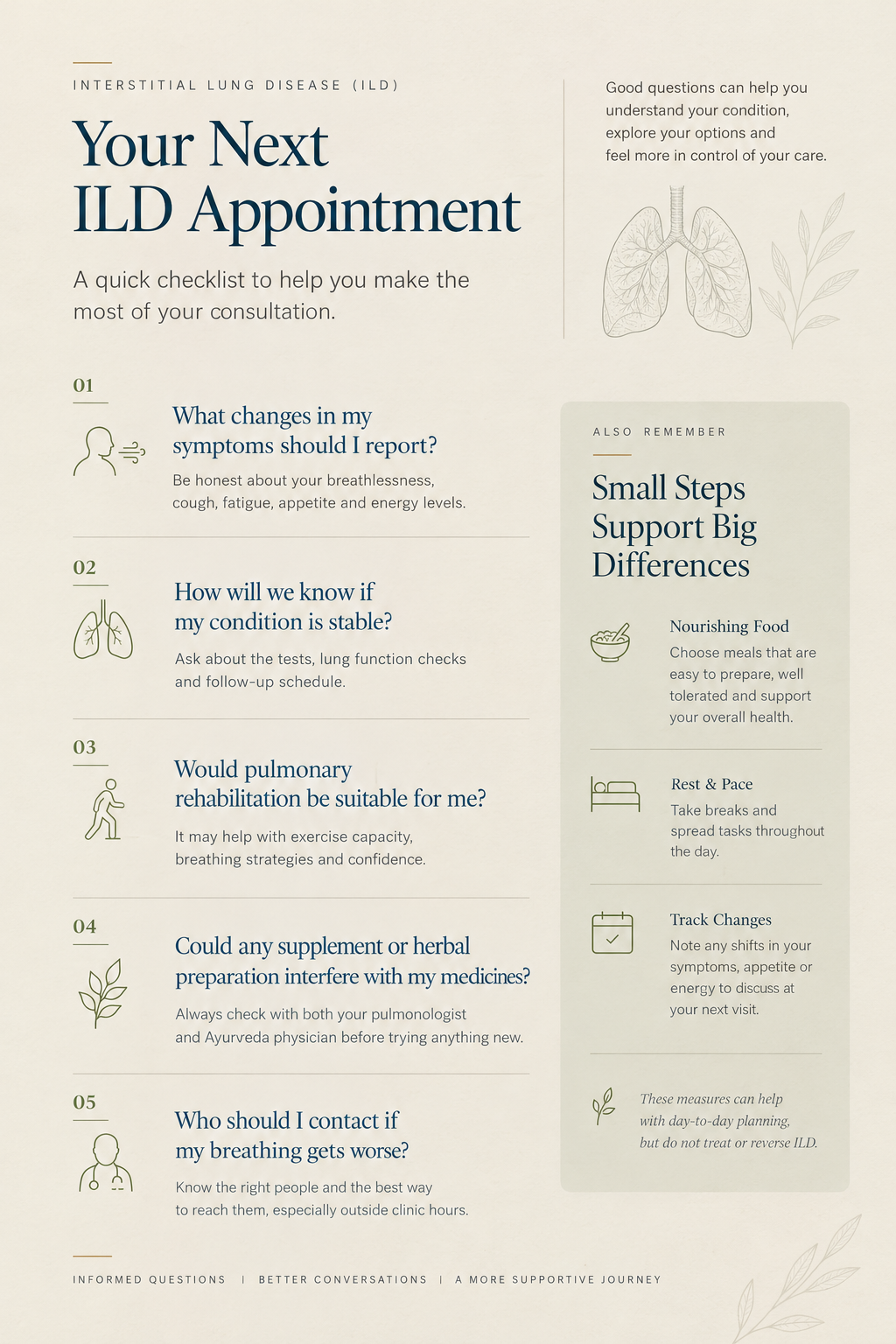
If someone wishes to explore Ayurveda, it is important that both healthcare teams know about the plan. This makes it easier to identify possible interactions, assess whether a proposed therapy is suitable and ensure that complementary care does not interfere with the treatment already in place. Before starting a new treatment, it may help to ask:
- What is this treatment intended to help with?
- Is there strong evidence for this supposed benefit?
- Could it affect my medications or another health problem?
- Is it appropriate for the person’s breathing difficulties and oxygen needs?
- How will changes in symptoms be monitored?
The questions are not meant to discourage people from considering their options. They help ensure decisions are made with an understanding of the potential benefits, risks and limitations.
Are there home remedies for interstitial lung disease?
Searching for interstitial lung disease home remedies is understandable when coughing, breathlessness, or fatigue continues to affect daily life. Some everyday measures may help reduce avoidable strain, but they cannot reverse fibrosis or replace prescribed treatment.
Avoiding cigarette smoke and known environmental irritants may be helpful. Following medical advice on vaccinations, infection prevention, nutrition and physical activity can also form part of an overall care plan. People who have been prescribed oxygen should use it as directed and should not change their oxygen settings without medical guidance.
Be wary of online remedies that promise to clear the lungs, dissolve scar tissue or cure ILD. There is no sound evidence to support such claims, and they may even lead people to put off treatment that they need. Progressive or new symptoms should not be assumed to be due to ILD and should not be treated at home. Sudden difficulty breathing, chest pain, blue or grey lips, confusion or a marked fall in oxygen levels requires immediate medical attention.
Living with ILD, one day at a time
ILD can bring uncertainty, and the support a person needs may change over time. For some, the priority is managing fatigue and preserving independence. For others, it may be maintaining nutrition, adapting daily activities or finding ways to cope with the emotional strain of a long-term illness.
Ayurveda may offer a complementary perspective on some of these concerns when care is individualised and coordinated with the respiratory team. The most useful approach is one that recognises the person’s day-to-day difficulties while keeping expectations realistic and safety at the centre of every decision.
Anyone considering Ayurveda for ILD should discuss their options with their Pulmonologist and a qualified Ayurveda physician. Together, they can consider which supportive measures are appropriate, which to avoid, and how to keep the overall treatment plan on track. The focus is not on choosing one system of care over another. It is about helping people living with ILD make informed decisions, receive the medical care their condition requires and find practical support for everyday life.
তথ্যসূত্র