- AyurVAID فارمیسی

کاروباری اوقات:
صبح 8 بجے تا شام 8 بجے (پیر تا ہفتہ)
صبح 8 تا شام 5 بجے (سورج)
کاروباری اوقات:
صبح 8 بجے تا شام 8 بجے (پیر تا ہفتہ)
صبح 8 تا شام 5 بجے (سورج)
Do you ever find yourself wondering how two people can consume the same meal and yet react to it differently? On the other hand, one of them feels heavy, bloated, or lethargic, while the other one feels light, energised, and satiated. Why does one individual take pleasure in the heat of summer while another person immediately starts looking for shade, refreshing beverages, or the nearby fan?
Within the framework of Ayurveda, these distinctions are explained by a basic concept known as ‘پراکرتی‘. From a more straightforward perspective, Prakriti can be seen as your initial constitution, which is the one-of-a-kind mind-body blueprint that you are born with. A person’s physical type, digestion, sleep, temperament, energy patterns, and even how they react to food, weather, job, and stress are all influenced by this factor.
Health is not the same for everyone is one of the most beautiful ideas that can be found in Ayurveda. What is nourishing for one person may be upsetting for another. The things that one individual finds to be a sense of equilibrium may cause discomfort for another individual. With the guidance of Prakriti, we are able to move away from advice that is inflexible and universally applicable and toward a more individualistic perspective of health.
The term “Prakriti” comes from the Sanskrit language and refers to an individual’s natural shape or base composition. According to Ayurveda, it is thought to be the pattern that is set at the moment of conception and is shaped by several variables, such as the constitution of the parents, the state of the doshas at that time, the season, and the environment that surrounds the human being.
Through the lens of the five main elements—space, air, fire, water, and earth—Ayurveda explains both the universe and the natural world. These three functional energies, which are referred to as doshas, are combined:
Every person has all three دوشاس, but not in equal measure. The unique proportion in which they are present creates Prakriti. That is why no two people are exactly alike, even within the same family.
Prakriti is your natural baseline. It is not a disease state. It is the original design of your body and mind, and understanding it gives you a clearer picture of what supports your health.
پراکرتی can be classified into 2: Deha Prakriti اور مناسکا Prakriti.
Deha Prakriti refers to the physical and physiological constitution governed by the three دوشیزہجبکہ Manasika Prakriti refers to the psychological temperament categorised by the three Gunas—Sattva, Rajas, اور تماس. کے طور پر manasika gunas سے متاثر ہیں doshas, Ayurveda broadly recognises seven types of Deha Prakriti based on the dominant دوشا:
where all three دوشاس are balanced
سما پراکرتی is often considered ideal, but it is quite rare. Most people are either single-dominant or dual-dominant. Some modern approaches further refine this understanding by studying the order of dominance, such as کفا وتا بنام وات کافہ, because even that subtle difference can matter in clinical practice.
The key idea is simple: constitution is personal, and healthcare should be personal too.
Prakriti can be classified into 2: جینئس اور مناسکا Prakriti.
Deha Prakriti’ refers to the physical and physiological constitution governed by the three دوشیزہجبکہ ‘Manasika Prakriti’ refers to the psychological temperament categorised by the three Gunas—Sattva, Rajas, اور تماس.
To understand Prakriti well, we need to understand the qualities of the three doshas.
Vata: the energy of movement
Vata is made of space and air. It governs movement in the body and mind — breathing, circulation, nerve impulses, digestion, elimination, speech, and even thought.
Individuals who possess a predominance of Vata are typically naturally thin, skinny, or slim. Their complexion can be dry, their hair can be dry, and they are easily susceptible to feeling cold. The body type of a Vata constitution is typically slender, and they might even have prominent veins or tendons.
Digestion is typically not consistent in people of a Vata nature. Appetite might be erratic on an everyday basis. Indigestion, gas, constipation, and inconsistent bowel movements can occur in Vata people. Sleep can easily be light and easily interrupted. They generally tend to be morning people because they have fragmented sleep.
Vata individuals can be innovative, alert, versatile, and imaginative. These individuals absorb new concepts swiftly and efficiently. They think in multiple ways all at once. They bring energy and newness into a situation. On the other hand, when Vata energy gets out of control, the same agility can transform into anxiety. Their strength is creativity. Their challenge is stability.
Pitta: the energy of transformation
Pitta is made of fire and water. It controls digestion, metabolism, body temperature, intelligence, and transformation. It is the force that turns food into nutrition and ideas into action.
Pitta people have a medium body structure with excellent muscle toning. The proportions of their body are generally perfect. The skin of these people is usually warm and sensitive, with conditions such as reddishness, spots, moles, and eruptions being common among them. Heat does not suit pitta people, and sweating is an issue for them.
They always have a sharp appetite and are generally unable to bear missing meals since their feeling of hunger sets in very soon. Digestive power is generally excellent for them; however, when Pitta rises, there could be problems such as acidity, burning sensation, loose motion, or inflammation.
Intelligence, focus, organisation, and decision-making skills are all qualities that can be seen in a person having pitta as a dominant force in his constitution. He likes everything to be clear-cut, which helps him succeed as a leader and planner.
When Pitta is high, it shows itself in irritability, intolerance, perfectionism, criticism, anger, or even fatigue. Their inner fire is powerful, but it must be balanced carefully.
Their strength is clarity. Their challenge is heat.
Kapha: the energy of structure
Kapha is made of water and earth. It gives stability, strength, lubrication, endurance, and nutrition. It is the factor that binds things together.
The Kapha body type is characterised by a broad and solid physique with good muscular development. The skin is soft and lustrous, and hair may be thick and abundant. They may be prone to gaining weight, but they are physically strong.
Digestion is slow but steady. The appetite is low, and they can skip a meal or two without experiencing any problems. The quality of their sleep is deep, prolonged, and restful. These people usually sleep in but get energised after waking up.
In terms of personality traits, the Kapha body type is tranquil, patient, loving, and trustworthy. They provide emotional stability and security for the members of the group. Learning abilities come naturally, and they can easily retain information.
When Kapha is in excess, it may lead to heaviness, inertia, attachment, low motivation, sluggishness and mental dullness.
Their strength is steadiness. Their challenge is stagnation.

Prakriti is far more than a personality description. It is the foundation of personalised prevention in Ayurveda.
One of the greatest values of Prakriti is that it helps us understand predisposition. In modern terms, this concept is sometimes discussed under Ayurgenomics — the study of how constitutional patterns relate to health tendencies.
This does not mean a person is destined to develop a particular disease. It simply means that certain patterns may be more likely in certain constitutions, and that this awareness allows for earlier support.
Knowing your type helps us act before imbalance becomes disease.
Prakriti is also useful in nutrition. Food is not just about calories or trends. In Ayurveda, food is chosen according to the individual.
The same meal may be ideal for one person and unsuitable for another. That is why Prakriti-based advice is so practical.
It also helps us understand seasonal sensitivity. A Pitta person may struggle during peak summer. A Vata person may feel more disturbed in dry, windy, cold weather. A Kapha person may become heavy and sluggish in damp, cool seasons. Ayurveda therefore encourages living in rhythm with nature rather than ignoring it.
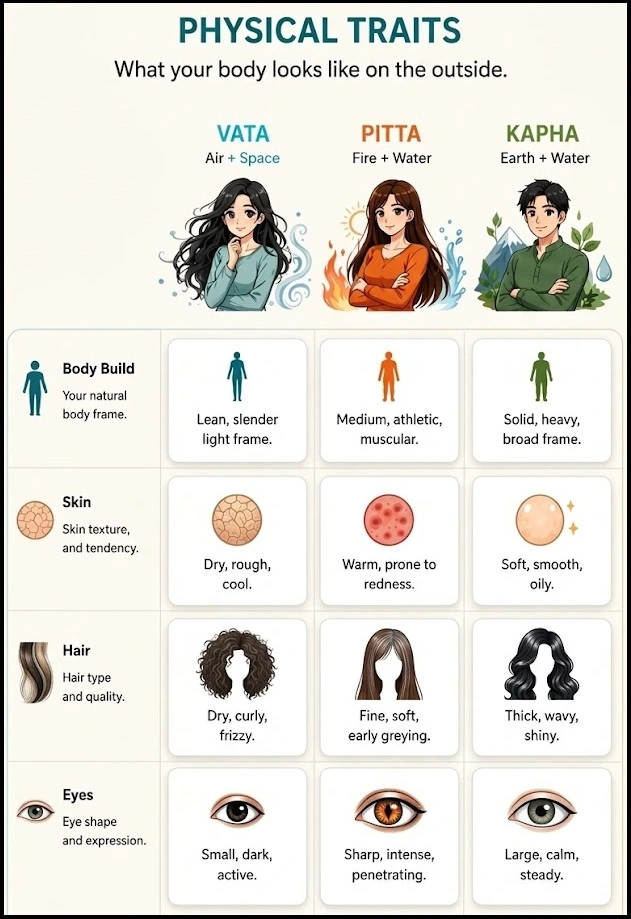
Yes. Self-observation can be a very helpful starting point.
Look at lifelong patterns rather than temporary symptoms. Ask yourself:
These clues can give you a broad idea of your constitution. Still, self-assessment has limits. Many people are mixed types, and a temporary imbalance can hide the original constitution. That is why a properly guided evaluation is always more reliable.
Once you understand your Prakriti, the goal is not to change who you are. The goal is to support your natural balance.
For Vata – Warm meals, regular meal timings, adequate rest, gentle movement, oil massage, and a calm atmosphere can be very supportive.
For Pitta – Cooling foods, hydration, emotional balance, and avoiding excess heat or overexertion are usually beneficial.
For Kapha – A lighter diet, regular exercise, stimulating activities, and an active routine help prevent heaviness and sluggishness.
These are broad principles, and individual guidance is always better than general advice. But even simple awareness can make a meaningful difference.
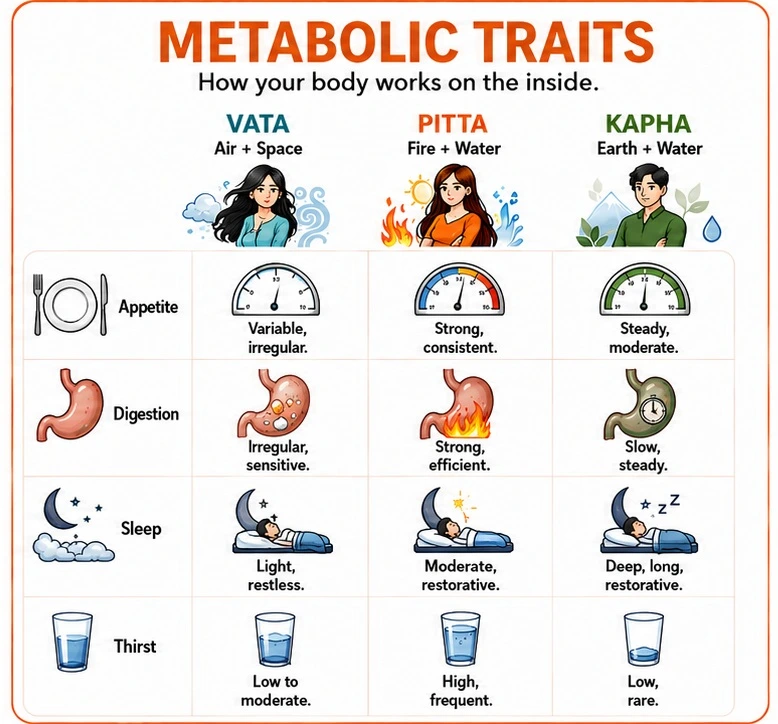
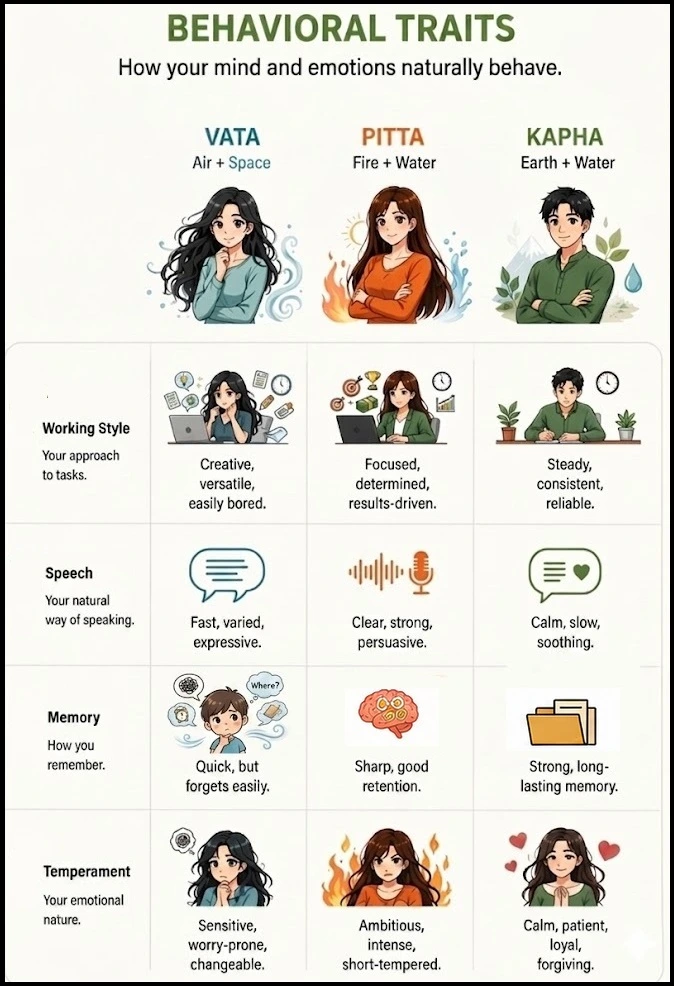
To assess the percentage of Vata, Pitta, and Kapha in your body, you can use the following comprehensive reference table based on the morphological, physiological, and psychological characteristics identified in Ayurveda texts and modern assessment tools.
قسم | ڈومین | وات | پت | کفھا |
جسمانی | جسمانی تعمیر | Thin, lean, or narrow frame; often underweight | Moderate, muscular build; medium height | Broad, heavy, or large frame; well-developed muscles |
جلد | Dry, rough, cold, or cracked; prominent veins/tendons | Soft, warm, sensitive; prone to moles, freckles, or acne | Smooth, oily, thick, and cool; clear complexion | |
ہیئر | Dry, brittle, thin, or curly | Fine, soft, straight; prone to early greying or balding | Thick, oily, strong, and voluminous | |
آنکھیں | Small, unstable, or “dusty” (darkish) | Medium, sharp, focused; reddish or yellowish tint | Large, stable, clear; thick eyelashes | |
میٹابولک | بھوک | Irregular or variable; sometimes strong, sometimes low | Strong, sharp, and unbearable if meals are missed | Low but steady; can easily skip meals |
عمل انہضام | Irregular, prone to gas and bloating | Quick, efficient; prone to acidity or burning sensations | Slow, sluggish; prone to mucus formation | |
خاتمہ | Tendency toward dry, hard stools and constipation | Regular; tendency toward soft or loose stools | Regular but slow; heavy or oily stools | |
پیاس | Variable; low to moderate | Intense; drinks large quantities of water | Low; drinks very little water | |
سو | Light, easily disturbed; tends to be an “early bird” | Moderate duration; alert upon waking | Deep, sound, and long; difficult to wake up | |
طرز عمل | کام کرنے کا انداز | Quick, hyperactive, often without a specific plan | Sharp, focused, analytical, and goal-oriented | Slow, steady, methodical, and calm |
تقریر | Talkative, fast, and sometimes unclear or hesitant | Precise, sharp, convincing, and authoritative | Slow, monotonous, pleasant, and gentle | |
یاد داشت | Learns very quickly but forgets just as fast | Sharp and precise; moderate learning speed | Slow to learn but has exceptional long-term retention | |
مزاج | Creative, energetic, but prone to anxiety and worry | Intelligent, ambitious, but prone to anger and irritability | Calm, loyal, patient, and caring; slow to anger |
Total Points: _______
چونکہ ہم اپنی خدمات کو بہتر بنانے کے لیے سخت محنت کرتے ہیں، آپ کے تاثرات ہمارے لیے اہم ہیں۔ براہ کرم آپ کی بہتر خدمت کرنے میں ہماری مدد کرنے کے لیے تھوڑا وقت نکالیں۔
تازہ ترین صحت سے متعلق تجاویز، خدمات پر اپ ڈیٹس، مریضوں کی کہانیاں، اور کمیونٹی کے واقعات کے لیے ہمارے ہسپتال کے نیوز لیٹر کو سبسکرائب کریں۔ آج ہی سائن اپ کریں اور باخبر رہیں!

مسئلہ کی اطلاع دیں۔
مشہور تلاشیں: امراضعلاجڈاکٹروںہسپتالوںپورے شخص کی دیکھ بھالمریض سے رجوع کریں۔انشورنس
کاروباری اوقات:
صبح 8 بجے تا شام 8 بجے (پیر تا ہفتہ)
صبح 8 تا شام 5 بجے (سورج)
