Introduction
Nous sommes nombreux à commencer notre journée en consultant notre téléphone avant même de sortir du lit. Le reste de la journée est souvent rythmé par les courriels, les réseaux sociaux, les échéances et les notifications incessantes. Bien que ce mode de vie soit devenu la norme, notre corps n'a jamais été conçu pour fonctionner sous un stress constant.
L'Ayurveda nous rappelle que la santé optimale ne repose pas sur des cures de désintoxication occasionnelles ou des séjours bien-être onéreux. Elle se construit plutôt par de petites pratiques quotidiennes et régulières. Cette philosophie se reflète magnifiquement dans Dinacharya – la routine quotidienne ayurvédique qui contribue à maintenir l’harmonie du corps, de l’esprit et du métabolisme.
Une bonne routine de bien-être de 30 minutes peut aider à rétablir l'équilibre, à améliorer la digestion, à calmer le système nerveux et à favoriser une bonne santé à long terme.
Considérez ce rituel de soins personnels ayurvédique comme un moyen d'investir en vous-même avant de prendre soin des autres.

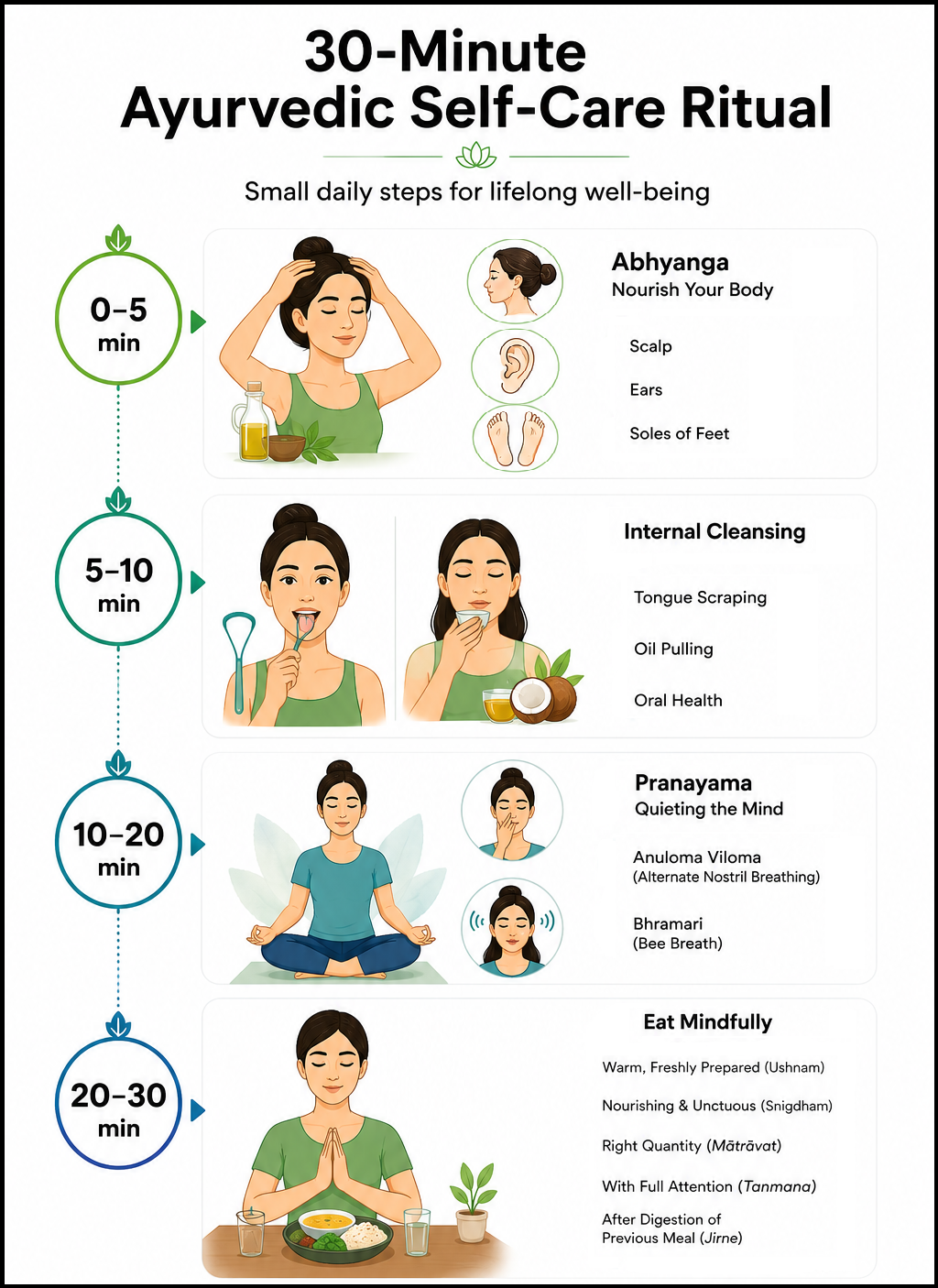
0-5 min : Abhyanga – Nourrissez votre corps
Les premières minutes de votre journée peuvent donner le ton pour le reste de la journée.
L'une des pratiques quotidiennes les plus appréciées de l'Ayurveda est l'Abhyanga, ou auto-massage à l'huile. Un massage complet du corps est extrêmement bénéfique, mais même cinq minutes de massage à l'huile chaude du cuir chevelu, des oreilles et de la plante des pieds peuvent faire une différence remarquable.
Ces zones sont très sensibles à Dosha Vatace qui est aggravé par des routines irrégulières, une surexposition aux écrans, le manque de sommeil et le stress mental.
Choisissez l'huile en fonction de la saison et de votre morphologie :
- L'huile de sésame chaude est particulièrement nourrissante pendant les mois les plus froids et pour les personnes de constitution Vata dominante.
- L'huile de coco est rafraîchissante et idéale pour l'été ou si vous avez un Pitta tendance.
- Des mouvements circulaires doux sur les articulations et de longs effleurements sur les membres stimulent la circulation et nourrissent les tissus (dhatus) et induire une relaxation.
Pratiquez un exercice doux comme la salutation au soleil (Suryanamaskara). Évitez les exercices matinaux intenses (Vyayama). Ce simple geste est l'une des manières les plus faciles de prendre soin de soi au quotidien selon l'Ayurveda et peut s'avérer particulièrement utile lorsque la vie semble accablante.
Min 5-10 : Nettoyage interne
Votre bouche peut vous en dire long sur votre état de santé général.
L'Ayurveda nous enseigne que Il aime Il s'agit des déchets métaboliques qui se manifestent souvent par un enduit sur la langue.
Commencez par vous gratter délicatement la langue 6 à 7 fois avec un gratte-langue en cuivre ou en acier inoxydable. Cette simple habitude :
- Découpe à travers le revêtement accumulé
- Rafraîchisseur d'haleine
- Un meilleur plaisir gustatif
- Soutient la santé digestive
Ensuite, pratiquez le bain de bouche à l'huile (Kavala ou Gandusha) avec une cuillère à soupe d'huile de sésame ou de coco. Faites circuler doucement l'huile dans votre corps pendant quelques minutes, tout en vous préparant pour la journée.
Les bains de bouche à l'huile réguliers peuvent aider :
- Promouvoir une bonne hygiène bucco-dentaire
- Santé des gencives
- Réduire les mauvaises bactéries buccales
- Favoriser la santé des dents et des tissus buccaux
Ces petites pratiques deviennent puissantes lorsqu'elles sont pratiquées régulièrement et intégrées à votre rituel de soins personnels ayurvédiques.
Minutes 10 à 20 : Pranayama (calmer l’esprit)
Nos modes de vie modernes peuvent souvent nous laisser physiquement épuisés et mentalement agités. C'est là que la respiration devient un remède.
Dix minutes de pratique du Pranayama suffisent pour équilibrer le système nerveux et préparer l'esprit pour la journée à venir.
L'Anuloma Viloma (respiration alternée par les narines) est l'une des techniques les plus simples et elle favorise l'équilibre entre le système nerveux sympathique (« combat ou fuite ») et le système nerveux parasympathique (« repos et digestion »).
Si vous avez l'habitude de vous réveiller irritable, en proie à une forte agitation mentale ou submergé par vos émotions, ajoutez quelques cycles de Bhramari Pranayama (respiration de l'abeille).
La douce vibration bourdonnante a un effet calmant naturel et fait taire le bavardage mental.
C’est dans cette partie de votre routine bien-être de 30 minutes que les gens constatent souvent la plus grande différence, non seulement au niveau de leur niveau de stress, mais aussi au niveau de leur concentration, de leur stabilité émotionnelle et de leur clarté d’esprit.
20 à 30 minutes : Mangez en pleine conscience
L'Ayurveda enseigne que la façon dont nous mangeons est tout aussi importante que ce que nous mangeons. Les textes classiques recommandent des aliments Ushnam (chauds et fraîchement préparés), Snigdham (suffisamment onctueux et riches en graisses saines), Matravat (consommés en quantité adéquate), Jirne (à consommer seulement après la digestion du repas précédent) et Tanmana (consommés en pleine conscience, sans distractions).
Les repas doivent être pris à un rythme tranquille, dans un environnement calme, et seulement lorsqu'on a réellement faim.
Ces principes intemporels contribuent à alimenter Agni (Feu digestif), favorisent une meilleure digestion et une meilleure absorption des nutriments, réduisent la formation d'Ama (toxines métaboliques) et contribuent à une bonne santé à long terme. Même dans le monde trépidant d'aujourd'hui, adopter ces habitudes alimentaires simples peut faire une réelle différence pour le bien-être général.
Conclure,
Cette pause consciente marque la fin de votre rituel de bien-être ayurvédique. Vous vous sentez ressourcé, et non pressé. La régularité est plus importante que la perfection. Il existe une idée fausse très répandue concernant l'Ayurveda : qu'elle prend beaucoup de temps. Ce n'est pas le cas. Certains matins seront chargés, et c'est tout à fait normal.
Ces jours-là, réduisez votre routine :
- Prenez de l'eau chaude.
- Grattez bien votre langue.
- Massez vos pieds avec de l'huile chaude.
- Prenez quelques minutes pour vous concentrer sur votre respiration.
Même quelques minutes de soins personnels ayurvédiques par jour valent bien mieux que de ne rien faire.
En Ayurveda, la prévention a toujours été préférable à la guérison. Ces habitudes simples favorisent une bonne digestion, équilibrent les doshas, atténuent les effets du stress quotidien et augmentent progressivement l'Ojas, la vitalité et la résistance naturelles du corps.
Votre routine bien-être de 30 minutes est une douce promesse que vous vous faites à vous-même : la promesse de commencer chaque journée avec plus d'équilibre, d'énergie et de conscience.
Car lorsque vous prenez régulièrement soin de vous, votre corps vous le rend bien en vous offrant une meilleure santé, votre esprit s'éclaircit et la vie semble un peu plus légère.
Vous recherchez des soins plus personnalisés ? Visitez notre page Soins pour découvrir les thérapies ayurvédiques authentiques.