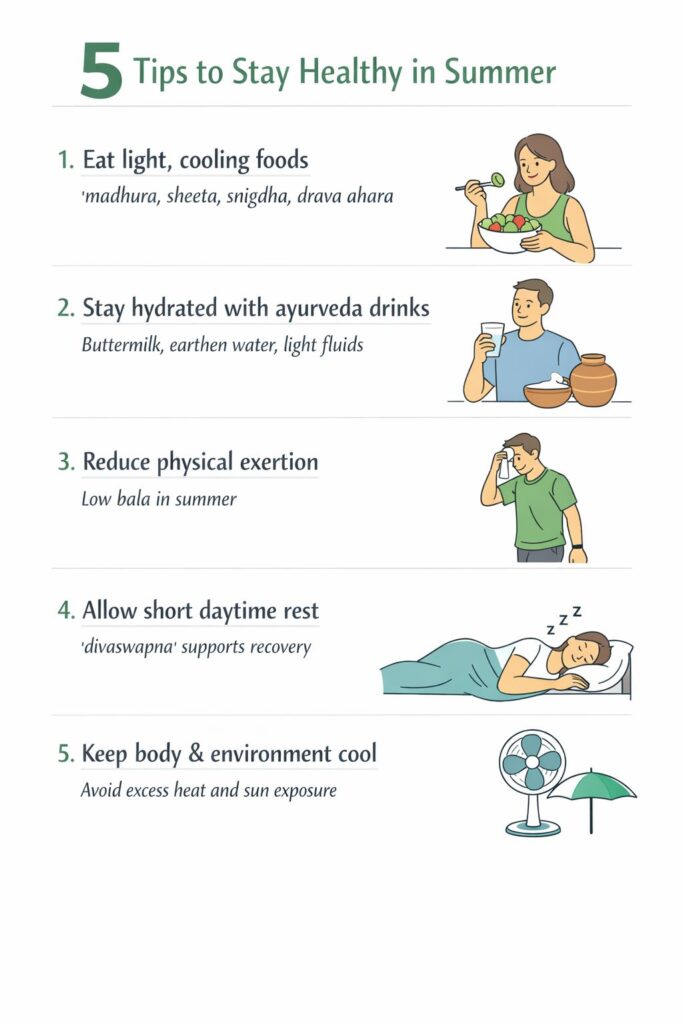
1. Eat in a Way That the Body Can Actually Handle
2. Drink, But Don’t Disturb Digestion While Doing It
There’s definite fluid loss during the summer. You can see it—dry skin, more sweating, constant thirst. That part is straightforward. What’s less obvious is how often hydration backfires.
Cold water gives quick relief, but if it’s taken repeatedly, especially around meals, Agni slows down. Patients then come back with complaints that don’t immediately sound related—loss of appetite, heaviness, even mild nausea.
In this kind of heat, the body doesn’t respond well to heavy or overly processed beverages. Instead, keep things simpler with Ayurveda drinks. Takra, or buttermilk, works well here—especially when digestion feels a bit off. It’s light, settles easily, and doesn’t weigh things down. Panaka is a simple preparation—water mixed with sugar or jaggery, with a little cardamom or clove added for flavour. Nothing elaborate. It helps with the kind of thirst that comes from heat and sweating, without interfering much with digestion. AyurVAID offers a range of bio-hydration drinks following the same traditional principles, helping the body stay refreshed and naturally replenished.
The thing about hydration, though, is that quantity matters. Some people start drinking large volumes, thinking more is better. It usually isn’t. The body doesn’t always need flooding—it needs steady support. Among the usual health tips for summer heat, hydration gets mentioned everywhere. The nuance rarely does.
3. Accept That Energy Levels Will Drop
This is one point people resist.
There’s an expectation now to maintain the same pace year-round—same workouts, same schedules, same output. But in Grishma, Bala is naturally lower. That’s just how the season functions.
You see it clinically—people who push through intense routines start feeling drained much sooner. Sometimes it shows up as body aches, sometimes just a kind of dryness or restlessness.
Ayurveda guidance around Vyayama is quite restrained here. It should be mild, limited, and should not occur during peak heat. Even that depends on the individual. Ignoring such factors and pushing harder doesn’t build resilience in this season. It usually does the opposite. Still, many tips for summer season don’t account for this shift at all. They assume the body operates the same way in April as it does in December. It doesn’t.

4. A Bit of Daytime Rest Actually Helps
Day sleep is generally avoided in Ayurveda, but Grishma is one of the few exceptions.
Longer days, shorter nights, continuous heat—it adds up. A short period of rest in the afternoon can restore some balance, especially in those already feeling fatigued. Not everyone needs it. And it shouldn’t become prolonged or heavy sleep. But when the body asks for it, ignoring it tends to worsen that drained feeling by evening.
Night routines matter too, though people often overlook this part. Late dinners, screen exposure, irregular sleep timing—it all compounds the seasonal strain.
Some of the more traditional advice—cool environments, open air, even exposure to softer nighttime conditions—had a purpose. It wasn’t just comfort. It was about letting the system settle after a long day of heat. When discussing tips to stay healthy in summer, rest is usually mentioned in passing. In reality, it quietly does a lot of the work.
5. Keep the Surroundings and Routine a Little Cooler
There’s food, and then there’s everything else.
Heat doesn’t just act through diet. It comes through the environment, the pace of life, and even interactions. People tend to get more irritable in summer—it’s a pattern you start noticing after a while in practice.
Simple things help more than expected. Staying in shaded or cooler spaces when possible. Wearing lighter, cotton fabrics. Reducing unnecessary exposure to harsh sunlight.
Even sensory inputs matter. Strong smells, noise, and overstimulation—they all add to that internal agitation, especially when Pitta is already edging upward. Traditional measures like applying Chandana might seem old-fashioned, but the underlying idea is clear—cool the body externally so it doesn’t have to struggle internally.
When people ask how can we stay healthy, they often look for one or two big changes. It usually comes down to several small ones that are done consistently.
Conclusion
References
- Pansare K, Sonawane G, Patil C, Sonawane D. Gond Katira: A Natural Remedy for Summer Heat and Hydration. Res J Pharmacol Pharmacodyn. 2025;17(2):95-101.
- Shah S, Patil A, Chapte RD. Ayurvedic literature on trishna. Int J Multidiscip Health Sci. 2022;8(3):3-10.
- Saini G. Prevention and management of heat stroke (anshughat) in Ayurveda: A review. Int Ayurvedic Med J. 2018;6(9):2146-2152.
- Ambulgekar S, Kannolli GN, Sajjenshetty MR. Concept of Greeshma Rutucharya w.s.r. to Sarvanga Sundara and Ayurveda Rasayana Teekas of Ashtang Hrudayam. J Ayurveda Integr Med Sci. 2020;6:283-289.
- Mankar DA, Mankar AS, Masule A, Kadam A. Lifestyle and Dietary Guidelines in Summer season: An Ayurvedic Review. J Adv Future Res. 2024.