Agni

Table of Contents

Agni Explained — How Gut Fire Shapes Metabolism & Immunity

In today’s world of processed foods, long screen hours and chronic stress, metabolic disorders are rising quickly.  Nearly 1 in 9 adults now live with diabetes, and rates of metabolic syndrome and obesity remain high across regions – a public-health burden that is growing, expensive and often silent.

Ayurveda’s ancient idea of Jatharagni, the “master fire” of digestion, speaks directly to this crisis: the health of yourdigestive system determines how food becomes fuel or becomes harmful.

Modern research links changes in gut microbes and gut barrier breakdowns to obesity, insulin resistance, and other metabolic disorders.

Emerging clinical data also show altered digestive enzymes(lower serum amylase/lipase) and diet-driven “leaky gut” patterns in people with metabolic dysfunction— suggesting impaireddigestive system function is both a marker and a mechanism in disease.

The gut-brain axis is the way the gut and brain communicate with each other through nerves, hormones, immune signals, and substances made by microbes, linking problems in digestion to issues with mood, thinking, and brain inflammation; as a result, metabolic diseases often happen together with anxiety

This blog explores how strengthening digestion and supporting the human digestive system,  the modern correlate ofagni, can be a practical, evidence-informed strategy to prevent and manage metabolic disorders.

What is Jatharagni?

Jatharagni is the digestive fire that carries out the chemical and metabolic work of the digestive system. It is generally called as agni. In modern terms, you can think of it as the combined action of gastric acid, bile, pancreatic secretions and digestive enzymes — but Ayurveda names this whole transforming principle Jatharagni because it is the central spark that nourishes every tissue.

Two classical slokas make the importance clear:

शान्ते अग्नौ म्रियते युक्ते चिरं जीवयति अनामयः। रोगी स्यात् विकृते मूलम् अग्निः तस्मात् निरुच्यते॥
— Charaka Samhita, Chikitsa Sthana 15/3–4

रोगाः सर्वे अपि मन्दे अग्नौ सुतराम् उदराणि तु।
— Ashtanga Hridaya, Nidana Sthana 12/1

When Agni is balanced, life and health continue; when Agni is disturbed or weak, disease arises. A sluggish Agni (Mandagni) produces Ama (undigested, sticky metabolic residue), which is the root of many chronic problems.

Why a balanced Agni matters

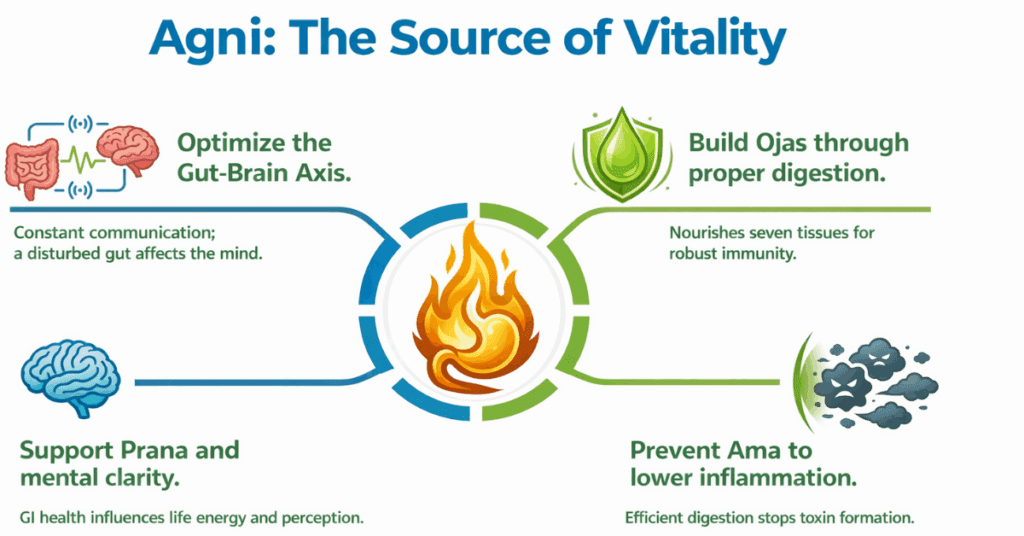
A balanced agni (Samagni) digests food properly into nutrients that build the seven tissues (dhatus) and ultimately create Ojas — the essence of immunity and vitality. This is the foundation of robust digestive system function.
Good digestion prevents Ama from forming. Reduced Ama = lower systemic inflammation and improved immunity.
Proper digestion supports Prana (life energy) and clear perception, because gastrointestinal health influences energy availability to the brain and tissues.
The gut-brain axis communicates constantly through nerves (like the vagus), hormones, immune signals, and substances made by gut microbes. If the gut is disturbed, the brain is affected — and vice versa.
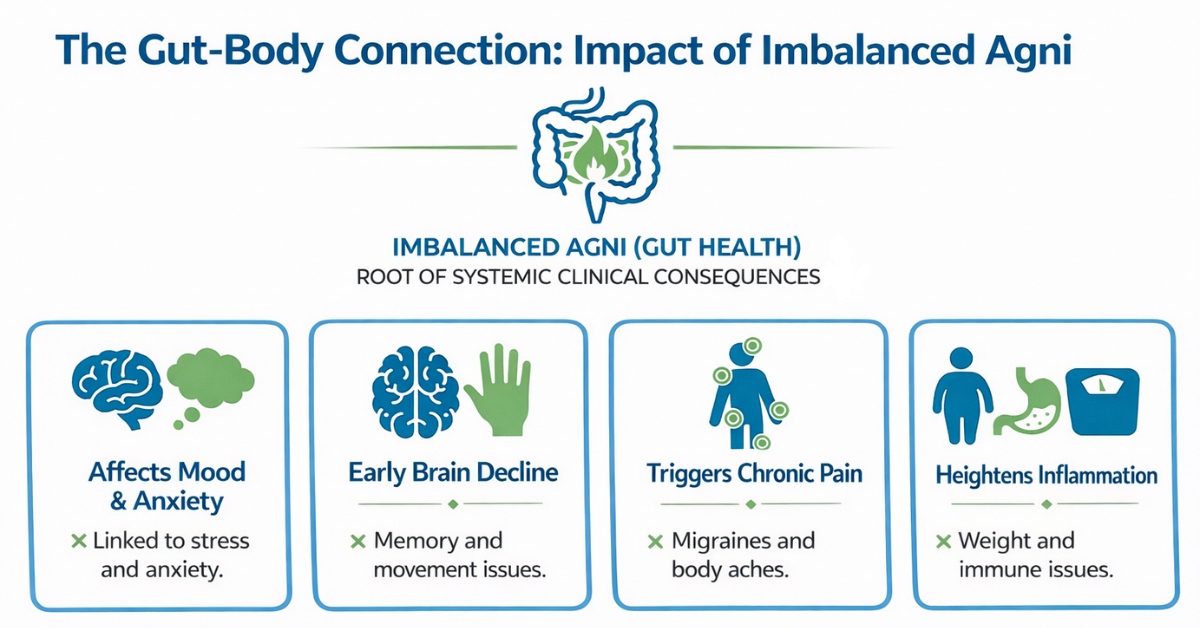
Clinical consequences of imbalanced Agni

  • Recurrent tummy symptoms like IBS or persistent indigestion, often with anxiety or low mood.
  • Gut complaints often accompany symptoms of anxiety or depression.
  • Early signs that link gut problems with movement disorders (for example, as seen with Parkinson’s) and memory changes.
  • Growing research suggests early gut changes may influence neurodevelopmental differences.
  • Chronic conditions with widespread pain (like migraine or fibromyalgia) frequently occur with gut symptoms.
  • Metabolic problems (weight issues, insulin resistance) and inflammatory gut diseases share gut-barrier and immune disturbances.
Insurance Backed

Precision Ayurveda
Medical Care

The Agni and Dosha relation

Doshas play a major role in igniting, maintaining and functioning of agni. The following is the effect and function of doshas with reference to agni.

States of Agni

State of Agni Ayurveda Description Modern Physiological Equivalent Clinical Expression / Result
Samagni (3 doshas balanced) Balanced, steady digestion Optimal gastric acid, well-timed digestive enzyme release, coordinated gut motility, healthy microbiome Good energy, regular appetite, efficient nutrient absorption, well-nourished tissues
Mandagni (Kapha aggravated) Slow or weak digestive system function Low gastric acid, reduced enzyme secretion, sluggish gut motility, dysbiosis Ama formation, post-meal heaviness, lethargy, weight gain, higher chronic disease risk
Tikshnagni (Pitta aggravated) Very sharp or intense digestion Excess gastric acid, rapid enzyme action, accelerated gastric emptying Hyperacidity, heartburn, burning sensation, tissue depletion, irritability
Vishamagni (Vata aggravated) Irregular, unpredictable digestion Dysregulated gut–brain signaling, erratic motility, inconsistent enzyme release Bloating, gas, alternating appetite and bowel habits, digestive instability
Assessment of these patterns helps plan diet, herbs and therapies targeted at restoring digestive system function.

Dosha Subtypes Governing Agni

Ayurveda Component Classical Role in Agni Modern Physiological Equivalent
Samana Vata Regulates the movement and coordination of Agni in the gut Gut motility, gastric emptying, intestinal peristalsis, enteric nervous system regulation
Pachaka Pitta Core digestive fire responsible for food breakdown Gastric acid (HCl), bile secretion, pancreatic digestive enzymes (amylase, lipase, proteases) contributing to metabolic heat
Kledaka Kapha Protects and stabilizes Agni by providing moisture and cushioning Gastric mucus, bicarbonate secretion, epithelial hydration, tight-junction and mucosal barrier integrity

Practical note: People rarely stay purely in one state. A patient may present with Mandagni in the monsoon and Tikshnagni in late summer. Treatment targets the individual’s current pattern.

How Jatharagni actually works

Jatharagni performs two core tasks essential for the human digestive system:

  1. Viveka (Separation): Separates the usable essence (Prasad) of food from waste (Kitta).
  2. Paka (Transformation): Breaks complex food into absorbable micro-nutrients — the building blocks that form tissues and support metabolism.

 When this engine runs well you maximize energy and minimize waste (Ama). When it falters, Ama accumulates and the downstream digestive system function and tissue metabolism (the dhatvagni) are impaired.

The 13 types of Agni (fires of metabolism)

Ayurveda describes a hierarchical system of 13 different types of Agni that coordinate your metabolism:
Fire Type Number Location Function
Jatharagni 1 Stomach / Duodenum Primary digestion of food
Bhutagni 5 Liver / Cells Processing the 5 basic elements (Earth, Water, Fire, Air, Space) found in food
Dhatvagni 7 Specific Tissues Tissue-level metabolism (formation of blood, muscle, bone, etc.)
This multi-level system mirrors what modern science calls cellular metabolism and enzymatic pathways. Jatharagni provides the initial “spark” that keeps the other 12 fires burning brightly.

Gut — immunity connection

When agni is sluggish (Mandagni), the human digestive system cannot fully process food. Undigested residues (Ama) form and circulate, clogging channels and provoking low-grade inflammation.

Clinically, Ama behaves like persistent metabolic waste that reduces immunity, impairs repair mechanisms and predisposes to chronic diseases (metabolic syndrome, autoimmune tendencies, recurrent infections). Protecting agni is therefore central to both digestion and immunity.

Seasonal and Daily Rhythms of Agni — why timing matters

Agni is not always the same. Your digestive fire goes up and down with the seasons and the time of day, just like nature does. When we know these rhythms, we can work with our bodies instead of against them.

  • Winter (stronger Agni): Cold weather naturally makes Jatharagni stronger. This is the best time to eat foods that are a little heavier and good for you because they help build tissues and your digestive system can handle them well.
  • Monsoon (weaker Agni): When the weather is humid, Agni gets weaker, and when the metabolic drive is weak, Agni gets dull. Light, warm, and easy-to-digest meals help keep the digestive system working well and stop Ama from forming.
  • Seasons of change: Agni changes as the body gets used to things. During this time of change, slowly changing your diet and using gentle digestive spices can help keep your digestion stable.
  • Daily rhythm of Agni: Jatharagni is strongest around noon, when the sun is highest. This makes lunch the most important meal. It is moderate in the morning and weakest at night, when heavy dinners can overload the digestive system.

One of the easiest and most effective ways to keep your digestive and metabolic health in good shape for a long time is to eat at the right times and choose the right foods.

How modern science aligns with Agni

Agni is linked to measurable physiology, like stomach acidity, bile secretion, pancreatic enzymes, and gut motility. Taking care of Agni with your diet and lifestyle helps ensure that digestive enzymes are released properly, the gut bacteria work well together, and hormones that manage metabolism and hunger stay balanced.

Practical ways to protect and kindle your fire — Key takeaways

  • Eat when genuinely hungry, do not overeat.
  • Warm or spice infused water during meal (a few sips) supports digestive enzymes and motility.
  • Agni is strongest mid-day — make lunch your largest, most nourishing meal.
  • Use spices like ginger, black pepper, cumin in moderation to stimulate digestion.
  • Chew well & eat mindfully, as it activates digestive enzymes.
  • Gentle post-meal walk supports gastric emptying and intestinal transit.
  • Favour light, warm, well-cooked foods over heavy or raw preparations when digestion is low.

FAQs

What is digestion?
Digestion, or Paka, is the biological process led by Agni that transforms ingested food into life energy, nutrient essence, and waste products. It is the fundamental digestive system function that converts external substances into internal tissues to support life and vitality.
How to improve digestion?
To improve digestion, you must nurture Jatharagni by consuming freshly cooked, compatible foods in appropriate quantities at regular intervals. Ensuring that your digestive enzymes are supported by a balanced diet and a stress-free environment helps maintain the fire in its ideal state.
How to digest food faster?
You can help your body digest food faster by using "Deepana" appetiser herbs that stimulate Jatharagni and "Pachana" aids that assist digestive enzymes in processing food. Consuming warm, cooked meals instead of cold or raw items also prevents the dampening of the internal fire, allowing the digestive system function to proceed more efficiently.
How to improve digestion naturally at home?
Natural ways to improve digestion include practicing mindful eating, such as chewing food thoroughly and eating only when genuinely hungry. Incorporating common kitchen spices like ginger, black pepper, and cumin acts as natural kindling to strengthen a sluggish human digestive system.
Are there Ayurvedic detox kits designed to strengthen agni?
Ayurveda utilises specialised detoxification procedures known as 'Shodhana' or 'Panchakarma' to eliminate toxins and restore the equilibrium of your internal fire. These traditional "kits" are personalised therapies designed to clear the channels of the human digestive system and rejuvenate metabolic strength.
What are the best Ayurvedic supplements to boost agni?
Traditional supplements like Trikatu and Ashta Choorna are highly effective for kindling a weak Jatharagni and supporting digestive enzymes. Specific herbal kashayams are also used to digest toxins and enhance the overall digestive system function.
What is the concept of agni in Ayurvedic medicine?
Agni is the biological fire responsible for all transformative and metabolic processes, representing the foundation of life, strength, and longevity. In the human digestive system, it exists as Jatharagni, which governs the primary breakdown of food and nourishes all other metabolic fires in the body.
How can I improve digestive fire according to Ayurveda using natural products?
You can enhance your internal fire by using natural appetizer products like ginger and long pepper that stimulate Jatharagni without causing irritation (when consumed along with food). Additionally, aligning your diet with seasonal rhythms ensures that your digestive system function remains strong regardless of external environmental changes.
Did the information meet your needs?

As we work hard to improve our services, your feedback is important to us. Please take a moment to help us serve you better.

Stay Connected to Health and Wellness

Subscribe to our hospital newsletter for the latest health tips, updates on services, patient stories, and community events. Sign up today and stay informed!

Homepage B RCB

Please fill out the form below to Request a call back

Patient details

Select Preferred Center

Content Details

We update our articles as new material becomes available, and our specialists keep a close eye on the health and wellness industry.

Written by
Dr Shobitha Madhur
Share this article on
Last updated on:
Do you have concerns with the content?

Report Problem

Table of Contents

Last updated on:

Report Problem

Do you have concerns with the content?

We’d Love to Hear from You!

Feedback form(disease page)

Can we help?

Something wrong with our medical content?
 
Report Problem form

Popular Searches: DiseasesTreatmentsDoctorsHospitalsWhole person careRefer a patientInsurance

Hours of Operation:
8am – 8pm (Mon-Sat)
8am – 5pm (Sun)

Follow Apollo AyurVAID hospitals