Tridosha

Table of Contents

Definition

In Ayurveda, Tridosha Siddhānta (the theory of three governing principles) forms the foundation of understanding health and disease. The word “Dosha” comes from the Sanskrit root “दुष्” (dush), meaning “that which can become disturbed.” This phrase does not mean the doshas are harmful. It means they are powerful. When balanced, they sustain life. When disturbed, they initiate disease. The three doshas are:

  • Vāta – the principle of movement
  • Pitta – the principle of transformation
  • Kapha – the principle of structure and stability

Together, they regulate every physiological and psychological function in the body. If Vāta does not move, nothing circulates. If Pitta does not transform, nothing is digested or metabolised. If Kapha does not stabilise, nothing holds shape. Every heartbeat, every breath, every thought, and every immune response depend on the harmonious interaction of these three forces.
Ayurveda does not divide the body into isolated systems. Instead, it describes regulation as an integrated intelligence. Interestingly, modern systems biology and neuroendocrine research now echo this view — recognising that metabolism, immunity, nervous function, and hormonal signalling constantly interact rather than operate separately. Tridosha is Ayurveda’s way of describing this interconnected regulation.
The Elemental Foundation

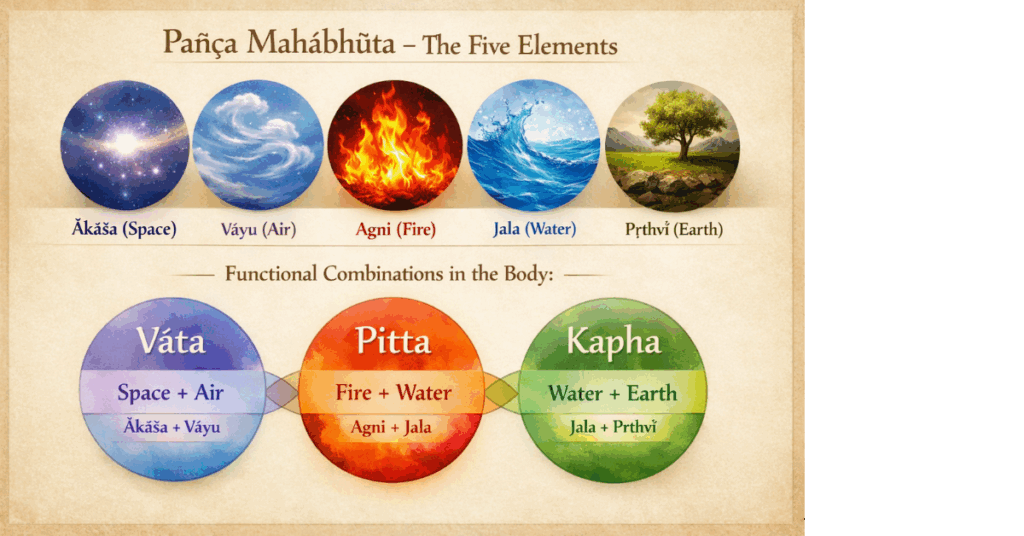
Ayurveda describes five elemental principles (Pañcha Mahābhūta): 

  • Ākāśha (space)
  • Vāyu (air)
  • Agni (fire)
  • Jala (water)
  • Pṛthvī (earth)

Within the living body, these combine functionally as:

  • Vāta = Ākāśha + Vāyu
  • Pitta = Agni + Jala
  • Kapha = Jala + Pṛthvī

Vāta – The Force of Movement

Vāta governs all motion in the body. This includes breathing, blinking, nerve impulses, blood circulation, bowel movements, speech, and even the movement of thoughts. Without Vāta, nothing moves. Ayurveda describes five subdivisions of Vāta that manage breathing, circulation, digestion, elimination and speech. This illustration shows how carefully movement was analysed.

When Vāta is balanced, it imparts: 

  • Flexible joints
  • Clear perception
  • Creativity
  • Proper elimination
  • Adaptability

When Vāta becomes disturbed, you can experience: 

  • Dry skin
  • Constipation
  • Gas and bloating
  • Anxiety
  • Irregular sleep
  • Variable appetite
  • Joint pain

If you look at modern research on stress and nervous system dysregulation, you’ll notice similarities. Chronic stress affects gut motility, sleep cycles, heart rhythm and mood stability. Ayurveda describes this pattern as Vāta disturbance — instability in movement and signalling. 

Pitta – The Force of Transformation

Any process of transformation in the body is governed by the Pitta dosha. Pitta transforms food into nutrients, nutrients into tissue, light into visual perception, and information into understanding. It is closely linked to digestion and metabolism but also to clarity and sharpness of mind. Ayurveda describes five forms of Pitta that regulate digestion by imparting colour to the blood, vision, skin metabolism, and intellectual processing.

When Pitta is balanced, you typically notice:

  • Efficient digestion without bloating or burning
  • Clear thinking and decisiveness
  • Even skin tone and good vision
  • Sustained concentration without mental fatigue

There’s a certain calm sharpness to balanced Pitta. You feel productive — but not overheated.

When Pitta becomes excessive, you might experience: 

  • Acidity
  • Burning sensations
  • Irritability
  • Inflammatory skin issues
  • Excess sweating

Modern research into inflammatory biology shows how metabolic overactivation and oxidative stress contribute to inflammatory disorders. The Ayurveda description of aggravated Pitta closely resembles these heat-driven processes. 

Insurance Backed

Precision Ayurveda
Medical Care

Kapha – The Force of Structure and Stability

Kapha provides structure. It forms tissues, lubricates joints, supports immunity, gives emotional steadiness, and maintains endurance. Without Kapha, the body would lack cohesion.

Ayurveda describes five functional divisions of Kapha, which are responsible for digestion, structural stability, taste perception, joint lubrication, and sensory organ nourishment.

When Kapha is balanced, it provides: 

  • Physical strength
  • Calm temperament
  • Stable energy
  • Good immunity

When Kapha accumulates excessively, it causes: 

  • Heaviness
  • Sluggish digestion
  • Weight gain
  • Congestion
  • Low motivation

Studies on metabolic syndromes, fluid retention, and ongoing low-level inflammation are similar to many patterns of Kapha aggravation, particularly in terms particularly in terms of sluggish metabolism, excess accumulation, and a tendency toward heaviness in the system. 

How the Three Doshas Work Together

No dosha functions independently. Each physiological activity requires the coordinated interplay of Vāta, Pitta, and Kapha, working together in dynamic balance to sustain life, maintain homeostasis, and support growth, transformation, and stability within the body. Like during digestion:

  • Vāta moves food.
  • Pitta digests it.
  • Kapha nourishes the tissue

Similarly, during thinking:

  • Vāta transmits signals
  • Pitta processes and interprets.
  • Kapha consolidates memory.

If movement becomes unstable, it can disturb digestion and structure. If heat becomes excessive, it can dry and irritate tissues. Movement may be impeded by overly rigid structures. This dynamic interaction is the heart of Tridosha. 

Why Tridosha Still Matters

Modern science increasingly views the body as an interconnected regulatory network—the nervous system, the endocrine system, immune signalling, the microbiome, and metabolic pathways. No system works alone. Tridosha is a clinical framework that recognises this interdependence. Instead of isolating one organ, it looks at patterns. It helps answer questions like: Why does one person develop acidity under stress while another develops anxiety? Why does the same food feel heavy for one person and energising for another? The answer often lies in how Vāta, Pitta and Kapha interact.

FAQs

Is Tridosha symbolic or medical?
It is a clinical framework used in diagnosis and treatment in Ayurveda. It explains patterns of function rather than isolated diseases.
Do these doshas physically exist?
They are not measurable chemicals. They are regulatory principles used to understand physiological behaviour.
Does everyone have all three doshas?
Yes. All three doshas are present in everyone, but in different proportions.
Why does stress affect digestion so quickly?
Stress quickly aggravates Vāta, which governs the nervous system, and this disturbance destabilises Pitta, impairing digestion almost immediately. Kapha, being more stable and slow-moving, is affected later but may lead to heaviness or sluggish digestion if stress becomes chronic.
Is inflammation the same as Pitta?
Not exactly, but many inflammatory patterns resemble aggravated Pitta. The full assessment depends on context.
Why do I feel heavy and slow during certain seasons?
Seasonal changes influence Kapha and Vāta. Cold and damp conditions often increase heaviness.
Can digestive issues involve more than one dosha?
Very often. Irregular appetite may involve Vāta, burning suggests Pitta, and heaviness indicates Kapha.
Does age influence doshas?
Yes. Childhood is Kapha-dominant, adulthood Pitta-dominant, and later life Vāta-dominant.
Can lifestyle disturb Tridosha balance even without disease?
Yes. Irregular meals, poor sleep, excessive heat exposure, overeating, inactivity, and chronic stress gradually disrupt Tridosha's balance.
Why is Tridosha important?
Tridosha is important because it offers a framework for comprehending individual physiological tendencies before they turn into pathological conditions. By recognising dosha imbalances early, interventions are functional and reversible rather than structural and disease-based.
Did the information meet your needs?

As we work hard to improve our services, your feedback is important to us. Please take a moment to help us serve you better.

Stay Connected to Health and Wellness

Subscribe to our hospital newsletter for the latest health tips, updates on services, patient stories, and community events. Sign up today and stay informed!

Homepage B RCB

Please fill out the form below to Request a call back

Patient details

Select Preferred Center

Content Details

We update our articles as new material becomes available, and our specialists keep a close eye on the health and wellness industry.

Written by
Dr Archana
Share this article on
Last updated on:
Do you have concerns with the content?

Report Problem

Table of Contents

Last updated on:

Report Problem

Do you have concerns with the content?

We’d Love to Hear from You!

Feedback form(disease page)

Can we help?

Something wrong with our medical content?
 
Report Problem form

Popular Searches: DiseasesTreatmentsDoctorsHospitalsWhole person careRefer a patientInsurance

Hours of Operation:
8am – 8pm (Mon-Sat)
8am – 5pm (Sun)

Follow Apollo AyurVAID hospitals