Metabolic Imbalance

Table of Contents

In modern health conversations, metabolism is often reduced to a number on a weighing scale or the speed at which we “burn calories.” Ayurveda offers a deeper, more useful picture. Here, the idea of what is metabolism expands beyond calories — it becomes the story of your inner fire, Agni, which governs every transformation in the body: digestion of food, conversion of nutrients into tissue, and even the subtle energy that powers thinking and immunity. When your Agni is steady, you feel energised, your skin glows, and your mind is clear. When it falters, you begin a slow slide toward metabolic disorders.

Metabolism in Ayurveda

Ayurveda teaches that metabolism is the work of several “fires”:

  • Jatharagni — the central digestive fire in the gut
  • Bhutagni — elemental fires responsible for finer transformations
  • Dhatvagni — the seven tissue-level fires that convert nutrients into the body’s tissues.

These fires together determine your basal metabolic rate — in Ayurveda terms, how strongly your body performs its day-to-day transformations. 

If these fires are too weak (called Mandagni), digestion is slow, food turns into sticky, toxic residue (Ama), and weight, fatigue, and other problems follow. If the fire is too sharp (Teekshnagni), digestion happens too fast and can “burn” tissues, producing inflammation. When it is erratic (Vishamagni), digestion and appetite swing unpredictably. These patterns can be seen physiologically in prakritis (the agni pattern will be the same throughout life) or due to pathological changes in Agni’s function.  

Why Agni matters: the root of health and disease

आयुः वर्णो बलं स्वास्थ्यं उत्साह उपचयौ प्रभा। ओजः तेजो अग्नयः प्राणाः … देह अग्नि हेतुकाः

(Charaka Samhita, Chikitsa Sthana 15/3-4)

This classical Ayurveda verse reminds us that longevity, complexion, strength, vitality, lustre (teja), ojas (vital essence), and life force (prana) all depend on the state of Agni. If the inner fire functions well, the whole body thrives. If it fails, disease follows. This phenomenon is why Ayurveda states, “रोगाः सर्वेऽपि मन्देऽग्नौ ” — most diseases begin with weak or disturbed Agni.

When Agni weakens, digestion becomes incomplete, and Ama forms. It clogs channels (srotorodha), prevents nutrients from reaching tissues, and allows metabolic waste to accumulate. Over time, these blockages and toxins set the stage for common modern conditions such as obesity, insulin resistance, fatty liver, hypothyroid-like states, and the cluster of problems we call metabolic syndrome.

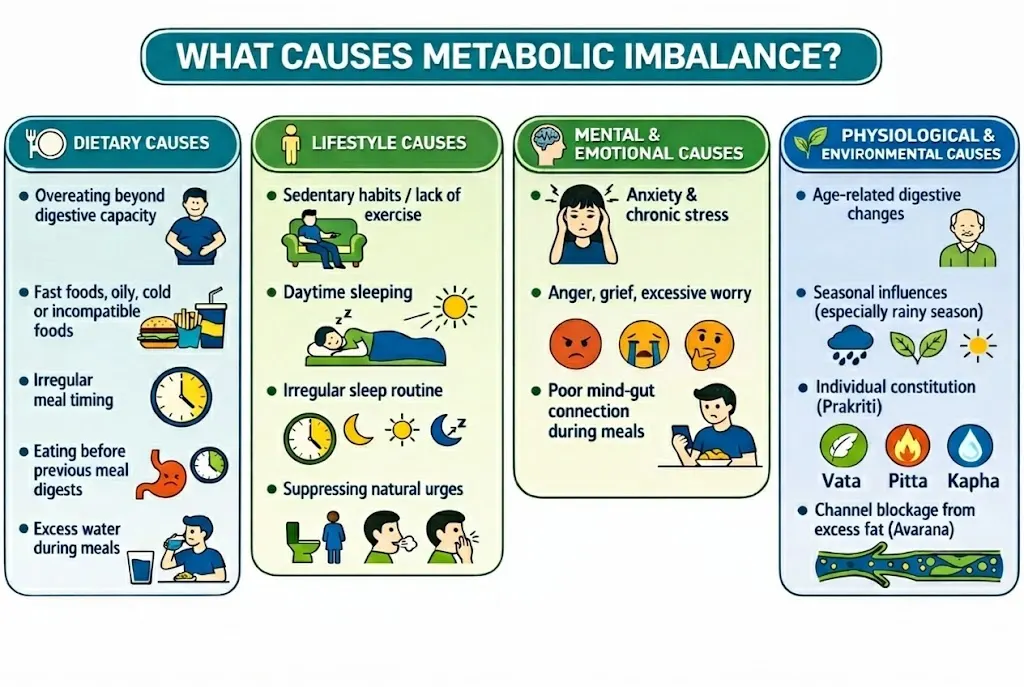
What causes metabolic imbalance?

Ayurveda groups focus on diet, lifestyle, mental-emotional factors, and physiological/environmental influences. 

Dietary causes

  • Overeating refers to consuming more food than your digestive system can process.
  • Frequent fast foods, oily meals, cold/frozen foods, or incompatible food combinations.
  • Irregular meal timing (vishamashana) or eating a new meal before the previous one is digested (adhyashana).
  • Excessive water intake with meals that “drowns” the digestive fire.

Lifestyle causes

  • Sedentary habits and lack of exercise (avyayama) reduce metabolic activity.
  • Daytime sleeping (divaswapna), irregular sleep, or suppressed natural urges disturb the body’s rhythms and Agni.

Mental and emotional causes

  • Anxiety, grief, anger, and chronic worry—these mental states blunt the digestive fire. Ayurveda emphasises that mind and digestion are interconnected: a worried meal is rarely well digested.

Physiological & environmental causes

  • Age (digestion changes across life), seasons (rainy season often weakens Agni), genetics (prakriti – a Vata-predominant person will have vishamagni (irregular metabolism), a Pitta-predominant person will have teekshnagni (intense metabolism), and a Kapha-predominant person will have Mandagni (slow metabolism)), and physical obstructions (avarana), such as excess fat blocking channels.
Insurance Backed

Precision Ayurveda
Medical Care

How do metabolic disorders appear?

Ayurveda maps modern conditions to patterns of Agni and dhatu disturbance:
  • Obesity (Sthaulya/Medoroga) often follows Mandagni and weak fat-tissue digestion. The result is poor-quality fat that blocks channels.
  • Diabetes (Prameha) is described as a deeper failure involving multiple dhatus and loss of ojas—often a long-standing consequence of Ama, avarana, and Kapha imbalance.
  • Hypothyroid-like states are seen as generalised slowdowns (dhatvagni mandya), with cold intolerance, weight gain, and sluggishness typical of Kapha-Vata interplay.
  • Irritable bowel and functional gut disorders correspond to grahani roga—local agni disturbances in the intestine that show alternating bowel habits, mucus, or burning, depending on the dominant dosha.

How to check your metabolic health?

Ayurveda suggests simple self-observations to assess metabolic strength:

  • Abhyavaharana Shakti — how much you can comfortably eat. If even small meals feel heavy, digestion may be weak.
  • Jarana Shakti — how well and how quickly you digest a meal. In a healthy state, food should be processed thoroughly within a sensible time (classically around 12 hours for a full meal cycle), without persistent gas, bloating, or acidity.

Also watch for signs of Ama: coated tongue, heaviness, poor appetite, sluggish bowel movements, and poor energy.

How to restore balance — steps to increase metabolism

If you are asking how to increase metabolism, Ayurveda offers a gentle, holistic plan rather than quick fixes:

  1. Kindle the fire (Deepana) — use digestive stimulants (herbs and spices like ginger, cumin, black pepper, and ajwain) taken as teas or within meals to strengthen agni.
  2. Digest Ama (Pachana) — short courses of pachana herbs and easy-to-digest foods help clear Ama; this should be done under guidance for persistent problems.
  3. Lightening therapies (Langhana) — reduction of heavy foods, fasting, etc., as required; these are not starvation but therapies to balance the metabolism.
  4. Exercise (Vyayama)—when practised according to body type—daily stimulates circulation, fat metabolism, and regular bowel habits.
  5. Sleeping habits and routines — regular sleep-wake cycles, avoiding daytime sleep when not necessary, and eating at regular times to strengthen the Agni.
  6. Emotional stability — mindfulness, pranayama, stress reduction, etc., are a must, as a calm mind is required for digestion to function properly.
  7. Proper diet — simple, warm, freshly cooked food, in proper quantity, without any incompatibilities, which is not too cold, will maintain the metabolism. Tailor meals to your prakriti and current dosha imbalance.

Ayurveda self-assessment is practical and often correlates with lab findings: people with weak Agni commonly show lipid abnormalities, insulin resistance, or inflammation markers. Use both Ayurveda observation and appropriate medical tests to guide care. 

Key takeaways

  • Metabolism in Ayurveda is the work of Agni — the master fire that transforms food into tissue and energy.
  • Weak or erratic Agni causes Ama, blocks channels, and is the underlying thread in many metabolic disorders.
  • Simple observations — how much you can eat (Abhyavaharana Shakti) and how well you digest (Jarana Shakti) — tell you a lot about your basal metabolic rate and digestive health.
  • To answer how to increase metabolism?: combine gentle digestive stimulation (deepana/pachana), appropriate lightening (langhana), daily exercise, regular routines, and emotional balance.
  • Integrating Ayurveda insight with modern tests gives the best, safest path back to steady Agni and lasting metabolic health.

FAQs

What is metabolism?
Metabolism is the sum of all transformative processes in the body governed by Agni (biological fire), converting food and sensory experiences into energy and tissues.
How to improve metabolism?
You can improve metabolism by eating only when hungry, using warming spices like ginger and black pepper, staying active through exercise, and avoiding cold drinks that "drown" your digestive fire.
What are the symptoms of a metabolic imbalance?
Common symptoms include constant fatigue, unexplained weight gain or loss, bloating, coated tongue, muscle weakness, and a general feeling of heaviness or "foggy" brain.
What is a metabolism imbalance?
A metabolism imbalance (or Agni Dushti) is a state where the body's internal fires are too weak, too erratic, or too sharp, leading to incomplete digestion and the buildup of toxic Ama.
How to fix metabolic imbalance?
Fixing it involves "Nidana Parivarjana" (avoiding the root cause like sedentary habits or heavy food), performing detox procedures like Virechana (purgation), and using Amapachaka (toxin-digesting) herbs.
How to check metabolic health?
In Ayurveda, we check metabolic health through Agni Pariksha: observing the appetite, the quality of bowel movements, and the presence of a coating on the tongue (which indicates Ama).
What are the 5 signs of metabolic syndrome?
Modern medicine identifies these as: (1) large waist circumference, (2) high triglycerides, (3) low HDL cholesterol, (4) high blood pressure, and (5) high fasting blood sugar.
How do I balance my metabolism?
Balance your metabolism by aligning your diet with your Prakriti (constitution), eating light and warm foods, practicing yoga and pranayama, and ensuring you get adequate sleep without sleeping during the daytime.
Can stress cause a metabolic imbalance?
Yes. Ayurveda teaches that psychological factors like anxiety, anger, and grief directly vitiate Agni, leading to indigestion even if the food eaten is healthy.
Is Triphala effective for increasing metabolism?
Yes. Triphala acts as a Rasayana that cleanses the Srotas (channels), regulates the endocrine system, and improves nutrient utilisation, effectively helping to balance the metabolism.
Did the information meet your needs?

As we work hard to improve our services, your feedback is important to us. Please take a moment to help us serve you better.

Stay Connected to Health and Wellness

Subscribe to our hospital newsletter for the latest health tips, updates on services, patient stories, and community events. Sign up today and stay informed!

Homepage B RCB

Please fill out the form below to Request a call back

Patient details

Select Preferred Center

Content Details

We update our articles as new material becomes available, and our specialists keep a close eye on the health and wellness industry.

Written by
Dr Shobitha Madhur
Share this article on
Last updated on:
Do you have concerns with the content?

Report Problem

Table of Contents

Last updated on:

Report Problem

Do you have concerns with the content?

We’d Love to Hear from You!

Feedback form(disease page)

Can we help?

Something wrong with our medical content?
 
Report Problem form

Popular Searches: DiseasesTreatmentsDoctorsHospitalsWhole person careRefer a patientInsurance

Hours of Operation:
8am – 8pm (Mon-Sat)
8am – 5pm (Sun)

Follow Apollo AyurVAID hospitals