- AyurVAID Pharmacy
The term “Dhatu” (धातु) is derived from the Sanskrit root “dhā”—”to hold”, “to support”, or “to sustain”. The traditional derivation, “dhārayati iti dhātuḥ”, means “that which upholds is called Dhatu.”
In the Charaka Samhita, the phrase “धारणात् धातवः” appears, translated as “they are called Dhatus because they sustain the body.” The Sushruta Samhita similarly describes them as the structural supporters of the organism. Dhatu is a fundamental tissue of the body that maintains structure and function. It is living tissue that is continuously nourished, transformed, and regulated. Each Dhatu represents a level of biological organisation that performs specific physiological work while also serving as the substrate for the next tissue in the organisation in sequence.
Ayurveda identifies seven Dhatus: Rasa (plasma), Rakta (blood), Mamsa (muscle), Meda (fat), Asthi (bone), Majja (marrow), and Shukra (reproductive tissue). They are not merely anatomical categories. Each Dhatu represents a stage in tissue metabolism — formation, maturation, maintenance, and eventual decline. When evaluating Dhatus in practice, the central issue is not simply how much tissue exists, but whether its formation is steady and proportionate.
Dhatu formation begins after digestion. Food is processed by
Jatharagni.From this, a refined nutrient portion, Ahara Rasa, enters systemic circulation. This circulating substrate does not nourish all tissues equally at the same time. Instead, each Dhatu has a specific metabolic activity (Dhatuvagni) that extracts and transforms what it requires. The sequence of formation is described as:
Rasa → Rakta → Mamsa → Meda → Asthi → Majja → Shukra
This sequence explains dependency. If early tissue metabolism is impaired, deeper tissues are affected later.
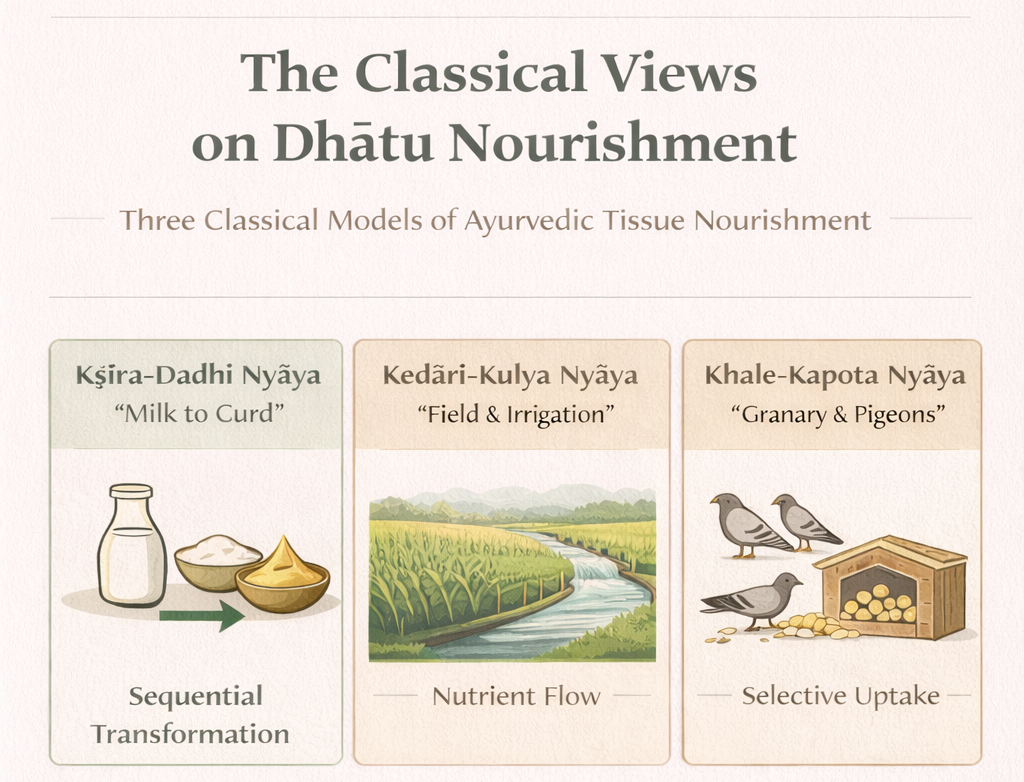
Together, these models describe transformation, distribution, and tissue-specific assimilation.

| Dhatu | Primary Functional Domain | What Balance Looks Like in Practice | Early Functional Disturbance |
|---|---|---|---|
| Rasa | Circulatory nourishment, hydration | Stable energy, normal skin moisture | Dryness, variable stamina |
| Rakta | Tissue vitality, heat regulation | Healthy complexion, predictable healing | Heat intolerance, inflammatory flares |
| Mamsa | Muscular support, organ covering | Adequate strength, good recovery | Early fatigue, loss of tone |
| Meda | Lubrication, metabolic reserve | Smooth joints, stable metabolism | Heaviness after meals |
| Asthi | Structural framework | Firm posture, strong teeth/nails | Joint sensitivity |
| Majja | Marrow, neuro-support | Stable cognition, coordination | Irritability, neuropathic sensations |
| Shukra | Reproductive and regenerative capacity | Sustained vitality | Chronic exhaustion |
Dhatu imbalance rarely begins with structural change. It often begins with digestive irregularity. Appetite fluctuates. There may be bloating or heaviness. Over time, partially processed nutrients circulate as Ama.
At this stage, symptoms are subtle. Slight dryness. Reduced endurance. Mild inflammatory tendency. If the disturbance continues, one or more Dhatus become metabolically unstable. Rasa depletion may precede Rakta disturbance. Meda excess may coexist with Asthi weakness. These combinations are common. Structural disease appears later. Once bone density reduces or adipose accumulation becomes pronounced, reversal requires sustained intervention.
The important point is that Dhatu pathology develops gradually. Early identification relies on functional assessment rather than laboratory confirmation.
Dhatu disorders are rarely isolated. A patient with sedentary habits may present with Meda accumulation but also complain of joint discomfort. The deeper tissue (Asthi) may already be affected through long-standing Vata aggravation.
Chronic psychological stress often first disturbs Rasa. Over time, Majja may show instability — irritability, poor concentration. Rakta disturbances frequently manifest through the skin before blood reports change.
The clinician must observe patterns:
Which tissue is primary? Which are secondary consequences?
Mixed presentations are expected, not exceptional.
Dhatu differs from Dosha. Doshas regulate function. Dhatus constitute the structure.
If the problem centres on variability, movement disturbances, or temperature dysregulation, and Dosha involvement is dominant. Dhatu involvement is crucial if the problem is one of tissue mass, density, or regenerative capacity.
‘Mala’ refers to waste. UpaDhatus are subsidiary tissues formed during Dhatu metabolism. Ojas represents systemic resilience derived from balanced Dhatus.
Confusion between these leads to incorrect treatment emphasis.
Dhatu status guides intervention.
Diet must correspond to metabolic capacity. In depletion states, nourishment should be digestible and steady. In excess states, metabolic stimulation precedes reduction.
Lifestyle modification is tissue-specific. Gradual strengthening in Mamsa depletion. Controlled mobilisation in Meda excess. Exercise that is weight-bearing but not aggravating is recommended for individuals with Asthi vulnerability.
Panchakarma is selected according to Dosha involvement affecting a Dhatu. Vasti often becomes central in Asthi and Majja disorders. Virechana may assist Rakta-dominant disturbances. Tissue strength determines eligibility.
Drug selection considers tissue affinity and metabolic compatibility. Rasayana is appropriate when Agni is stable and Srotas are clear. Acute correction and long-term stabilisation are distinct phases.
Dhatu imbalance frequently precedes structural disease by years.
Prolonged tissue instability often leads to metabolic disorders, degenerative bone changes, and chronic inflammatory patterns. Intervening during early functional disturbance is less complex than managing established structural damage. The value of the Dhatu theory lies in recognising metabolic imbalance before irreversible change occurs.
As we work hard to improve our services, your feedback is important to us. Please take a moment to help us serve you better.
Subscribe to our hospital newsletter for the latest health tips, updates on services, patient stories, and community events. Sign up today and stay informed!

Report Problem
Popular Searches: DiseasesTreatmentsDoctorsHospitalsWhole person careRefer a patientInsurance

