Rakta Dhatu

Table of Contents

In Ayurveda, health is not only the absence of disease but the harmonious functioning of a beautifully ordered inner world. One of the central pillars of that inner order is the system of seven tissues, the Sapta Dhatus. Among these, Rakta Dhatu—blood—is often called an “enlivener.” Furthermore, it is classified as one of the ten vital dwellings of life (Dasha Pranayatana), meaning any significant injury to this tissue can lead to disability or death. This blog explains what Rakta Dhatu is, why it matters, how it connects with Pitta, and what you can do in everyday life to keep your blood healthy.

What is Rakta Dhatu?

The Sanskrit root behind Rakta is Ranj (रञ्ज्), which means “to colour”, “to delight”, or “to give lustre”. In Ayurveda, Rakta Dhatu (रक्त) is the refined tissue that gives the body its red colour, nourishes the next tissue (Mamsa Dhatu), and sustains life itself. In classical words:
“रक्तं वर्णप्रसादनं मांसपुष्टिं जीवयति च” —meaning healthy blood brightens the complexion, nourishes muscle, and enlivens the body.
Though Ayurveda describes Rakta as a living tissue with qualities and functions, its practical correlation with modern haematology is clear: Rakta includes red blood cells, haemoglobin-rich blood, plasma elements that carry nutrients and oxygen, and the physiological roles that support vitality.

How is Rakta formed?

According to Ayurveda, tissues are formed sequentially from the food we eat. The first refined essence to be produced after digestion is Rasa Dhatu. This is comparable to the circulating nutrient plasma in modern physiology.

The Rasa is then refined through various metabolic processes mediated by Pitta, particularly Ranjaka Pitta. These processes take place mainly in the liver and spleen.

During these processes:

  • The colourless Rasa Dhatu develops its characteristic colour, red.
  • The tissue becomes richer, denser, and more nourishing.
  • The new tissue formed is Rakta Dhatu. 

In modern understanding, this transformation loosely parallels the formation and maturation of red blood cells and haemoglobin within the body’s haematological system.

Thus, the health of digestion, liver function, and Pitta balance directly influences the quality of Rakta produced in the body.

Insurance Backed

Precision Ayurveda
Medical Care

Raktavaha Srotas – the channels that carry blood

In Ayurveda, every tissue is transported through specialised channels called Srotas. The channels responsible for carrying Rakta are known as Raktavaha Srotas.

Classical texts identify the liver (Yakrit) and spleen (pleeha) as the principal roots of these channels.

Healthy Raktavaha Srotas ensure that:

  • Blood circulates smoothly through the body
  • Nutrients reach tissues efficiently
  • Heat and metabolic by-products are properly regulated

When these channels are disturbed, symptoms such as inflammation, skin disorders, bleeding tendencies, or circulatory problems may arise.

The close link between Rakta and Pitta

Rakta and Pitta share many qualities: heat (ushna), liquidity (drava), sharpness (teekshna), and a subtle unctuousness. Ayurveda often calls Pitta the “resident” (ashrayi) within Rakta — they are intimately connected. In classical terms, Pitta functions as a metabolic by-product (mala) of Rakta, and because the liver is the principal site where both blood and Pitta are processed, the state of your liver directly shapes the quality of your blood.

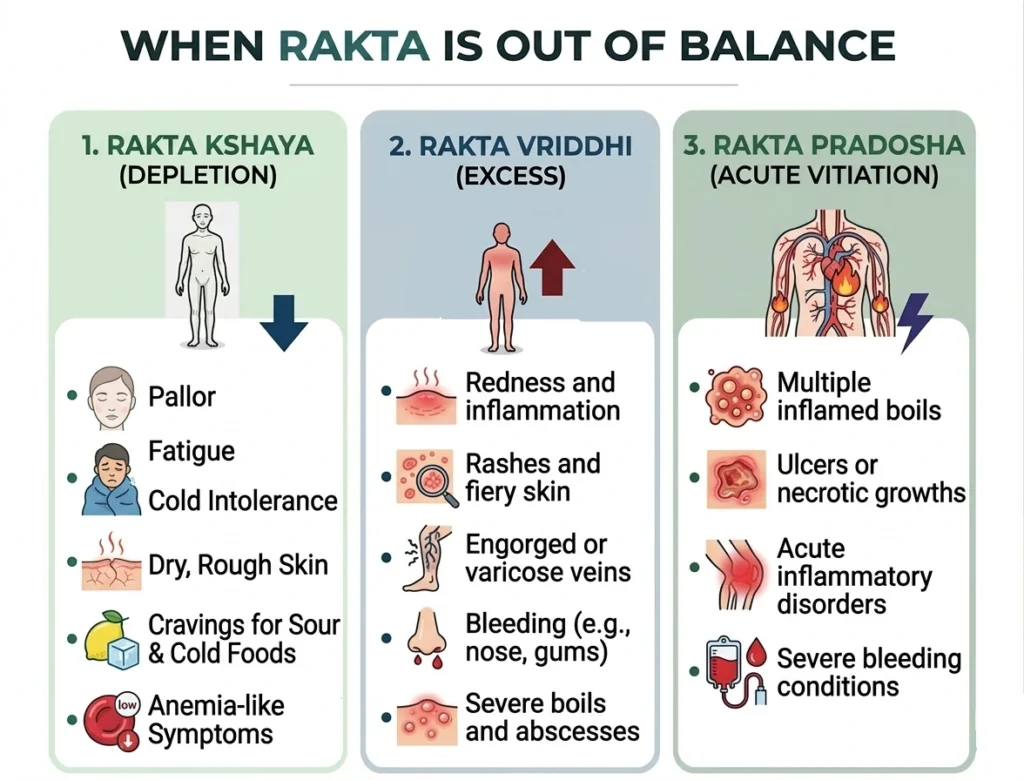
When Pitta is balanced, it aids correct blood formation; when Pitta is aggravated, it “heats” the blood, causing inflammation, rashes, bleeding tendencies, or other disorders that Ayurveda groups as Raktapradoshaja Vikara. Clinically, you will often see this as skin and inflammatory problems, bleeding tendencies, or signs of liver stress. Common presentations include:

  • Persistent skin disorders such as eczema, psoriasis or stubborn acne.
  • Local or systemic inflammation — gouty pain, abscesses, burning sensations.
  • Bleeding manifestations like heavy menstruation or bleeding gums.
  • Jaundice or other signs that the liver is unable to purify the blood effectively.

In practice, this means that protecting liver function and pacifying Pitta are central to restoring healthy Rakta.

The Vital functions of Rakta dhatu

Rakta Dhatu is the body’s vital life support—its primary role is Jeevana, literally “sustaining life.”. Beyond basic survival, healthy Rakta performs several quietly powerful tasks. 

  • It flows through the channels, delivering both macro- and micronutrients to every cell, and so keeps the whole organism nourished and active.
  • A well-nourished Rakta is also the secret of a glowing complexion and natural lustre: skin that appears fresh and alive often reflects the quality of the blood beneath it.
  • Because Rakta is the immediate progenitor of Mamsa Dhatu, it nourishes muscle tissue and underpins our strength, tone, and physical stability.
  • Sensation too depends on good circulation — when blood flow falters, we notice numbness or a loss of subtle touch.
  • Rakta helps regulate the body’s internal warmth, contributing to comfortable, even thermal balance.

Signs of healthy Rakta (Rakta Sara)

In Ayurveda, the ideal state is Dhatusamya—balanced tissues. When Rakta is in harmony, you tend to feel light-hearted, digest well, and enjoy sharp, clear senses.

A person with excellent Rakta, called Rakta Sara, often shows:

  • A radiant, reddish lustre of lips, palms, soles, and nails.
  • Smooth, unctuous, and warm skin.
  • Strong digestion, clear senses, and steady vitality.
  • Calm, compassionate temperament and sharp intellect (though such people may dislike excessive heat).

If you notice these signs, they often correlate with robust blood indices in modern tests: healthy haemoglobin, adequate RBCs (red blood cells), and good PCV (packed cell volume), MCV (mean corpuscular volume), and MCH (mean corpuscular haemoglobin) values.

When Rakta is lowered or vitiated

Ayurveda describes two main problematic states:

  1. Rakta Kshaya — depletion: This resembles anaemia. Symptoms include pallor, dry, rough skin, fatigue, cold intolerance, poor muscle nourishment, and craving for sour or cold foods.
  2. Rakta Vriddhi / Raktapradosha — excess or vitiated blood: Presents as redness, inflammation, boils, rashes, bleeding, or engorged veins. When Pitta overheats the blood, inflammatory or bleeding disorders can follow.

Classical texts also describe that if a disease resists predictable treatments, one should suspect blood vitiation — making Rakta a useful diagnostic litmus.
The Upadhatu Concept: Secondary Tissues

Each primary dhatu forms secondary tissues called Upadhatu. From Rakta Dhatu, these are Sira (the vessels and channels that carry blood and nourishment/veins) and Kandara (the tendinous bands that anchor muscles to bones). Clinically, problems in Rakta often first show up in these upadhatus—think varicose veins or recurring tendon pain (tendinitis)—so they serve as a quick, useful window into blood health and help direct treatment.

Rakta as a diagnostic window

Ayurveda practitioners use direct observation (Pratyaksha), inference (Anumana), and classical knowledge (Aaptopadesha) to assess blood quality. Visual checks of the eyes, tongue, lips, palms, nails, and forehead give immediate clues. Modern parallels are obvious: conjunctival pallor suggests anaemia; inflamed skin points to blood vitiation; jaundice warns of liver–blood interaction. Together, ancient signs and contemporary labs (CBC, haemoglobin, and ferritin when needed) give a fuller picture.

Practical ways to care for your Rakta (cool the overheated blood/support depletion)

Because Rakta and Pitta influence each other, the practical plan either soothes overheated blood or gently builds depleted blood cells. Here are evidence-informed suggestions that fit the Ayurveda framework:

Foods and tastes

  • Favour sweet, bitter, and astringent tastes. Regular helpful foods: pomegranate, beets (in moderation), black grapes, cooked leafy greens, basmati rice, and cooling dairy like buttermilk (not the sour one).
  • Spices to support digestion without heating: coriander, cumin, and fennel.
  • Avoid excess pungent, sour, and salty foods if you have Pitta or inflammatory signs. Limit fermented foods, strong alcohol, and deep-fried or excessively oily foods. 

Lifestyle

  • Manage stress and anger—they directly “heat” the blood. Simple breathwork like Sheetali and Sitkari pranayama cools the system.
  • Avoid midday heat and long sun exposure; rest during the hottest hours.
  • Gentle, regular exercise is excellent; avoid excessive exertion in hot weather.
  • Keep a routine — avoid daytime sleeping after heavy meals. 

Therapeutics

In clinical settings, procedures such as Virechana (purgation) and raktamokshana (bloodletting therapy) are considered effective for clearing excess Pitta and cleansing the blood. These should only be done under professional supervision.

Mental health, emotion, and Rakta

Ayurveda sees blood as closely tied to temperament. Balanced Rakta supports cheerfulness, clarity, and compassion. When Rakta is vitiated, irritability, anger, confusion, and mental dullness can follow. Thus, emotional self-care (managing anger, getting restorative sleep, and gentle meditation) is as important as diet.

A few practical checks you can do at home

  • Look at the lining of your lower eyelid for pallor (a simple screen for anaemia).
  • Observe your lips, palms, and nails for lustre and colour changes.
  • Notice digestion, energy levels, and ability to tolerate heat. If you feel persistent fatigue, breathlessness, or excessive bruising/bleeding, please consult a clinician and consider basic blood tests (CBC, haemoglobin, ferritin).

Final thoughts

Rakta Dhatu is more than the fluid that moves through arteries and veins — it is a foundation of vitality, complexion, muscle strength, and even temperament. Caring for blood is therefore both a medical and a lifestyle practice: nourish it with good food, protect it from excessive heat and stress, and seek professional guidance when signs suggest depletion or inflammation.

FAQs

Is Rasa the same as plasma?
Cooling and blood-enriching foods like pomegranates, beets, black grapes, and Amalaki (indian gooseberry) are excellent.
Can emotional stress affect my blood?
Yes. Since Rakta is tied to Pitta, excessive anger and frustration can "heat" the blood, leading to skin rashes and high blood pressure.
What is the Ayurvedic treatment for impure blood?
The primary treatments are Virechana (purgation) to remove excess Pitta and Raktamokshana (bloodletting), which is considered "half the treatment" for many surgical and skin diseases.
How do I know if my Rakta Dhatu is healthy?
If your skin is clear, your digestion is smooth, you feel physically strong, and you have a generally happy, enthusiastic disposition, then your Rakta Dhatu is likely in excellent balance.
What is the meaning of Rakta?
The word "Rakta" is derived from the Sanskrit root "ranj," or "Raj Ranjane," which fundamentally means "to colour," "to dye," "to stain," or "to paint." In a physiological context, it refers to the tissue that acquires a red colour after the colourless Rasa Dhatu (plasma), which is acted upon by metabolic heat in the liver and spleen.
What is Rakta Dhatu in Ayurveda?
Rakta Dhatu is the second of the seven fundamental tissues (Sapta Dhatus) that form the framework of the human body. It is the refined form of Rasa Dhatu and is closely correlated with blood and its components, specifically Red Blood Cells. Its primary function is Jeevana, which means sustaining life and providing vitality to every cell in the body.
What is raktatisara in Ayurveda?
Raktatisara is a clinical condition characterized by diarrhea accompanied by the discharge of blood. It occurs when a person already suffering from Pitta-type diarrhea (pittaatisara) continues to indulge in dietary or lifestyle habits that further aggravate Pitta, causing blood to mix with the stool.
What is the importance of Rakta?
Rakta is considered the foundation of the living body and is so essential that it is often described as synonymous with life itself (Prana). It is responsible for maintaining a stable internal environment, enhancing skin complexion, and nourishing the muscle tissue (Mamsa Dhatu).
Did the information meet your needs?

As we work hard to improve our services, your feedback is important to us. Please take a moment to help us serve you better.

Stay Connected to Health and Wellness

Subscribe to our hospital newsletter for the latest health tips, updates on services, patient stories, and community events. Sign up today and stay informed!

Homepage B RCB

Please fill out the form below to Request a call back

Patient details

Select Preferred Center

Content Details

We update our articles as new material becomes available, and our specialists keep a close eye on the health and wellness industry.

Written by
Dr Shobitha Madhur
Share this article on
Last updated on:
Do you have concerns with the content?

Report Problem

Table of Contents

Last updated on:

Report Problem

Do you have concerns with the content?

We’d Love to Hear from You!

Feedback form(disease page)

Can we help?

Something wrong with our medical content?
 
Report Problem form

Popular Searches: DiseasesTreatmentsDoctorsHospitalsWhole person careRefer a patientInsurance

Hours of Operation:
8am – 8pm (Mon-Sat)
8am – 5pm (Sun)

Follow Apollo AyurVAID hospitals