- AyurVAID Pharmacy
Have you ever stopped to wonder how a single bite of food eventually reaches and nourishes your toes — or how a simple breath keeps your mind awake and your heart beating? In Ayurveda, we answer this with a beautiful, practical idea: the body is a network of living channels called Srotas. The classical saying ‘Srotomayam hi Shariram’ reminds us that the human body is essentially this system of channels — a living map through which everything that sustains us flows.
In this blog, I’ll walk you through what Srotas are, why they matter, how they can go off track, and practical, gentle ways to keep your internal highways clear.
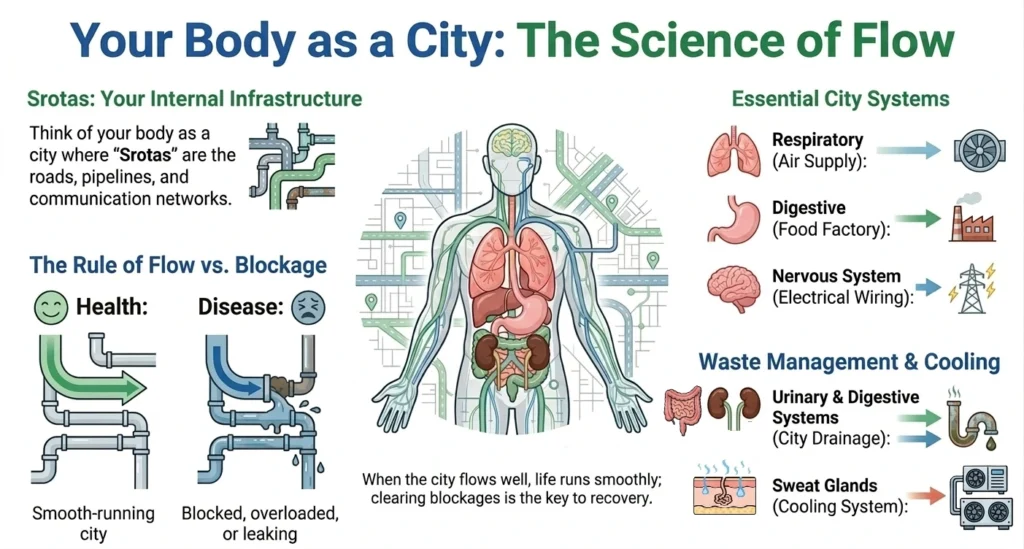
The word ‘Srotas’ comes from the Sanskrit root ‘ सु स्रवणे ‘ and is defined in the classical way as स्रवणात् स्रोतांसि — that is, channels through which things flow. But Srotas are more than pipes. They are functional pathways: microscopic and macroscopic routes that allow food to be absorbed, nutrients to be carried, waste to be removed, and subtle forces like breath and mind to move.
Think of Srotas as a combination of blood vessels, lymph channels, nerve pathways, ducts, and even the microscopic spaces between cells. They are the highways and lanes of the body’s inner logistics.
Classical Ayurveda categorises the internal transport systems into thirteen main channels, with Artavavaha and Manovaha being mentioned by Sushruta and Charaka Acharya in other contexts. Each one has a role, an origin, what it carries, and signs that it’s disturbed.
NOTE: Moolasthana – the root location where the channel begins. Healthy roots → healthy flow → healthy body
Below is their description:
| Srotas (Channel) | Moolasthana (Origin) | What it does | What flows through it | Modern understanding | Common signs of disturbance | Common diseases / conditions |
|---|---|---|---|---|---|---|
| Pranavaha Srotas | Hridaya (Heart) & Maha Srotas | Helps you breathe | Prana (air, oxygen) | Respiratory system | Breathlessness, labored breathing | Asthma, COPD, bronchitis |
| Udakavaha Srotas | Talu & Kloma | Maintains body fluids | Udaka (water) | Fluid balance system | Dryness, excessive thirst | Dehydration, electrolyte imbalance |
| Annavaha Srotas | Amashaya (Stomach) | Digests food | Anna (food) | Digestive system | Poor appetite, bloating | Gastritis, GERD, IBS |
| Rasavaha Srotas | Hridaya & vessels | Nourishes the body | Rasa (nutrients) | Circulation & lymphatic system | Fatigue, nausea | Malnutrition, chronic fatigue |
| Raktavaha Srotas | Liver & Spleen | Carries blood | Rakta (blood) | Blood circulation | Bleeding, redness | Anaemia, jaundice |
| Mamsavaha Srotas | Ligaments & Skin | Builds muscles | Muscle tissue | Muscular system | Swelling | Myopathies, tumours |
| Medovaha Srotas | Kidneys & Omentum | Regulates fat | Adipose tissue | Fat metabolism | Weight gain | Obesity, diabetes |
| Asthivaha Srotas | Fat tissue & pelvis | Supports bones | Bone tissue | Bone system | Bone pain | Osteoporosis, arthritis |
| Majjavaha Srotas | Bones & joints | Nourishes marrow & nerves | Bone marrow & brain tissue | Nervous system | Dizziness | Neuropathies |
| Shukravaha Srotas | Testes | Supports fertility | Semen | Male reproductive system | Sexual weakness | Infertility |
| Artavavaha Srotas | Uterus | Supports female cycle | Menstrual blood | Female reproductive system | Irregular periods | PCOS, infertility |
| Mutravaha Srotas | Urinary bladder | Forms urine | Urine | Urinary system | Painful urination | UTI, stones |
| Purishavaha Srotas | Large intestine | Eliminates stool | Faeces | Colon | Constipation | IBS, colitis |
| Swedavaha Srotas | Fat tissue & pores | Controls sweating | Sweat | Sweat glands | Excess sweating | Skin disorders |
| Manovaha Srotas | Heart/Brain | Governs mind | Thoughts, emotions | Nervous system | Anxiety, confusion | Depression, epilepsy |

Although the language is ancient, the observation is strikingly modern. When Ayurveda talks about tiny, reticulated channels (Anu, Pratana), it is pointing to capillaries, lymphatics, interstitial fluid spaces, and neural pathways — all the microscopic routes where exchange happens.
Examples of modern parallels:
Therefore, Srotas is a language to describe anatomy and physiology that is functional and systemic rather than purely structural.
In Ayurveda, Agni and Srotas work together like a skilled chef and a kitchen’s supply lines. The Srotas are the channels that bring the raw materials—nutrient essences—to the place where Agni can act. At the tissue level, dhatvagni is the little metabolic fire that receives the Rasa delivered through the channels and transforms it into healthy tissue.
The result is a two-way relationship: When a channel such as rasavaha becomes clogged or disturbed, the metabolic fires can weaken or lose their power to digest and transform. Equally, when the digestive Agni is disturbed, it quickly affects the annavaha srotas, impairing the flow and quality of nutrients entering the tissues.
Together, the balance of Agni and the openness of Srotas determine dhatupaka—the proper metabolism and formation of tissues. Keep the channels clear and the fires steady, and the body’s nourishment and balance will follow naturally.
When channels lose their normal function, Ayurveda calls this Srotodushti — channel vitiation. Classical texts describe four ways this can happen:
Another important idea is Khavaigunya: a localised weakness or defect in a channel. When tissues become depleted (kshaya) or a channel has a weak spot, Vata — the mobile force — can occupy that empty space and create disease. The classical line captures this danger:
देहे स्रोतांसि रिक्तानि पूरयित्वाऽनिलो बली । करोति विविधान् व्याधीन् सर्वङ्गेकाङ्गसंश्रयान् ॥ (Charaka)
Put simply, leaky or blocked channels create opportunities for imbalance and disease.
A common question in Ayurveda is whether Doshas have their own specific channels. The classical texts do not describe separate pathways exclusively for Doshas. Instead, Doshas move through the existing Srotas (body channels) to carry out both normal functions and disease processes.
In simple terms, Doshas are the “movers”, and Srotas are the “pathways”. For optimal health, both need to be in balance — Doshas should be stable, and Srotas should be clear and open.
The goal of treatment is to restore flow, remove blockages, and maintain the “sterility” and health of the channels. Here are the main principles, explained simply:
You don’t need heavy treatment to keep Srotas healthy. Small, consistent habits help:
Understanding Srotas changes how we see health. Instead of separate organs, imagine a whole transportation system: when roads are clear, the city runs smoothly; when roads are blocked, traffic jams and accidents follow. Your body behaves the same way.
If you ever feel “stuck”, tired, bloated, breathless, or mentally foggy, it can be your Srotas asking for gentle attention. Start with small changes — restful sleep, warm, nourishing food, breathwork, and a trusted practitioner’s guidance when deeper cleansing is needed.
Take care of your internal highways, and your body’s intelligence will quietly return the favour.
As we work hard to improve our services, your feedback is important to us. Please take a moment to help us serve you better.
Subscribe to our hospital newsletter for the latest health tips, updates on services, patient stories, and community events. Sign up today and stay informed!

Report Problem
Popular Searches: DiseasesTreatmentsDoctorsHospitalsWhole person careRefer a patientInsurance

