- AyurVAID Pharmacy
In Ayurveda, some of the most effective medicines are also the simplest in form. Choornam is one such dosage form. At first glance, it appears to be only a finely prepared herbal powder. A thoughtfully processed, therapeutically purposeful, and remarkably versatile medicine.
Its value lies in its practicality. Choornam is easy to prepare, convenient to store, simple to administer, and often quick in action. For this reason, it has remained important not only in classical formulations but also in everyday clinical practice.
This article explores Choornam in a clear and clinically relevant way — its definition, preparation, classification, therapeutic role, modern adaptations, and the precautions that ensure safe use.
In Ayurveda, Choornam or Churna refers to a finely prepared powder made from properly dried medicinal substances. Classical texts consider it an Upakalpana of Kalka, meaning it shares a close relationship with herbal paste, but in a dry and powdered form.
The classical definition from the Sharangadhara Samhita states:
“अत्यन्तशुष्कं यद्द्रव्यं सुपिष्टं वस्त्रगालितम्।
तत्स्याच्चूर्णं रजः क्षोदस्तन्मात्रा कर्षसंमिता॥”
This means that a substance which is fully dried, finely ground, and filtered through a clean cloth is called Choornam, also known as Raja or Kshoda. The traditional dose mentioned is one Karsha, approximately 12 grams.
This definition reflects an important Ayurveda principle: a powder is not merely a crushed herb. It is a carefully prepared medicinal form in which dryness, fineness, and uniformity are all clinically meaningful.
The preparation of Choornam is not a mechanical process alone. It demands attention to detail at all stages, because the quality of the end product depends on the attention given to each step.
Selection and Cleaning
The process starts with the selection of raw drugs in the proper stage of maturity and potency. Then they are thoroughly cleaned to remove any dust, stones, etc. In Ayurveda, purity of the raw material is the first requirement for a reliable formulation.
Washing and Drying
Depending on the nature of the drug, the material is washed and then dried in sunlight or shade until it becomes completely free of moisture. This step is important because dampness can reduce shelf life, encourage clumping, or affect stability.
Individual Powdering
When ingredients vary in hardness, it is best to powder them separately. Soft, medium, and hard ingredients do not degrade at the same rate. If ground together, the softer ingredients may become excessively fine while the harder ones remain coarse. Ayurveda values uniformity, and separate powdering helps achieve that.
Sieving
Next, the powder is passed through a fine cloth or a sieve, which provides a smooth, even texture and consistency to the final product.
Mixing
After all the ingredients are separately powdered and sieved, they are mixed in the right proportion, as determined by their weights. This process is done with the help of a hammer mill or a ball mill, which is used in the present day. However, the method is the same – precision, uniformity, and mixing.

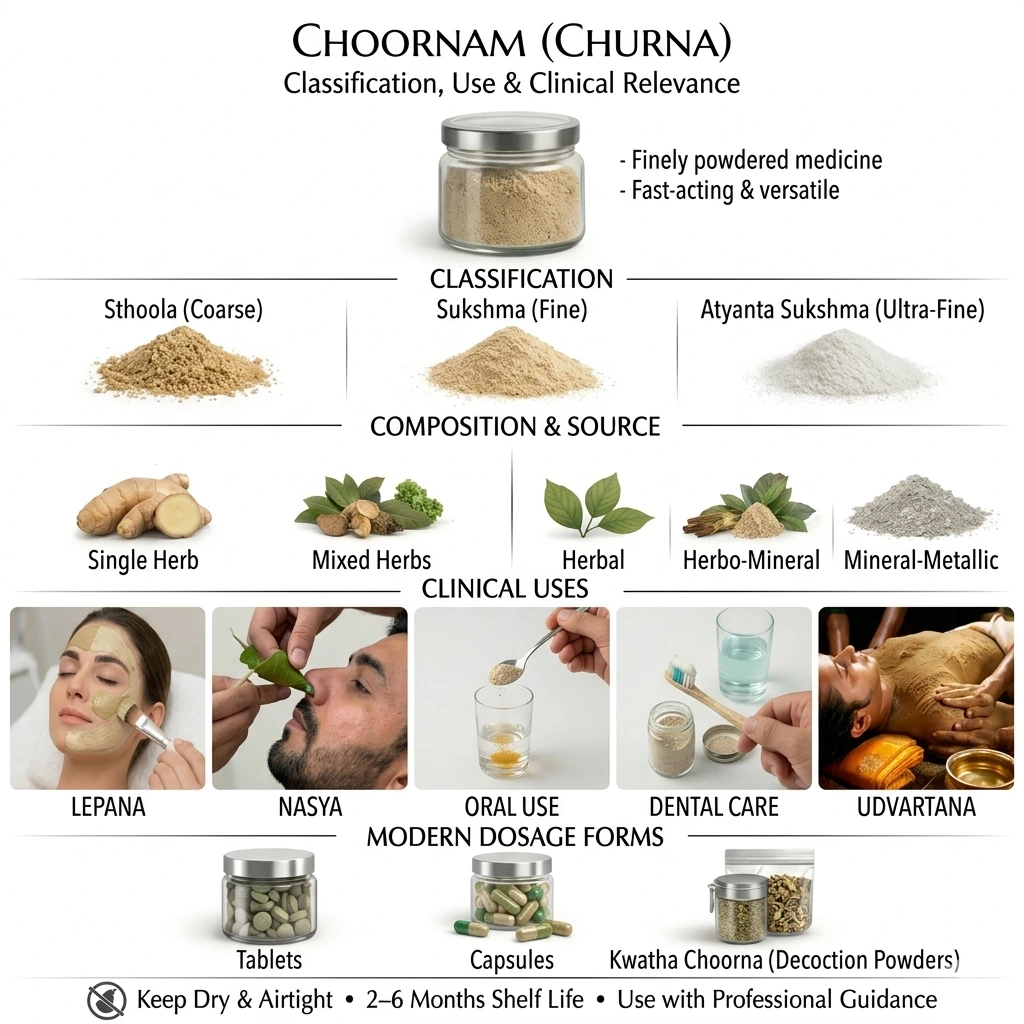
Choornam may be classified in several ways, depending on particle size, ingredients, and composition.
Based on Particle Size
The fineness of the drug is not a matter of marginal concern; it can have a direct impact on the drug’s performance from a clinical standpoint.
Based on Ingredients
Drugs prepared from a single ingredient are for specific purposes, while those prepared from more than one ingredient are for more general effects.
Based on Composition
Choornas may be:
This flexibility is one of the reasons Choornam has remained such an important dosage form in Ayurveda.
One of the key strengths of Choornam is its relatively quick action. Because the particles are finely divided, the surface area is greater, which may support faster interaction with the digestive system.
Ayurveda also recognises that a Choornam begins to act at the very moment it touches the tongue, because taste itself can initiate digestive responses.
In clinical use, Choornas are commonly employed as:
When digestion is weak, appetite is low, or a light and easy-to-administer medicine is needed, Choornam is often a practical and clinically sound choice.
In Ayurveda, Choornam is never used in isolation; rather, it is used along with an Anupana, which is a vehicle or a suitable medium for the medicine, i.e., warm water, honey, milk, or ghee.
It goes beyond facilitating easy consumption of the medicine. It can also affect the tolerance, direction of action, and mode of delivery of the medicine.
For example, a pungent powder, when taken with ghee, can be less irritating to the stomach, whereas the same powder, taken with honey, can improve the palatability. Therefore, Anupana should always be individualised.
Choornam is used in many ways, which reflects its versatility.
Oral Administration
Used for digestive, respiratory, and general systemic support.
External Application (Lepana)
Applied as a paste in selected skin conditions, wounds, or localised discomfort.
Powder Massage (Udvartana)
Used in specialised therapies, especially for skin health and weight-related care.
Dental Care
Used as an herbal tooth powder in Pratisarana to support oral hygiene and gum health.
Nasal Administration (Nasya)
Very fine powders are used in selected nasal therapies to help clear the channels.
This wide range of applications is one reason Choornam continues to occupy an important place in both home and clinical Ayurveda.
Churna is usually given in a small dose of about 1 Karsha (roughly 12 grams), but the exact amount should always be chosen based on the medicine and the person.
As a general rule, the anupana (vehicle/ adjuvant) also changes according to the body type and the condition being treated. In classical references, the usual guide is:
Common anupana include warm water, milk, ghee, honey, asava, madhya, yusha, phalamla, and dhanyamla.
In simple terms, the right churna and the right anupana together help the medicine work better and also make it easier on digestion.
Although Choornas are natural, they are still medicines and must be handled with care.
Traditionally, the shelf life of these compounds is assumed to be within a range of 2-6 months. This can be extended (2 years) with the help of newer packaging materials and storage conditions, as long as quality standards are met.
Powders are also sensitive compounds, especially with respect to moisture, humidity, and oxidation.
It must also be ensured that the formulation is tested for purity and safety, especially in case of compounds that are intended for regular use.
Some of the Choornas, especially the hot or pungent ones, can cause gastric irritation, heartburn, or nausea in case of improper use or excess dosage.
Self-administering Choornam may seem to be harmless, but in some cases, it may cause Aushadha Ajirna. This is a state where the administered medicine is difficult to digest. This condition happens when the Choornam is too heavy and too potent for the individual to digest.
A qualified Ayurveda doctor considers various factors before giving an individual a Choornam. These factors include Prakriti, Agni (digestive fire), age, disease stage, symptoms, and anupana suitability.
Some Choornas may be contraindicated in certain situations:
In Ayurveda, the right medicine is not simply the one that is effective in general. It is the one that is appropriate for that person at that time. That is where clinical judgement becomes essential.
Choornam is a beautiful example of Ayurveda’s practical intelligence. It is versatile in use, yet firmly rooted in classical principles. And when prepared correctly and prescribed appropriately, it remains one of the most valuable dosage forms in Ayurveda.
As we work hard to improve our services, your feedback is important to us. Please take a moment to help us serve you better.
Subscribe to our hospital newsletter for the latest health tips, updates on services, patient stories, and community events. Sign up today and stay informed!

Report Problem
Popular Searches: DiseasesTreatmentsDoctorsHospitalsWhole person careRefer a patientInsurance

