- AyurVAID Pharmacy
A cup of Kashayam or Kwatha may look like an ordinary herbal drink, but it is actually a carefully prepared decoction carrying the concentrated essence of herbs. Guided by classical Ayurveda principles, it has been used for generations because it helps extract water-soluble constituents of medicinal plants for therapeutic and practical use.
Kashayam is designed to support digestion, improve assimilation, and deliver the healing potential of herbs quickly and easily. This blog explores Kashayam in a simple, practical manner—its meaning, classical foundation, preparation, therapeutic value, modern adaptations, and precautions to keep in mind.
‘Kashayam’ and ‘Kwatha’ are often used interchangeably. It is a process where herbs are boiled with a certain amount of water to extract soluble constituents. This is different from a simple infusion, where herbs are only steeped in hot water for a short time.
Kashaya provides stability to the body, maintaining a harmonious relationship between Tridoshas. This preparation falls under one of the important categories of Panchavidha Kashaya Kalpana, a five-fold classification of liquid preparations in Ayurveda.
In Sanskrit, Kashaya is explained in a meaningful way:
Together, the terms convey the idea of a preparation that helps the body function in an orderly and balanced manner.
“कष हिंसां करोति इति कषाय:” — that which causes dryness in the throat and causes the shrinkage of disease is called Kashaya.
Linguistically, Kashaya refers to something that helps regulate bodily functions appropriately and maintain internal balance. It may also indicate the astringent taste, a particular colour, or a filtered herbal extract prepared through boiling.
कण्ठस्य कर्षणात् प्रायो रोगाणां वापि कर्षणात् ।
कषायशब्द प्राधान्यात् सर्व योगेषु कल्प्यते ॥
(Sharangadhara Samhita)
Because it acts on the throat and helps draw out disease, and because the term ‘Kashaya’ is considered prominent, this preparation is used in many medicinal formulations.
The term also points to the standard method of preparing a decoction: one part of coarsely powdered drug is mixed with sixteen parts of water and boiled over a mild fire until the liquid reduces to one-eighth of its original quantity. The strained liquid is then used while lukewarm.
The term is also associated with the idea of pulling out disease from the body. Although freshly prepared Kashaya has a short shelf life, it remains a foundational preparation in Ayurveda.

These distinctions matter because Ayurveda pays attention to detail. The same word can point to taste, preparation, or function depending on the context.
Preparing a proper Kwatha is not merely boiling herbs in water. It involves the following steps:
1. Selection of Raw Materials – Herbs are first cleaned, dried, and made into a coarse powder called Yavkuta Churna, because it allows better extraction and easier filtration. In addition, if the powder is very fine, the decoction might become heavy, cloudy, or difficult to strain.
2. Water-to-Herb Ratio – The amount of water to be used is based upon the nature of the drug:
The method is adapted to the nature of the ingredient rather than forcing all herbs into the same pattern.
3. The Boiling Process – The mixture is boiled in a wide-mouthed vessel over a mild fire (Mandagni). The vessel is kept uncovered so that the water can evaporate slowly and steadily. Clay vessels have long been preferred in classical practice because they support even heating.
4. Reduction and Filtration – The decoction is boiled until it reduces to one-fourth or one-eighth of the original amount. It is then filtered through a clean cloth/sieve while still warm.
5. Prakshepaka Dravyas: These are the medicinal adjuvants that are added to the prepared Kashaya just before consumption to enhance the palatability of the decoction and increase its efficacy. These adjuvants may be in the form of powders, the quantity of which is fixed at 3 grams, and may also be in the form of fluids, i.e., honey and milk, the quantity of which varies according to the condition of the patient.
Kashaya is classified into different types by Acharyas, based on both the method of preparation and the intended therapeutic action.
Among these, Acharya Harita offers one of the most practical classifications, dividing Kashaya into seven types according to the degree of water reduction and their specific effects on the body. These are
Kashaya is also recognised as one of the five basic pharmaceutical preparations under Panchavidha Kashaya Kalpana, along with fresh juices, pastes, and different forms of infusions. Other classical scholars, such as Sushruta and Kashyapa have presented their own variations, including milk-based and powdered forms. Even so, Harita’s classification continues to be especially useful because it connects the method of preparation with the desired therapeutic effect in a very clear way.
Why does Kashaya occupy such an important place in Ayurveda? One reason is its high bioavailability. The water-soluble active herbal constituents facilitate absorption and often yield a quicker response.
Kashaya is often used to calm troubled Doshas, especially when Kapha or Pitta are out of balance, or when Vata needs a little support. It is also renowned for its Vrana Ropana property, which means it can help purify wounds, reduce swelling, and promote healing when used externally. Being water-based, it tends to be much lighter and easier to digest than oil-based or sticky remedies.
This makes the use of Kashaya in clinical practice extremely versatile. It can be both gentle and effective, depending upon how it has been prepared.
This classical form is very effective, but it is not very convenient for our modern lives. It has a short shelf life and a palatability issue. To solve this problem, some very useful modifications have been developed:
These forms help preserve the classical intent of the formulation while making it easier to use in everyday life.
Kashaya is far more versatile than most people realise. It is not limited to internal use.
Oral Health: Used for gargling (Gandusha) in throat and mouth care.
There is no single standard dose for Kashaya; it is usually decided according to the formulation, the condition being treated, and the individual’s need. Classical references mention around 96 mL (2 Pala), generally taken lukewarm. In clinical practice, doses commonly range from 15–50 mL, once or twice daily.
The choice of anupana (adjuvant) depends on the Dosha, the disease, and the nature of the medicine. Commonly used vehicles include honey, sugar or jaggery, ghee, milk, and warm water.
A classical approach is also described:
Both the dose and the anupana should be selected thoughtfully, based on the individual, for the best therapeutic result.
Freshly prepared Kashaya should ideally be used within a few hours, usually within 3 to 5 hours, depending on the preparation and surrounding conditions. Reheating is generally avoided because it may affect the quality of the herbal constituents.
Commercial liquid preparations are often concentrated and preserved and have a shelf life of 3 years. They usually need to be diluted before use. Kashaya Tablets (Ghana Vati) and Kwatha Churna typically have a shelf life of 2 years. It is always important to read the instructions carefully, because a home-prepared decoction and a market formulation are not the same.
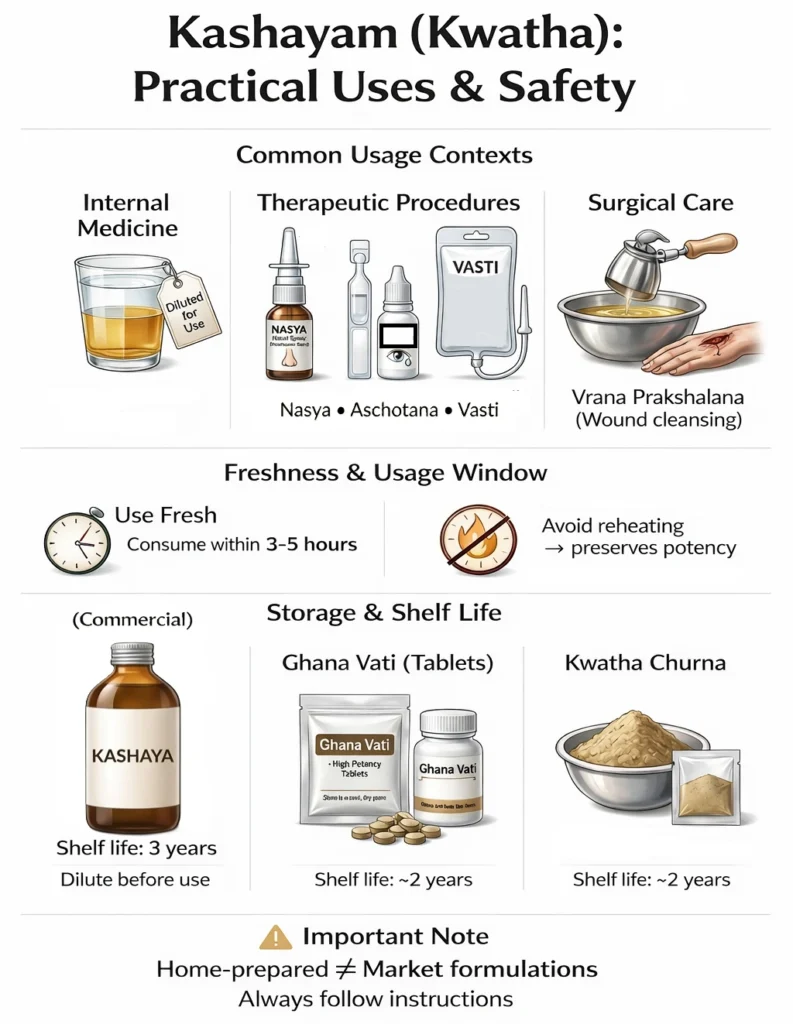
Although Kashaya may look like a simple herbal drink, it is still a medicine and should be used with proper understanding. The type of herbs, the potency of the decoction, the timing of administration, and additives all make a difference.
This given formulation may not be suitable for all individuals. The prescription depends on the Prakruti of the person, the condition being treated, and the stage of illness. Some decoctions are best taken on an empty stomach, while others are best taken with meals. Likewise, Prakshepa Dravyas, such as honey, sugar, or ginger powder, are added thoughtfully because they influence the action of the medicine.
As we work hard to improve our services, your feedback is important to us. Please take a moment to help us serve you better.
Subscribe to our hospital newsletter for the latest health tips, updates on services, patient stories, and community events. Sign up today and stay informed!

Report Problem
Popular Searches: DiseasesTreatmentsDoctorsHospitalsWhole person careRefer a patientInsurance

