Asava and Arishta

Table of Contents

Introduction

What are Asava and Arishta?

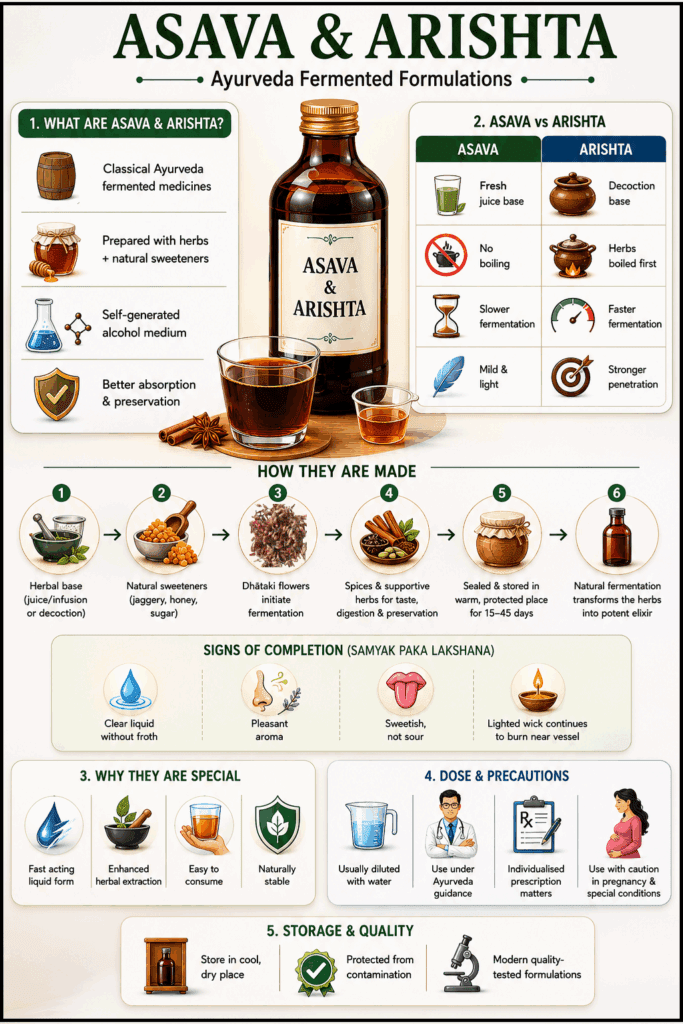
In Ayurveda, these preparations belong to Sandhana Kalpana, the classical science of fermentation.
These are created by fermenting herbs together with natural sweeteners like jaggery, honey or sugar. In the process, there is a slight production of alcohol, which comes from the fermentation process and is not added from outside.

Difference between the two:

  • Arishta is made by decocting the herbs first before creating the mixture.
  • Asava is made using the fresh juice extracted from the herbs without decoction.

This is an age-old method of extracting the essence from the herbs in a very efficient manner.

Key Differences

Feature Asava Arishta
Base Material Fresh herbal juice or cold infusion. Boiled herbal decoction (Kashaya).
Heat Application No heat applied to the herbs. Herbs are boiled in water first.
Fermentation Speed Relatively slower process. Relatively faster due to boiled medium.
Potency Lighter and faster absorption. Deeper tissue penetration.

Why are they considered special?

Asava and Arishta are valued for several reasons.

They are fast-acting because they are in liquid form. They are often better absorbed because the natural fermentation process helps extract both water-soluble and alcohol-soluble herbal components. They are usually pleasant to take, especially compared to bitter powders or strong decoctions. And because of the naturally formed alcohol, they tend to be self-preserving, which gives them good stability.

In many ways, they represent Ayurveda’s practical intelligence: a formulation that is not only therapeutic but also patient-friendly.

Insurance Backed

Precision Ayurveda
Medical Care

A common concern: do these contain alcohol?

Yes, but this needs to be understood in the right context.

In Asava and Arishtas, the presence of alcohol results from a natural fermentation process. The amount of alcohol found in it is low and acts merely as a vehicle carrying the herbal components.

It is totally unlike the consumption of alcohol for recreational purposes, where the amount consumed is much larger. In Ayurveda, these are medicinal preparations, used in carefully prescribed doses under guidance. In fact, some of them are traditionally used even in conditions where the body needs support with digestion, weakness, liver balance, or recovery.

How are Asava and Arishta prepared?

The herbal base is prepared first. While Arishta’s base is prepared using the decoction method (where herbs are boiled in water), the base of Asava is prepared from fresh juice or infusion without boiling. Natural sweeteners like jaggery, honey and sugar candy are used in fermentation. The Dhataki flowers are used to start fermentation in several classical formulas, while spices and supportive herbs are included to improve their taste and make them more effective.

Traditionally, this mixture was put inside a closed container and was left for several days or weeks in a warm place till fermentation was completed. According to classical treatment, fermentation was determined on the basis of samyak paka lakshana.

In modern times, the process of fermenting medicinal plants has been advanced to include the use of regulated temperature, hygienic containers, standardised filtration processes and microorganism safety standards.

How do we know it is ready?

Ayurveda literature provides definite criteria for completion known as Samyak Paka Lakshana.

An ideally prepared Asava or Arishta should be transparent and free from any bad flavour or taste, and neither too sour nor too thick in consistency. This outcome can be confirmed based on the clarity of taste and odour, along with colour and other physical attributes that indicate successful fermentation.

In contemporary practices, the ancient knowledge regarding proper fermentation is supplemented with laboratory tests. Measurements of specific gravity and pH value confirm that the fermentation process has completed. Alcohol and sugar content in the solution provide additional confirmation of the completion of the fermentation process. Other parameters that include total solids, titratable acidity, refractive index and viscosity are measured to standardise the finished product. Along with this, microbial safety testing and HPTLC fingerprinting are used to confirm purity, consistency and quality before the formulation is released for use.

Commonly used examples

Some of the best-known formulations include:

  • Dasamoolarishtam– traditionally used for postpartum recovery, weakness, and joint support
  • Saraswatharishtam– used for memory, focus, and nervous system support
  • Draksharishtam – often used in respiratory weakness, low appetite, and fatigue
  • Lohasavam – commonly used for anaemia and digestive weakness
  • Kumaryasavam – widely used in women’s health, especially for menstrual concerns

Each formulation has its purpose, and the selection depends on the person’s condition, digestion, strength, and overall constitution.

A few important precautions

Although these are classical medicines, they must be used thoughtfully.

They are usually taken diluted with water and in the dose advised by a qualified Ayurveda physician. People with diabetes, gastric sensitivity, pregnancy, or special health conditions should use them only under supervision.

The same medicine can be helpful for one person and unsuitable for another. That is why individualised prescribing is so important in Ayurveda.

Dose and Anupana:

  • Adults: The classical dose is roughly 48–96 ml per day, usually taken in divided doses (approx. 25–30 ml twice a day).
  • Children: They can be used in children as young as six months in very small, carefully calculated doses (e.g., 2–3 ml for infants, 10 ml for 5–6 year olds).
  • Administration: It is almost always recommended to dilute with an equal amount of water before taking.
  • Anupana: Lukewarm water is the best medium. Hot water is not recommended as it may interfere with the self-generated alcohol medium.

Storage and shelf life

Asava and Arishta are often considered to become more refined with age, but in practical pharmacy, quality, storage, and expiry standards remain important.

They should be stored properly, protected from light and contamination and purchased from reliable manufacturers. Today, many pharmacies also use modern quality checks to ensure safety, purity and consistency.

Conclusion

Asava and Arishta remind us that Ayurveda has always understood something profound: medicine should be both effective and gentle, both classical and practical.

These formulations are a fine example of how fermentation can transform herbs into a medicine that is easier to absorb, easier to preserve, and often easier to take. More than just herbal tonics, they are an expression of Ayurveda’s deep understanding of preparation, timing, and healing.

When chosen correctly and used under guidance, Asava and Arishta continue to be valuable companions in the journey toward better health.

FAQs

Is the alcohol in Asava/Arishta harmful like regular liquor?
No. The alcohol is self-generated in small amounts (5–10%) to act as a solvent and preservative for the herbs. When taken in the prescribed dose, it is therapeutic and generally does not cause intoxication.
Can I take these tonics on an empty stomach?
It is usually recommended to take them after food to prevent gastric irritation, especially since they have a slightly acidic nature.
Do Asava and Arishta expire?
Ayurveda traditionally suggests they have a very long shelf life (10 years or more). However, modern regulations usually provide an expiry date. If the liquid becomes very cloudy, develops an off-smell, or tastes very sour, it should be discarded.
Why must I dilute it with water?
Dilution helps reduce the concentration of alcohol and sugar, making it gentler on the stomach and easier for the body to absorb.
Are they safe for children?
Yes, in proper diseases and minimal, diluted doses. Specific tonics are commonly used for paediatric health.
Can diabetic patients take them?
Because they contain jaggery or sugar, diabetic patients must consult their doctor. If blood sugar is stable, small doses may be allowed, but they are not recommended for uncontrolled diabetes.
Why are some tonics called Asava and some Arishta?
It refers to the heat used. Arishtas are made from boiled decoctions, while Asavas are made from fresh juices or cold infusions without using fire.
Did the information meet your needs?

As we work hard to improve our services, your feedback is important to us. Please take a moment to help us serve you better.

Stay Connected to Health and Wellness

Subscribe to our hospital newsletter for the latest health tips, updates on services, patient stories, and community events. Sign up today and stay informed!

Homepage B RCB

Please fill out the form below to Request a call back

Patient details

Select Preferred Center

Content Details

We update our articles as new material becomes available, and our specialists keep a close eye on the health and wellness industry.

Written by
Dr Shobitha Madhur
Share this article on
Last updated on:
Do you have concerns with the content?

Report Problem

Table of Contents

Last updated on:

Report Problem

Do you have concerns with the content?

We’d Love to Hear from You!

Feedback form(disease page)

Can we help?

Something wrong with our medical content?
 
Report Problem form

Popular Searches: DiseasesTreatmentsDoctorsHospitalsWhole person careRefer a patientInsurance

Follow Apollo AyurVAID hospitals