- AyurVAID Pharmacy
If there is one Ayurveda preparation that feels both familiar and special at the same time, it is Avaleha. Most people know it as ‘herbal jam’, ‘medicated confection’, or ‘lehya’, but in Ayurveda it is much more than a sweet mixture of herbs. It is a thoughtfully prepared dosage form that combines medicine, nourishment, and ease of use in a single spoonful.
For patients who find decoctions too bitter, powders too rough, or tablets too dry, Avaleha often feels like a blessing. It is easy to take, pleasant to taste, and deeply useful in many conditions where the body needs support, strength, and recovery. From the famous Chyawanprash to classical formulations like Agastya Rasayana, Avaleha has remained a trusted part of Ayurveda practice for centuries.
The term ‘Avaleha’ is derived from the Sanskrit root “lih-aswadane,” where “lih” signifies the act of licking and “aswadane” refers to a pleasant taste. That alone tells us a lot about this formulation. It is meant to be consumed slowly, in a semi-solid form, so that the medicine stays in contact with the mouth and becomes easier to swallow and digest.
Classical Ayurveda texts describe Avaleha as a dosage form prepared by cooking herbal liquids, such as decoctions or fresh juices, with sweetening agents until they become smooth, thicken and jam-like. It is usually considered an upakalpana, or secondary preparation, but in actual practice, it has earned a critical place of its own.
The beauty of Avaleha lies in the way Ayurveda transforms a bitter or sharp herb into something that is both healing and acceptable to the patient. It is not just medicine made sweeter. It is medicine made more palatable.
One of the main reasons Avaleha is so widely loved is that it is simple to take. Many Ayurveda medicines work wonderfully, but are not always easy for every patient to tolerate. Children, older adults, and weak patients often struggle with strong tastes or difficult textures. Avaleha solves that problem beautifully.
Its sweet base makes it more pleasant, while the herbal ingredients still carry the therapeutic action. The semi solid texture also makes it convenient to consume. Instead of forcing the patient to struggle with a bitter decoction, Ayurveda offers a formulation that feels softer, gentler, and more nourishing.
Avaleha also provides a nutritive support base. Other components such as jaggery, sugar, honey, ghee, or oil not only enhance taste but also provide energy and contribute to nourishment. Such ingredients help the body absorb the herb appropriately and make prolonged consumption easier. The importance of this property of Avaleha can be seen in its use in Rasayana and Brimhana treatments, where building strength and restoring vitality are important.
Another strength of Avaleha is that it remains stable. Because it is cooked down and concentrated, it tends to last longer than fresh herbal preparations. That makes it practical both traditionally and in modern pharmacy.

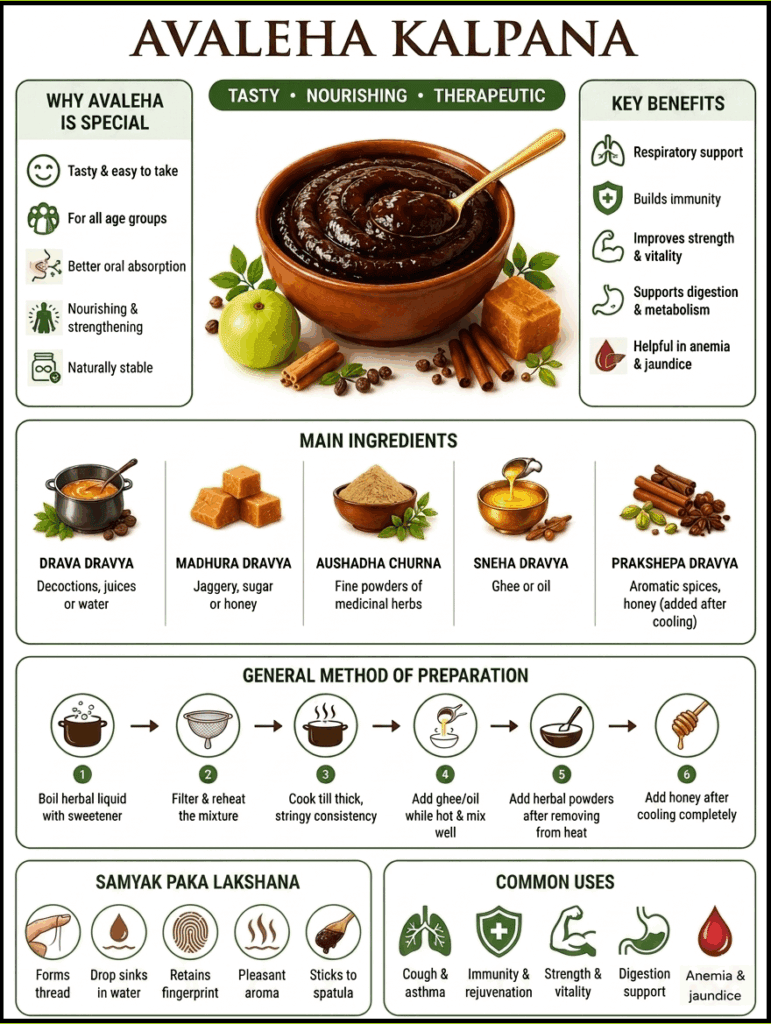
Usually, the process begins with a liquid base such as a decoction, herbal juice, milk, or water.
This is then mixed with a sweet substance such as jaggery, sugar, or sugar candy and boiled slowly until it starts thickening. When it reaches the appropriate stage of reduction, the powder of herbal medicines is added. In some cases, ghee and oil can be added to enhance its medicinal effects.
Some materials are used only after extinguishing the fire. They include aromatics in powder form and honey, which cannot be heated too much. According to Ayurveda, this method of cooking is important because it influences the look, potency, and effectiveness of the medication.
All this is what gives us a stable, pleasant and useful medicine out of common ingredients.
The classical literature suggests many signs indicating the proper consistency of Avaleha. They show the correct way to check it.
One such sign is known as Tantumatva, when the preparation can be stretched between the fingers, forming a thread.
Another is Apsu majjana, where a small portion sinks in water instead of dissolving instantly.
Peedito mudra refers to the way a fingerprint stays visible on the surface when lightly pressed.
Darvi Pralepa shows that the mass sticks properly to the stirring spoon, without being too runny.
Gandhavarnarasodbhava means the aroma, colour, and taste have developed as expected.
These signs may sound old-fashioned, but they reflect a profound understanding of how a well-made Avaleha should behave. In a traditional pharmacy, such observations are part of quality control.
Avaleha can appear in a few different forms depending on how much the liquid is reduced during cooking.
At a lighter stage, it may resemble a syrup and is sometimes referred to as Phanita. When further concentrated, it becomes Rasakriya, a thicker and more semi-solid form. The standard form most people recognise is Avaleha itself, soft enough to lick and swallow comfortably. With further heating and reduction, the preparation may become more solid, leading to forms like Ghana or the Khanda.
This flexibility is one of the reasons Avaleha remains such a practical formulation. The same basic idea can be adapted into different consistencies depending on the therapeutic goal and storage needs.
Avaleha is especially valued for its nourishing and restorative qualities. It is often prescribed when the body is weak, depleted, recovering, or in need of support.
They are used for cough, wheezing, breathlessness, and long-standing respiratory irritation. Their purpose is not only to ease symptoms, but also to support the respiratory system in a more balanced and sustained way.
Some Avalehas are also used in conditions such as anaemia, liver disorders, piles, and certain skin disorders in conditions where digestion, strength, and liver support are important. Other formulations are used when the goal is to improve vitality, nourish depleted tissues, or assist recovery after chronic illness.
Even though Avaleha is gentle and nourishing, it is not suitable for everyone in every situation. Like all medicines, it needs to be used thoughtfully.
Many Avalehas contain sugar, jaggery, or honey, so they may not be appropriate for people with diabetes unless a specially modified version is chosen under proper supervision. They are also considered relatively heavy to digest, so in patients with very weak digestion, poor appetite, or acute fever, they may not be the best choice.
Some formulations also have a warming effect, which may not suit every constitution, especially in people with strong Pitta tendencies. This is why the choice of Avaleha should always be based on the person’s condition, not just the diagnosis alone.
Another important point is the handling of honey. Honey should never be heated. In proper Ayurveda preparation, it is added only after cooling and always in accordance with classical rules.
The dose of Avaleha depends on the formulation, the patient’s age, strength, and disease condition. Traditionally, the quantity may range from small to moderate spoonfuls, but in actual clinical practice, it should always be individualised.
The timing of administration also matters. For some respiratory complaints, it may be given on an empty stomach. For other conditions, the physician may advise taking it after meals.
The accompanying Anupana, or vehicle, can make a meaningful difference. Warm milk is often used with nourishing preparations. Warm water, or sometimes sugarcane juice, may be chosen depending on the therapeutic intention. Ayurveda rarely looks at the medicine alone; it always considers how the medicine is taken.
Traditionally, Avaleha was intended to be consumed within a limited period. In modern commercial preparations, regulatory standards now allow a shelf life of up to three years, provided manufacturing and storage are done properly.
Storage is very important. Avaleha should be kept in a clean, airtight container, away from moisture and contamination. Glass or food-grade containers are preferred. If the preparation develops fungus, a strange smell, or any unusual change in texture, it should be discarded.
A good Avaleha should remain clean, fragrant, and stable. Once spoilage begins, it should no longer be used.
Even though Avaleha is an ancient formulation, it has not become outdated. Modern pharmaceutical methods have made it easier to standardise and package products. Today, many preparations are available in granule form, which makes them easier to measure, transport, and consume.
Some manufacturers also prepare sugar-free versions for patients who need more careful blood sugar control. Steam-jacketed vessels, mechanical mixers, and quality-controlled processes help maintain consistency from batch to batch.
These changes do not take away from the classical idea. They simply make the formulation more practical for present-day use.
For many people, Avaleha is not only a medicine for illness but also a supportive tonic during certain seasons or phases of life. When used appropriately, it can help maintain energy, strengthen the body, and support long-term resilience.
At the same time, it should not be treated like a casual sweet. It is a medicine first and a nourishing preparation second. The right formula, the right dose, and the right timing matter just as much as the ingredients.
Avaleha Kalpana beautifully reflects what Ayurveda does best: it makes healing practical and gentle. It transforms herbs into a form that patients can actually take and continue with. It supports the body while delivering medicine. It balances taste with function and tradition with practicality.
That is why Avaleha has remained so relevant for so long. It is not just a sweet herbal preparation. It is a carefully designed care, nourishment, and therapy – one that continues to earn trust generation after generation.
As we work hard to improve our services, your feedback is important to us. Please take a moment to help us serve you better.
Subscribe to our hospital newsletter for the latest health tips, updates on services, patient stories, and community events. Sign up today and stay informed!

Report Problem
Popular Searches: DiseasesTreatmentsDoctorsHospitalsWhole person careRefer a patientInsurance

