- AyurVAID Pharmacy
Every time the word “metal” comes up in Ayurveda, it tends to create a mix of curiosity and concern.
Many people ask the same question: “How can a medicine that contains gold, iron, copper, zinc, or mercury be safe?” And when headlines link Ayurvedic medicines to “heavy metal toxicity” or “liver damage” the worry becomes even stronger. That concern is valid. No responsible clinician should dismiss it. In modern medicine, we know that raw heavy metals can be harmful. They can accumulate in the body, interfere with normal cellular function, and damage organs such as the liver, kidneys and nervous system.
A properly prepared Ayurveda Bhasma is not the same as raw metal. It is not a simple powder, and it is certainly not something that should be taken casually or purchased blindly online. Bhasma is the result of a highly refined pharmaceutical process that transforms the original metal or mineral into an entirely different medicinal form. That distinction matters.
Because when people say, “Ayurveda uses metals,” they often imagine untreated metal entering the body directly. That is not what classical Ayurveda describes. In fact, the entire science of Bhasma preparation was developed to make metals and minerals therapeutically useful, biologically compatible, and suitable for minimal, precise doses.
In many ways, Bhasma reflects one of the earliest and most sophisticated examples of transformation-based medicine.
The word Bhasma literally means ‘ash’, but the term does not fully capture its depth.
A Bhasma is a specially processed herbo-mineral or herbo-metallic preparation made through a series of controlled steps known as Bhasmikarana (Incineration). In this process, the raw substance is purified, triturated with herbal media and repeatedly heated under specific conditions until it is transformed into a fine, stable, biologically compatible form. This is not just about making a substance smaller. It is about changing its nature.
Some commonly used Bhasmas include
These formulations have been described in classical texts and are still used today in carefully selected clinical situations.
One of the most common misunderstandings is that Bhasma means the patient is swallowing metal in its original form. That is not accurate. Raw metals are dense, heavy, and poorly absorbed by the body. If untreated metal powder were ingested, it could indeed pose a toxicity risk. Classical Ayurveda pharmaceutics recognised these risks long before modern toxicology became a formal science. Through Shodhana and Marana, the original metallic state is transformed. Modern analytical studies have shown that many properly prepared Bhasmas contain metal oxides, sulphides, and nano-sized particles rather than elemental metal in its crude form.
So when we speak of Bhasma, we are speaking of transformation, not direct metal consumption. Though charcoal and diamond both contain carbon, no one would say they behave the same way. The source may be related, but the final properties are entirely different.
A lot of scientific attention has recently focused on the nano-sized nature of some Bhasma preparations. Certain studies have reported particle sizes in the range of 5–50 nanometres in some formulations.At that scale, important changes occur:
This phenomenon is one reason modern researchers sometimes compare Bhasma to nanomedicine.
Ayurveda described a similar principle through the concept of Yogavahi—a substance that helps carry and enhance the action of other ingredients. The classical language is different, but the underlying pharmaceutical insight is striking.
This does not mean that every Bhasma is automatically safe or that every product on the market is correctly prepared. It does mean that the science behind classical Bhasma formulation is far more sophisticated than many people realise.

The process of making Bhasma is slow, deliberate and highly methodical.
1. Shodhana — purification
The raw material undergoes repeated purification with substances such as herbal decoctions, milk, sesame oil, or gomutra, depending on the classical instructions for that specific formulation.
This step is not cosmetic. It helps reduce impurities, modify properties, and prepare the substance for further transformation.
2. Bhavana — trituration
The purified substance is ground again and again with herbal juices or decoctions.
This prolonged process helps the medicinal substance interact intimately with the herbal media. It also contributes to particle refinement and consistency.
3. Marana — incineration
This stage is the defining step.
The material is subjected to repeated cycles of controlled heating. Traditionally, this was carried out using the Puta system, where sealed earthen containers were heated with cow dung cakes and allowed to cool naturally.
Today, many standardised pharmacies use electric muffle furnaces to maintain more precise temperature control while preserving the classical principle of transformation.
Some Bhasmas require many cycles before they are considered complete. That is why true Bhasma preparation is a highly skilled pharmaceutical process, not a quick manufacturing shortcut.
Very often, the moment an Ayurvedic medicine is linked to a case of liver injury, the conclusion is made too quickly: “The metal caused it.”
First, not all Ayurveda medicines contain metals. In fact, most are purely herbal.
Second, not every metal is toxic. Iron, zinc, copper, magnesium, calcium, and selenium are essential for normal physiology. The issue is not simply the presence of a metal. The issue is its form, dose, preparation and use.
Third, liver injury has many possible causes. Patients may be taking prescription medicines, over-the-counter supplements, alcohol, nutritional products, or multiple herbal preparations at the same time. Without a proper clinical evaluation, it is not possible to blame one ingredient immediately.
This is why I always tell patients that “Ayurvedic” does not automatically mean harmless, just as “metal-containing” does not automatically mean toxic.
The real question is whether the product is genuine, thoroughly prepared, and correctly prescribed.
Ayurveda itself warns against improperly prepared Bhasma.
An inadequately processed preparation, sometimes referred to as Apakwa or Ashuddha Bhasma, may not have undergone complete transformation. Such a product may retain undesirable qualities and can certainly be unsafe.
So yes, there is a legitimate safety issue—but the danger lies in poor preparation, contamination, adulteration, or irresponsible use, not in the classical concept of Bhasma itself.
This scenario is exactly why quality control is central to Ayurveda.
Classical Ayurveda developed simple but highly meaningful tests to assess whether a Bhasma is thoroughly prepared.
1. Varitaratva
A properly made Bhasma should float on still water. This property indicates extreme lightness and fineness.
2. Rekhapurnatva
When rubbed between the fingers, the particles should enter the fine lines of the skin. This test shows that the material is extremely subtle.
3. Nishchandratva
The preparation should not have a metallic shine. That metallic brilliance must be fully removed.
4. Apunarbhava
The material should not revert to its original metallic state when tested again.
5. Niruttha
The Bhasma should no longer behave like metal in test conditions.
These classical checks may appear simple, but they reflect a profound understanding of transformation, stability and therapeutic suitability.
Modern scientific validation helps establish what classical Ayurveda has long emphasised: a properly prepared Bhasma is not a crude metal powder but a carefully transformed therapeutic substance. Modern laboratory techniques have made it possible to accurately ascertain the particle size, structure, composition, purity and safety.
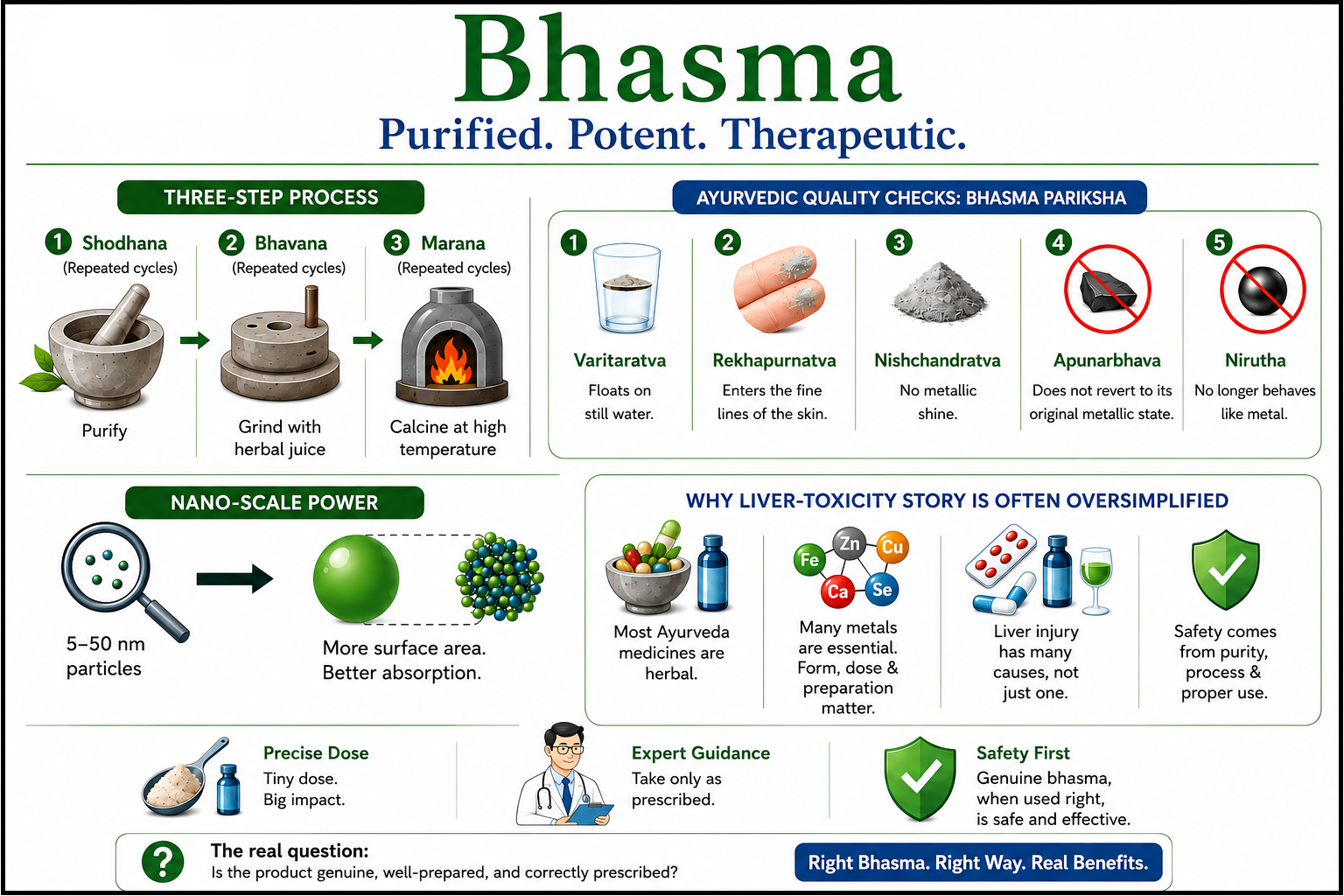
Bhasma is not meant for casual self-medication. It is generally used in specific clinical contexts where its potency and tissue-level action are considered useful.
Rasayana therapy
Many Bhasmas are used in Rasayana Chikitsa, the Ayurvedic branch that focuses on rejuvenation, vitality, resilience, and healthy ageing.
Chronic disorders
Because Bhasmas are potent and act in minute doses, they may be used in long-standing conditions such as anaemia, metabolic disorders, respiratory disease, chronic inflammation, cancer, autoimmune diseases and some degenerative conditions.
Their use depends on the person’s Prakriti, digestive strength, stage of disease, and overall constitution. In Ayurveda, the medicine is never separated from the patient.
Bhasmas are usually not given in isolation. In clinical practice, they are often prescribed with a suitable Anupana—a carrier such as honey, ghee, or warm water—to improve absorption and help the medicine reach the intended tissue more effectively. In many formulations, they are also combined with other herbal and mineral ingredients to create classical Kalpas or Yogas, where the Bhasma acts as the main therapeutic component and the accompanying herbs support and enhance its action. These preparations may be available in different dosage forms, such as Vati or Gutika (tablets or pills), Churna (powders), and Avaleha (semisolid formulations). In some cases, especially with mercury-based preparations, the ingredient is seldom used alone; it is always processed and administered as part of a carefully prepared compound formulation.
Swarna Bhasma
Traditionally valued for rejuvenation, immunity, vitality, and mental support.
Loha Bhasma
Used in conditions associated with iron deficiency and impaired blood formation.
Yashada Bhasma
Commonly used for skin issues, wound healing, and metabolic disturbances.
Tamra Bhasma
Traditionally used in disorders involving the liver, spleen, metabolism, and lipid balance.
Abhraka Bhasma
Considered a deeply nourishing and rejuvenative formulation, often used in chronic debilitating states and respiratory conditions.
Each of these has its own role. They are not interchangeable, and they should never be chosen casually based only on names or internet advice.
One of the most striking features of Bhasma therapy is the dose.
Unlike many herbal formulations that are given in grams, Bhasmas are usually prescribed in milligram quantities.
Common therapeutic doses often range from 15 mg to 250 mg per day, depending on the formulation and the patient’s condition.
This minimal dose is one reason why proper supervision is essential. Such medicines are powerful, and their use must be precise.
In Ayurveda, Bhasma is rarely given alone.
It is usually administered with an Anupana—a carrier or vehicle chosen according to the disease and the person. This may include honey, ghee, milk, warm water, or herbal decoctions.
The Anupana is not just an afterthought. It influences absorption, tissue delivery, and therapeutic action. In modern terms, it works somewhat like a delivery system.
This method is another example of how Ayurveda thought deeply about not just what to give but how to give it.
Research into Bhasma is still evolving. Available studies suggest that properly manufactured classical Bhasmas may have safety profiles very different from those of raw metals. Some experimental studies on preparations such as Yashada Bhasma and Abhraka Bhasma have shown reassuring safety findings even at doses much higher than usual clinical doses. At the same time, concerns about contamination, poor manufacturing, mislabelling and inappropriate use are real and must be taken seriously.
So the question is not simply whether a metal is present. The question is whether the medicine has been prepared according to classical standards and modern quality requirements.
That is where responsible practice begins.
Not really. A properly prepared Bhasma is not the same as raw metal. It is the outcome of a highly refined process designed to transform, detoxify, and optimise a substance for use in the body.
At the same time, it is not a wellness product to be ordered casually from an unknown website or taken based on social media advice. These are powerful medicines. They should be used only when clearly indicated and only under the guidance of a qualified physician.
The safety of Bhasma depends on several things:
The question is not whether Bhasma is always dangerous or always safe. The question is whether it has been made well, prescribed wisely, and used appropriately.
When that happens, Bhasma remains one of the most fascinating examples of how Ayurveda combined deep pharmaceutical insight with clinical intelligence long before modern science had the vocabulary to describe it.
As we work hard to improve our services, your feedback is important to us. Please take a moment to help us serve you better.
Subscribe to our hospital newsletter for the latest health tips, updates on services, patient stories, and community events. Sign up today and stay informed!

Report Problem
Popular Searches: DiseasesTreatmentsDoctorsHospitalsWhole person careRefer a patientInsurance

