Majja Dhatu

Table of Contents

In Ayurveda, health is the harmonious functioning of all doshas (bodily humours), dhatus (tissues) and malas (waste products). One of the central pillars of that inner order is the system of seven tissues (Sapta Dhatus). They are the subtle tissues that build and sustain the body, providing Dharana (support) and Poshana (nourishment). Majja Dhatu occupies the sixth place in this sequential chain of tissue formation, following Asthi (bone). It is the soft, unctuous essence that fills and nourishes the inner cavities of bone, and it forms a vital interface between our structural integrity and neural vitality.

What is Majja Dhatu?

The Sanskrit root “मज्जन्” implies something sunk, seated, or immersed. The expression “मज्जतिति मज्जा” describes that which is immersed or bathed — an apt image for a tissue that literally fills the hollows of bones. Classical synonyms such as Asthisneha (the unctuous part of bones), Asthisara (essence of bone), and Shukrakara (producer of reproductive tissue) signal Majja’s close kinship with both skeletal and reproductive processes. In clinical terms, Majja is recognised as the essence derived from Asthi and is essential for preserving the pliancy and nutritive function inside the bony framework.

How is Majja Formed?

Majja is formed by successive metabolism. After the formation of Asthi Dhatu (bone), pores and cavities are formed due to the influence of Vata Dosha; in those pores and cavities, the unctuous element of Meda Dhatu (Fat) enters and forms Majja. In modern biology, we observe a similar sequence of events. During bone modelling, the space formed by osteoclasts is filled by a mixture of haematopoietic tissue (red marrow) and adipose tissue (yellow marrow). Thus, Majja can be correlated with bone marrow — both the blood-forming compartment and the fat-rich marrow that supports metabolic and endocrine functions.
Insurance Backed

Precision Ayurveda
Medical Care

Majjavaha Srotas

Majjavaha Srotas denotes the channels responsible for the circulation, transformation, and nourishment of Majja. Classical texts describe the roots of these channels in Asthi and Sandhi (joints), ensuring that nutrient supply reaches both bone interiors and adjacent articulations. When these channels are compromised—by Abhighata (trauma), compressive pathology, or dietary incompatibilities— the movement and quality of Majja are disturbed, producing local and systemic signs.

The Link Between Majja and the Brain

One of the fascinating aspects of classical physiology is the way in which the brain (Mastulunga) comes under the umbrella of Majja. Just as bone marrow is protected in the hollow of the bone, the brain too is protected in the cranial vault and is said to resemble half-melted ghrita (clarified butter) in consistency. This adjective refers to the lipid nature of the brain. In this respect, modern science also affirms that the brain consists of a high lipid content (myelin and phospholipids) that plays a major role in neural conduction.

The Vital Functions of Majja Dhatu

The functions of Majja Dhatu can be listed as follows:
  • Snehana: It provides the necessary unctuousness to the bone marrow and nervous system.
  • Bala: It provides physical strength.
  • Asthi-purana: It fills the bone marrow to avoid brittleness.
  • Shukra-pushti: It provides nourishment to the reproductive system.
The marrow’s role in erythropoiesis (red blood cell formation) and its contribution to immuno-endocrine signalling are direct physiological expressions of Majja’s classical functions.

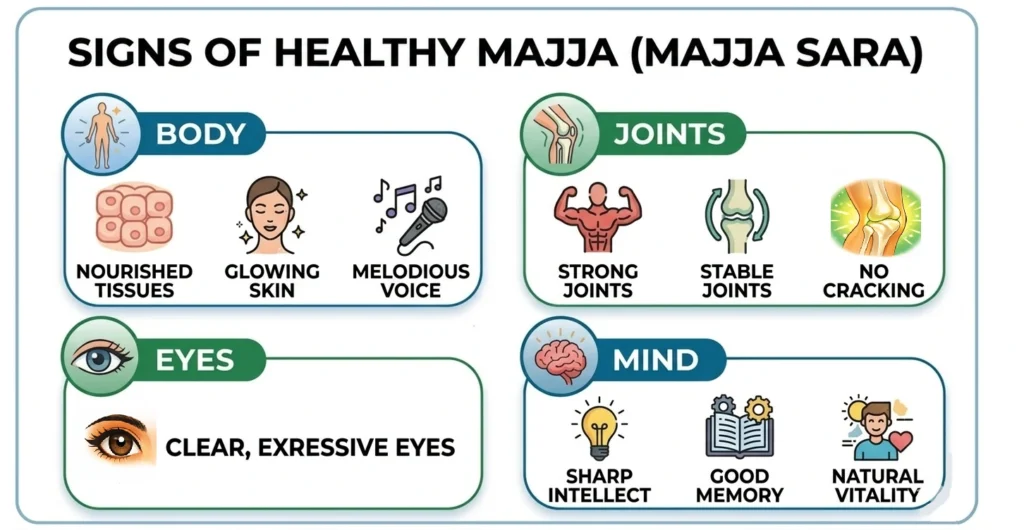
Signs of Healthy Majja (Majja Sara)

When Majja is replete and balanced, particular traits become evident:

  • Physically: soft, well-nourished tissues, an unctuous and glowing complexion, and a melodious, resonant voice.
  • Joints: robust, well-filled, rounded articulations without crepitus.
  • Eyes: large, clear, and expressive (MahaNetra).

Mentally: sharp intellect, good memory, capacity for learning; and a general sense of vitality and fortune. These characteristics reflect the nourishing and stabilising influence of sound Majja on both body and mind.
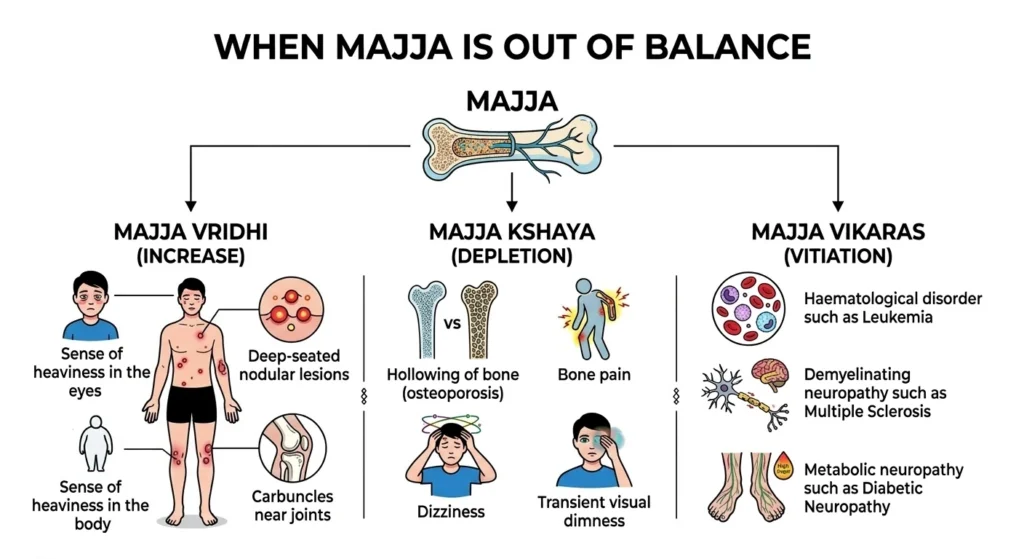
Signs of Majja Vridhi, Kshaya, and Vikaras

Imbalance of Majja manifests in patterned ways:

  • Majja Vridhi (increase): produces a sense of heaviness in the eyes and body and can predispose to deep-seated nodular lesions or carbuncles near joints.
  • Majja Kshaya (depletion): leads to hollowing of bone (Asthi Saushirya—analogous to osteoporosis), bone pain, dizziness (Bhrama), and transient visual dimness (Timira darshana).
  • Majja Vikaras: Chronic vitiation may contribute to conditions where marrow or nerve tissue is compromised—classically described in terms that modern clinicians might recognise as haematological disorders (leukaemia—disorder of bone marrow), demyelinating neuropathies (Multiple Sclerosis), or metabolic neuropathies (Diabetic Neuropathy).

The Upadhatu (Secondary Tissues) of Majja

The metabolic processes that form Majja also yield secondary tissues, or Upadhatus. Classical authorities differ in the assignment of certain structures: for instance, Kesha (head hair) is identified by Sharangadhara as an Upadhatu of Majja, whereas others associate it with Asthi. Elements of the eyeball — the sclera and ocular fluids — are also regarded as products of Majja metabolism, underlining its role in maintaining sensory and structural integrity.

Diagnosing Majja Vitiation

Diagnosis in practice combines classical observation with modern investigations. Clinical clues include joint-centred pain, recurrent fainting spells, persistent bone pain described as splitting or deep-seated, and changes in reflexes. In contemporary practice, objective measures such as bone mineral density (DEXA) and haematological assays complement the classical symptom picture, allowing for precise assessment of marrow health and skeletal status.

Practical Ways to Care for Your Majja

Caring for your Majja involves an interrelated approach to your diet, your lifestyle, and therapeutic interventions:

  • Foods: The food articles with sweet and bitter tastes are favoured. Fatty food items such as ghee and bone broth can be very beneficial for Majja. It is important to include calcium-rich food items as well as vitamin D supplements for the healthy development of precursor Asthi.
  • Lifestyle: Abhyanga, or self-massage, is very important for Vata balance and for the healthy nourishment of your body tissues. Exercise is very good for the metabolism of your body tissues, but it must be done in such a way that it does not increase Vata. Sleep is essential for the healthy regeneration of your neural and bone tissues.
  • Therapeutics: Nasya is an important intervention for healthy cranial Majja, while Vasti, or medicated enemas, such as bitter milk-based Tikta Ksheer Vasti, is important for healthy bone and bone marrow.

Mental Health, Emotion, and Majja

Stability of Majja and clarity are key to mental stability and clarity. Depletion of Majja can cause memory loss, confusion, anxiety, or a general feeling of emptiness, while healthy, well-nourished Majja helps us cope with life, think clearly, and have emotional stability.

A Few Practical Checks You Can Do at Home

There are some simple things that you can check in your daily life to get an idea of your Majja balance –
  • Eye Exudate: Observe the secretions in your eyes upon waking. Dryness or excessive mucous/oiliness may suggest Majja imbalance.
  • Voice and joint sounds: A sweet, lubricated voice and silent joints indicate healthy Majja, while a dry voice or creaky joints may indicate Majja imbalance.

To Conclude

In caring for Majja Dhatu, it steadies the mind and nourishes life at its deepest level. This tissue is where the wisdom of Dhatu Poshana Nyaya meets modern insights into marrow and neural health—a reminder that ancient principles and contemporary science can guide each other toward practical, gentle care.
Favour sweet and bitter tastes, include wholesome ghee and nutrient-dense foods, practise daily Abhyanga, protect sleep and moderate activity. Observe your body: the voice, joint ease, and clarity of mind are honest clues to Majja’s welfare. Nourish the marrow, and you nourish the very seat of strength and presence within.

FAQs

What is majja dhatu in Ayurveda?
Majja Dhatu is the sixth of the seven fundamental tissues, primarily residing within the bone cavities and comprising the bone marrow and the entire nervous system. It is responsible for providing unctuousness to the body, filling the bones, and nourishing the reproductive tissues.
How to strengthen majja dhatu?
To strengthen Majja Dhatu, one should consume sweet and bitter foods and use healthy fats, like ghee. Ayurveda therapies like Nasya (nasal oils) and Tikta Ksheer Vasti (medicated enemas) are also highly effective for deep nourishment.
What is majja in the human body?
In the human body, Majja represents the soft organic material filling the internal cavities of bones, as well as the brain and spinal cord tissue. It is often correlated with the modern concepts of bone marrow and the central nervous system.
What is the synonym for Majja dhatu?
Common synonyms for Majja Dhatu include Asthisneha (bone fat), Asthisara (essence of bone), Asthija (born from bone), and Dehasara (essence of the body).
How to repair damaged brain nerves naturally?
Repairing brain nerves naturally involves consistent Nasya therapy with medicated oils and the regular intake of Medhya Rasayana herbs. These practices promote the health of Majjadhara Kala, which protects the myelin sheath and supports nerve regeneration.
How to increase brain power quickly?
Practicing Shirodhara (oil dripping on the forehead) and consuming Ghee infused with brain-boosting herbs can quickly calm the nervous system and sharpen cognitive focus. Ensuring high-quality sleep and daily Pranayama also rapidly enhances oxygenation and for improved mental performance.
What are the waste products (Mala) of Majja Dhatu?
The metabolic waste products of Majja Dhatu include unctuous secretions from the eyes (Akshi-vit), the skin, and the unctuousness found in faeces.
What is the modern correlation of the Majjavaha Srotas roots?
The roots of the Majjavaha Srotas—Asthi and Sandhi—correlate to the anatomical fact that red bone marrow is primarily found in the spongy bone located at the joint-forming ends of long bones and in flat bones.
What is the relationship between Majja Dhatu and Shukra Dhatu?
Majja Dhatu is the direct predecessor of Shukra Dhatu (reproductive tissue), and its proper nourishment is essential for the healthy formation and replenishment of semen and female reproductive fluids.
Did the information meet your needs?

As we work hard to improve our services, your feedback is important to us. Please take a moment to help us serve you better.

Stay Connected to Health and Wellness

Subscribe to our hospital newsletter for the latest health tips, updates on services, patient stories, and community events. Sign up today and stay informed!

Homepage B RCB

Please fill out the form below to Request a call back

Patient details

Select Preferred Center

Content Details

We update our articles as new material becomes available, and our specialists keep a close eye on the health and wellness industry.

Written by
Dr Shobitha Madhur
Share this article on
Last updated on:
Do you have concerns with the content?

Report Problem

Table of Contents

Last updated on:

Report Problem

Do you have concerns with the content?

We’d Love to Hear from You!

Feedback form(disease page)

Can we help?

Something wrong with our medical content?
 
Report Problem form

Popular Searches: DiseasesTreatmentsDoctorsHospitalsWhole person careRefer a patientInsurance

Hours of Operation:
8am – 8pm (Mon-Sat)
8am – 5pm (Sun)

Follow Apollo AyurVAID hospitals