- AyurVAID Pharmacy
Muscular tissue in Ayurveda is described through the concept of Mamsa Dhatu. It is the third among the seven structural tissues that support the body. Put very simply, Mamsa refers to the muscular part of the body. The flesh that gives the body its shape, strength, and stability. Muscle tissue fills the spaces between bones, protects internal organs, and stabilises joints. Without it, the skeletal frame would remain exposed and mechanically unstable.
If you look at two patients sitting in front of you, the difference is often obvious even before examination begins. One person may have firm limbs and a steady posture. Another may appear thin, with slightly wasted muscles around the temples or thighs. That difference tells us something about the condition of Mamsa Dhatu.
The Sanskrit word Mamsa simply means ‘flesh’. In common language, it refers to the soft tissues that cover the body. Ayurveda uses the word in a more specific physiological sense. Here, it refers to the muscular structures that form after the development of Rakta Dhatu.
“मांसं शरीरलेपनम्”
The meaning is straightforward. Mamsa acts as a covering of the body. Muscles surround bones and organs. They protect them and provide form. Ayurveda literature also mentions several related words for flesh—Pishita, Kravyam, Palala, and Amisha. Some of these terms appear in dietary contexts, others in anatomical descriptions. In surgical discussions, the organised units of muscular tissue are usually referred to as Peshi.
The terminology changes depending on the context, but the underlying idea remains the same: the fleshy structural component of the body.
Like all tissues described in Ayurveda, Mamsa is understood through the framework of the Panchamahabhutas. Two elements are particularly dominant.
If you think about it, this combination makes sense. Muscle has to be strong, but it also needs a certain softness to function properly. In classical descriptions, the qualities of Mamsa Dhatu are usually listed as ‘guru’, ‘sthira’, and ‘kathina’. Heavy, stable, and firm. But in practice, what we see is simpler. Healthy muscle feels compact and resilient. It is not excessively soft, and it is not rigid either.

Ayurveda describes tissue formation as a gradual process. Food is first digested and transformed into Rasa Dhatu, the primary nutritive fluid circulating through the body. From this develops Rakta Dhatu. When Rakta undergoes further metabolic processing, the next tissue formed is Mamsa Dhatu. This transformation depends on the activity of Mamsa Dhatvagni.
If digestion is functioning well and nutrients circulate properly, muscular tissue develops normally. If digestion becomes weak, the quality of nourishment reaching muscles declines.
You sometimes see this in patients with long-standing digestive disturbance. They may say, “Doctor, I eat well but still feel weak.” Over time, their muscles become thinner. The underlying problem is not always diet alone — it is often impaired metabolic processing.
During the formation of Mamsa Dhatu, certain secondary structures or Upadhathus are also produced.
One of them is Vasa. This refers to the fatty component associated with muscles. It helps maintain softness and lubrication within muscular tissue. Some texts also mention Tvacha—the skin layers—in relation to the metabolism of Mamsa. The association is not surprising when we think about anatomy. Skin and muscle lie closely together, and changes in one often affect the other.
Ayurveda explains that every tissue receives nourishment through channels called Srotas. The channels responsible for muscular tissue are called Mamsavaha Srotas. Ayurveda describe their roots as Snayu and Tvak — ligaments and skin. At first, this description can feel slightly unusual. But clinically, it makes sense.
Muscles connect with ligaments and tendons, and they lie directly beneath the skin. When muscular tension develops, the surrounding connective tissue and skin often change as well. For example, a patient with chronic neck tension may develop tight ligaments and thickened tissue around the shoulders. The skin over the area sometimes feels different, too.
The primary function described in Ayurveda is Lepana — covering. Muscle tissue surrounds the skeletal framework and protects internal organs. But that is only part of the story.
Muscles stabilise joints. They allow voluntary movement. They contribute significantly to physical strength, which Ayurveda calls Bala. They also participate in metabolic activity. Anyone who has done heavy physical work knows how much energy muscles consume. And nutritionally speaking, Mamsa Dhatu also supports the formation of the next tissue, Meda Dhatu.
When Mamsa Dhatu is well developed, classical texts describe the individual as Mamsa Sara.
Such individuals usually show well-formed muscles in areas like the temples, shoulders, chest, and thighs. Their joints appear stable, and their movements are coordinated. They tolerate physical effort reasonably well. You sometimes see this in people who have naturally strong body structures. Even if they are not particularly athletic, their muscles feel firm and resilient during examination.
Interestingly, classical descriptions also mention psychological traits. These individuals are often described as patient, courageous, and steady in their actions.
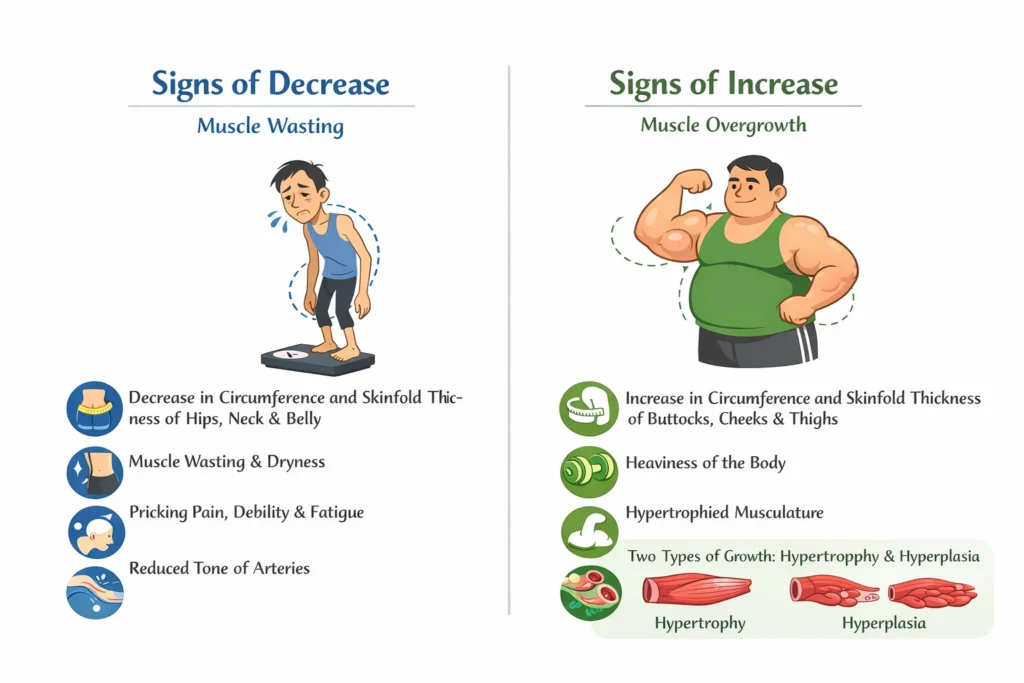
Reduction of muscular tissue is described as Mamsa Kshaya. The signs are usually gradual. The limbs become thinner, and there is a noticeable reduction in circumference and skinfold thickness of areas such as the hips, neck, and abdomen due to loss of muscle mass. The buttocks and cheeks may appear sunken, and wasting can also be observed in structures like the thighs, chest, axillae, calves, and even the genital region.
Patients may also complain of dry tissues, sharp or piercing pain, general weakness, and easy fatigue, in addition to the visible wasting. Physical endurance decreases, and even mild activity may feel exhausting. Classical texts also mention a reduced tone of blood vessels, particularly in the arterial walls. In many such cases, Vata Dosha plays an important role, especially when there has been long-standing undernutrition, chronic illness, or excessive tissue depletion.
The opposite condition is Mamsa Vriddhi, where muscular tissue becomes excessive or abnormal in growth. In such situations, there may be an increase in circumference and skinfold thickness of body parts like the buttocks, cheeks, lips, penis, thighs, arms, and calves. The body may feel heavy, and the musculature may appear unusually bulky or enlarged.
Sometimes localised enlargements of muscle areas are seen, and in certain cases, nodular or abnormal muscular masses may develop. Classical descriptions refer to this as extra-muscular growth or hypertrophied musculature. From a structural perspective, such an increase can broadly be understood in two ways:
Hypertrophy, where the size of muscle cells increases, and hyperplasia, where the number of muscle cells increases. These changes are often associated with Kapha predominance and slower metabolic activity and typically develop gradually rather than suddenly.
Management depends on whether there is depletion (Mamsa Kshaya) or excess (Mamsa Vriddhi) of muscular tissue. In practice, treatment focuses on correcting the underlying dosha disturbance and restoring proper dhatu metabolism.
In Mamsa Kshaya, therapy is directed toward dhatu poshana (tissue nourishment). Measures that support proper digestion (agni) and gradual tissue rebuilding are emphasised. Nourishing diets, adequate protein intake, strengthening formulations, and restorative therapies may be used. When Vata predominates, unctuous therapies such as snehana, a strengthening diet, and appropriate brimhana measures are generally considered.
In contrast, Mamsa Vriddhi requires a different approach. Here, the goal is to reduce excessive tissue accumulation and correct Kapha dominance. Lightening measures (langhana), metabolic stimulation, appropriate exercise, and dietary moderation are usually recommended. In certain conditions where abnormal muscular masses develop, surgical or para-surgical interventions described in classical texts may be considered.
The exact approach depends on the underlying dosha involvement, metabolic state, and the overall strength of the patient.
As we work hard to improve our services, your feedback is important to us. Please take a moment to help us serve you better.
Subscribe to our hospital newsletter for the latest health tips, updates on services, patient stories, and community events. Sign up today and stay informed!

Report Problem
Popular Searches: DiseasesTreatmentsDoctorsHospitalsWhole person careRefer a patientInsurance

