Medo Dhatu

Table of Contents

When we hear the word “fat”, most of us think first of weight gain, dieting, or something we need to get rid of. But we have to think about it from a different angle. Fat is something that we need in our bodies for many functions. This tissue is called Medo Dhatu. It is one of the seven dhatus or tissues, that we need for our survival. This tissue is not just a repository of fat; rather, it is a dynamic tissue that keeps our body cushioned, warm, and well-lubricated; helps us maintain our body temperature, etc. When it gets imbalanced, it leads to problems like Sthaulya (obesity) and Prameha (diabetes). In this blog, let’s explore what it is, how it is formed, how it functions, signs that it is healthy or disturbed, and simple, practical ways you can care for it at home.

What is Medo Dhatu?

The Sanskrit root ‘Mid’ (मिद्) means ‘unctuousness’ or ‘oiliness’. In Ayurveda, Medo Dhatu (मेद) is the fourth of the Sapta Dhatus (seven tissues). It is described as heavy, oily, and stabilising — qualities that protect organs, provide insulation, and keep joints and skin supple. In classical terms:

मेदः स्नेहस्वेदौ दृढत्वं अस्थिपुष्टिं च

This line reminds us that Medo Dhatu provides oleation (Snehana), contributes to sweating (Sweda), gives sturdiness (Dridhatva), and nourishes the bones (Asthi Pushti). Modern science supports this view: adipose tissue stores energy, insulates the body, cushions organs, and acts as an endocrine organ (it releases hormones such as leptin and adiponectin).

How is Medo Dhatu formed?

Ayurveda describes tissue formation as a stepwise transformation. Mamsa Dhatu (muscle tissue) is refined by its metabolic fire (Mamsadhatwagni) to form Medo Dhatu. If the digestive and tissue fires (Agni) are balanced, the resulting fat is nourishing and healthy. If Agni is weak or disordered, fat can become pathological, leading to excess or depleted fat and the diseases that follow.

In modern terms, the process mirrors how nutrients from food are metabolised, stored in adipocytes (fat cells) as triglycerides, and mobilised when the body needs energy. Healthy metabolism and a balanced digestive fire mean the fat stored is functional; dysfunction leads to excess visceral fat, metabolic syndrome, and insulin resistance.


Insurance Backed

Precision Ayurveda
Medical Care

The channels that carry fat — Medovaha Srotas

Each tissue has transport channels called Srotas. The channels for fat are the Medovaha Srotas. Classical texts name their roots differently (kidneys, omentum, pelvic area, or muscle), but the practical point is the same: these channels distribute nutrients to form and maintain fat tissue. Think of them as the microcirculation in and around fat stores — especially in the omentum and tissues around the kidneys. When these channels are blocked or vitiated, fat metabolism goes awry and modern problems like insulin resistance and visceral obesity can appear.

Why Medo Dhatu and Kapha are closely linked

There is a special relationship called Ashraya-Ashrayi bhava between Medo Dhatu and Kapha. They share similar qualities — heavy, oily, and moist. So when Kapha increases, Medo often follows, and the reverse is also true. This explains why Kapha-pacifying measures are helpful when reducing excess fat.

Important functions of Medo Dhatu

  • Snehana (Oleation): Keeps skin, hair, and eyes lubricated.
  • Sweda (Sudation): Relates to sweat and body temperature regulation.
  • Dridhatva (Sturdiness): Adds stability and structural support.
  • Asthi Pushti: Nourishes bone and connective tissues; fat-derived stem cells even help bone formation.
  • Protection: Acts as a mechanical cushion around organs and joints.
  • Endocrine role: Releases adipokines that affect appetite, inflammation, and insulin sensitivity.

Signs of healthy Medas — Medo Sara

Someone with balanced Medo Dhatu often has lustrous skin, a clear, strong voice, bright eyes, healthy teeth, and appropriate moisture in the body. Emotionally, such people tend to be generous, steady, and content. In practical terms, a healthy distribution of subcutaneous fat, good metabolic markers, and steady energy are the signs to look for.

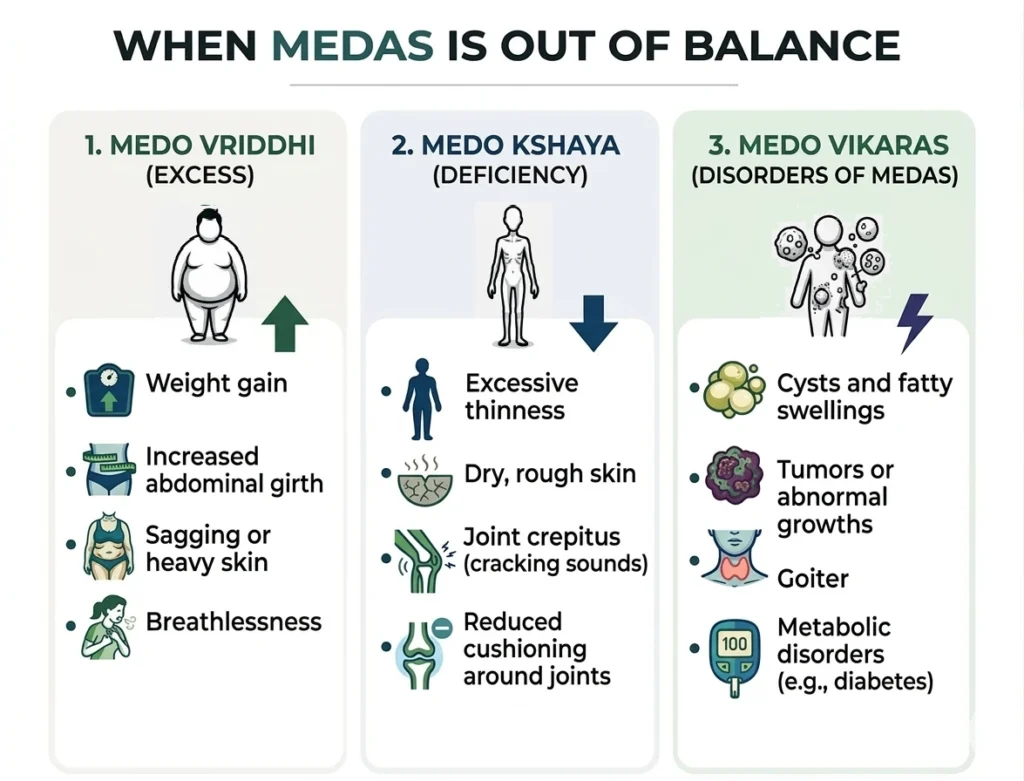
When Medas is out of balance

Medas can go out of balance in 3 ways – 
  1. Medo Vridhi (excess): Weight gain, increased abdominal girth, sagging skin, foul body odour, breathlessness on exertion — commonly connected with conditions like Sthaulya (obesity) and Prameha (diabetes).
  2. Medo Kshaya (deficiency): Thinness, dry skin, joint crepitus (cracking sounds), and poor cushioning — sometimes seen after severe illness or prolonged stress.
  3. Medo Vikaras: Vitiation of Medas can lead to cysts, tumours, goitre, and particularly metabolic disorders such as diabetes (Madhumeha).

The Upadhatu Concept: Secondary Tissues

The tissues generate secondary tissues known as Upadhatus in Ayurveda. The primary Upadhatu for Medo Dhatu is Snayu (ligaments). The tissues play a critical role in holding muscles and bones together. The tissues give the body a strong framework. While sweat, or Sweda, is the waste product known as Mala, some Ayurveda schools view sweat as a secondary tissue due to its protective effects for the skin.

Diagnosing Medas Vitiation

The symptoms for diagnosing fat-related disorders in Ayurveda include increased sweating, numbness in the hands and feet, and increased sweetness in the mouth. The last symptom is a precursor to diabetes. Modern diagnostics use Body Mass Index (BMI) as a criterion. A high BMI indicates obesity or Medo Vridhi. A low BMI indicates Medo Kshaya or emaciation.

Simple home checks you can do

  • Sweat test: Is your sweat unusually foul-smelling or very abundant? That may suggest an imbalance.
  • Sound test: Do your joints crack or feel hollow? This could be a sign of fat depletion.
  • Skin check: Is your skin naturally smooth and slightly oily, or is it too dry or sticky? – Dry skin could be a sign of reduced fat in the body. 
  • Sag test: Look for pendulous or sagging skin in the abdominal region, breasts, or buttocks. Excess Medas is indicated by sagging skin. 

Practical ways to care for Medo Dhatu

Diet and lifestyle are the key areas that need attention. Simple practices are effective. 

Diet 

  • Prefer tastes that help in reducing excess fat: Tikta (bitter), Katu (pungent), and Kashaya (astringent) tastes. Barley is healthy. 
  • Avoid: Excessive intake of sweets, fried foods, and high-fat and high-dairy products.
  • Regulate your meals: Regularity in meals and avoidance of overeating will help in maintaining Agni.

Lifestyle 

  • Regular exercises: Vyayama is a must. Exercises will help in burning extra fat and stimulating Agni.
  • Avoid: Diva Swapna (daytime sleep). It may affect your metabolism and aggravate Kapha.
  • Sleep: Regulate your sleep; it is necessary for hormone balancing.
  • Manage stress: Excessive stress may affect your appetite and fat reserve; meditation and pranayama are a must for stress management.

Therapies

  • Langhana (short therapeutic fasting) can mobilise stored fat when supervised.
  • External therapies: Udwartana (herbal powder massage) and certain Panchakarma procedures (such as Virechana or therapeutic purgation) are classical approaches for breaking down excess Medo.

Mind and Emotions Matter

The emotional state plays a part in Medas. Grief can lead to Medo Kshaya. Low spirits or stress can lead to overeating and obesity. Activities that help the mind and emotions, such as community, purpose, meditation, and breathing exercises, can help overcome these issues.

When to Seek Help

If you notice sudden changes in your weight, tiredness, breathlessness during physical activities, thirst and urination, and abnormalities in metabolic tests such as high blood sugar and lipid abnormalities, please consult a qualified practitioner. The combination of Ayurveda principles and modern tests such as BMI, waist measurement, blood sugar tests, and lipid tests can provide a clearer picture.

Closing Thought

Medo Dhatu is not the enemy. It is a vital tissue that gives life, warmth, and shape. You need not want to get rid of fat. You need to maintain a healthy and functioning Medo Dhatu. With healthy food, physical activities, routines, and managing stress, you can help your Medo Dhatu do its job for you.

FAQs

What is the primary function of Medo Dhatu?
It provides lubrication (Snehana), produces sweat (Sweda), gives the body stability (Dridhatva), and nourishes bone tissue.
What is the modern equivalent of Medo Dhatu?
It is primarily correlated with adipose (fat) tissue and circulating lipids like cholesterol and triglycerides.
What is the "waste product" of fat tissue in Ayurveda? Sweat (Sweda)
is considered the Mala (waste product) of Medo Dhatu.
Why is obesity linked to diabetes in Ayurveda?
Both involve a vitiation of Medo Dhatu and its channels (Medovaha Srotas), which block the pathways for other tissues.
What causes a deficiency in fat tissue?
Poor nutrition, chronic illness such as IBS, excessive exercise, or even emotional trauma can cause a deficiency in fat tissue.
What is an Upadhatu of Medas?
The secondary tissue of Medo Dhatu is Snayu (ligaments and tendons).
Is daytime sleeping bad for fat metabolism?
Yes, Diva swapna (day sleep) is identified as a major cause for the vitiation of fat channels, leading to potential disruptions in fat metabolism and overall energy balance.
Where is Medas primarily stored in the body?
It is primarily found in the abdomen (Udara), hips (Sphika), and small bones.
What is Medo dhatu?
Medo Dhatu is the fourth fundamental tissue in Ayurveda that correlates with adipose tissue and lipids. It is predominantly composed of the Earth and Water elements, possessing heavy and oily qualities.
How to increase medo dhatu?
To increase this tissue, one should prioritise the consumption of heavy, oily, and sweet foods. Proper rest and regular oil massages, known as Abhyanga, are also essential practices.
Did the information meet your needs?

As we work hard to improve our services, your feedback is important to us. Please take a moment to help us serve you better.

Stay Connected to Health and Wellness

Subscribe to our hospital newsletter for the latest health tips, updates on services, patient stories, and community events. Sign up today and stay informed!

Homepage B RCB

Please fill out the form below to Request a call back

Patient details

Select Preferred Center

Content Details

We update our articles as new material becomes available, and our specialists keep a close eye on the health and wellness industry.

Written by
Dr Shobitha Madhur
Share this article on
Last updated on:
Do you have concerns with the content?

Report Problem

Table of Contents

Last updated on:

Report Problem

Do you have concerns with the content?

We’d Love to Hear from You!

Feedback form(disease page)

Can we help?

Something wrong with our medical content?
 
Report Problem form

Popular Searches: DiseasesTreatmentsDoctorsHospitalsWhole person careRefer a patientInsurance

Hours of Operation:
8am – 8pm (Mon-Sat)
8am – 5pm (Sun)

Follow Apollo AyurVAID hospitals