- AyurVAID Pharmacy
Ojas is considered the finest, purest essence of the body, formed after the proper development of all seven dhatus, from rasa to shukra. It reflects the body’s capacity to resist disease and its overall vitality. Ojas is closely linked to vyadhikshamatva, the body’s natural resistance to disease. This is why it is often associated with immunity. But its influence goes beyond just fighting illness. It also supports stability and stamina. It helps the body adapt to physical and mental challenges.
Ojas is not something visible. Instead, we recognise it by how the body behaves. People with good ojas recover faster from illness. They maintain steady energy, tolerate stress better, and appear physically and mentally strong. A reduction in ojas may be noticed as fatigue, low endurance, frequent illness, or slow recovery. Sometimes, this condition shows up even before any clear disease develops.
The word “ojas” is derived from the root “ubja”, which means strength, vigour, or vitality. Classical texts connect it closely with bala, the functional strength of the body. ओजस्तु तेजो धातूनाम् means Ojas is the essence of all dhatus. This phrase is straightforward in meaning. It is not a separate tissue. This is what remains when tissue formation has reached its most refined stage. It is described in classical texts as being situated in the heart and having a colour range from white to yellowish or reddish, similar to ghee. It is said to taste like honey and have a fragrance like roasted grains, reflecting its subtle and refined nature. In this way, ojas is more than just strength—it is the underlying vitality that sustains life itself. If Ojas is lost or depleted, the life force of the person is seriously compromised.
Ojas is described as arising from the prasada bhaga of all dhatus. This means it is not formed at one level alone. It reflects the cumulative outcome of the entire sequence—from rasa to shukra.
In physiological terms, its formation depends on:
When these are working in continuity, the body maintains tissue integrity. When they are not, ojas is the first to show instability, even before structural loss becomes obvious.
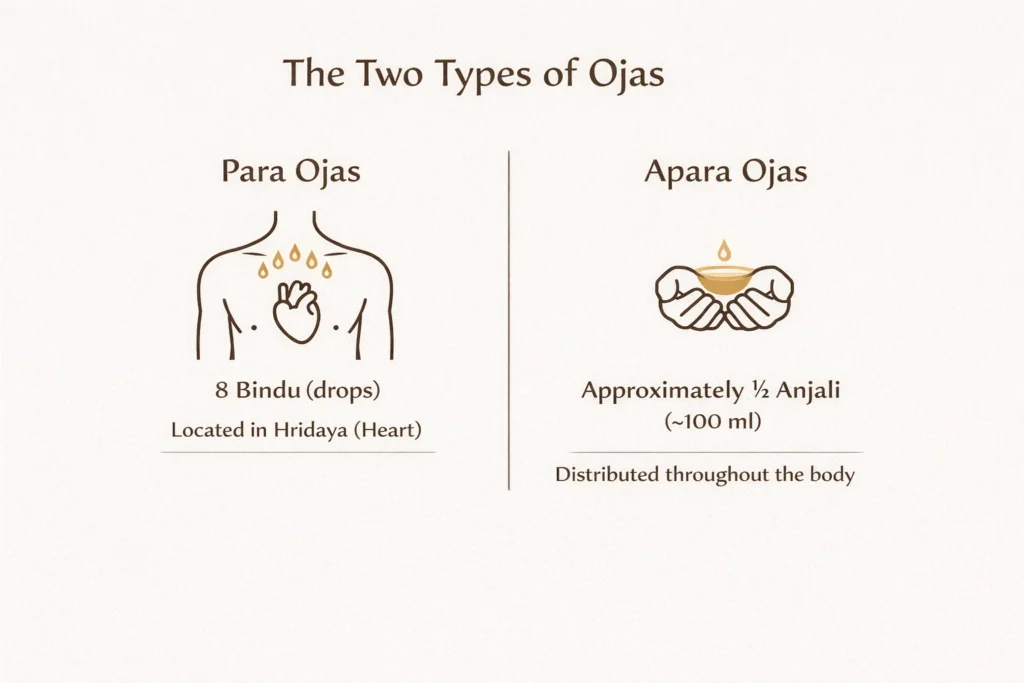
There are two types of ojas mentioned:

Ojas has a close functional relationship with kapha dosha. Both share qualities:
Because of this, depletion of kapha often parallels depletion of ojas.
At the same time, vata plays a significant role in its disturbance. Excess vata leads to:
Such instability gradually affects ojas. This observation appears repeatedly in long-standing vata disorders.
Pitta influences the metabolic processes behind formation. When excessive, it may lead to qualitative changes—burning, irritability, inflammatory patterns—which indirectly disturb ojas.
Classical texts describe stages such as:
In early disturbance, patients may complain of:
Later, more systemic features appear. These descriptions are not always seen in textbook form. They appear mixed, especially in chronic disease.
Management of ojas is not about directly “increasing” it. It depends on restoring the conditions that allow it to form. The first step is always agni. If digestion is not stable, attempts at nourishment do not translate into tissue strength. This is something seen repeatedly. Patients may consume a good diet, tonics, and supplements, but without improvement. Once agni is corrected, the same inputs start to show an effect. Diet is usually:
Excessively dry, irregular, or restrictive diets tend to worsen depletion. Lifestyle correction is equally important:
In certain cases, rasayana approach is used, but only after digestion and metabolism are reasonably stable. Panchakarma is considered selectively. Excessive cleansing in a depleted individual worsens the condition. Stabilisation comes first.
As we work hard to improve our services, your feedback is important to us. Please take a moment to help us serve you better.
Subscribe to our hospital newsletter for the latest health tips, updates on services, patient stories, and community events. Sign up today and stay informed!

Report Problem
Popular Searches: DiseasesTreatmentsDoctorsHospitalsWhole person careRefer a patientInsurance

