- AyurVAID Pharmacy
The term Rasa (रस) derives from the Sanskrit root ras, meaning “to flow,” “to taste,” or “to circulate as a fluid.” In a physiological context, it refers to the primary nutritive fluid that circulates after digestion.
Ayurveda explains: “rasayati iti rasaḥ” — that which moves or circulates. In clinical interpretation, Rasa represents the first nutritive tissue formed after food has been properly digested.
Rasa is not simply liquid content in the body. It is the metabolically processed nutritive medium that sustains all other tissues. It precedes Rakta in the sequence of Dhatu formation and serves as the immediate source from which deeper tissues are nourished. When we evaluate Rasa clinically, we are assessing the quality of nourishment at its earliest structured stage.
Food undergoes digestion under the action of Jatharagni. This produces two fractions:
The Sara portion becomes Ahara Rasa, a transitional nutritive substrate. At this point, it is not yet stable tissue. It is the nourishing part that circulates through the body and can be readily used by tissues. Ahara Rasa enters systemic circulation through channels associated with the heart. Classical descriptions identify the heart as the central root of Rasa distribution. From there, it travels through Rasa-vaha Srotas.
At the tissue level, Rasa Dhatuvgni refines this substrate. Through its action:
This is a continuous process. Rasa is constantly being formed, utilised, and replenished.
Three regulatory influences govern this transformation:
If Agni is weak, Rasa forms in an unrefined state — either too dilute or too heavy. If Vata is irregular, distribution becomes inconsistent. If Kapha accumulates excessively, stagnation develops. Rasa formation, therefore, reflects digestive integrity, metabolic precision, and circulatory efficiency.
Rasa circulates through specialised channels known as Rasa-vaha Srotas. Classical texts describe their roots in the heart and major vessels. Clinically, these channels represent the dynamic transport system responsible for distributing nourishment. They are functional pathways rather than gross anatomical structures.
When the Rasa-vaha Srotas are clear:
When obstructed or weakened:
Channel integrity is as important as tissue formation.

Rasa performs several functions.
Rasa also forms the Upadhatus:
Stable Rasa produces predictable menstrual cycles and adequate lactation.
In a patient with balanced Rasa, one observes steady energy, appropriate hydration, mild lustre of skin, and emotional steadiness. There is no dramatic vibrancy — simply functional stability.
Disturbance begins early and often subtly.
In the early stages, disturbances are functional. If imbalance persists:
In Kapha-dominant patterns, chronic stagnation may contribute to metabolic disorders over time. Rasa disturbance is therefore often the first observable Dhatu imbalance.
Rasa Kshaya (Depletion) vs Rasa Vriddhi (Excess)
When Rasa Dhatu becomes reduced, the body begins to show signs of insufficient nourishment and fluid support. A patient may feel restless and uneasy. There can also be intolerance to loud sounds. Palpitations are sometimes noticed, and even small amounts of physical activity may lead to fatigue or discomfort in the heart region. These signs suggest that the body’s circulating nutritive fluid is not adequate to support normal activity.
When Rasa Dhatu increases beyond its normal level, the symptoms tend to resemble those seen with Kapha dominance. Digestion may become weak, and excessive salivation can occur. Many patients report a feeling of heaviness in the body along with sluggishness or lack of motivation. The skin may appear pale or whitish, and there may be a sensation of coldness.
Other features may include looseness in the body tissues, breathlessness, and cough. Excessive sleep may also be noticed in such individuals. The overall picture usually reflects a sense of heaviness in the body, with fluid qualities becoming more dominant than usual.
A reduction in Rasa often develops gradually. It is frequently seen in people with long-standing digestive weakness, after prolonged illness, or in those who have been under continuous physical or mental strain. In contrast, an increase in Rasa tends to occur when Kapha becomes dominant and metabolic activity slows. Digestion becomes less efficient, and the body begins to retain more fluid and heaviness than it can comfortably manage. Mixed presentations are common.
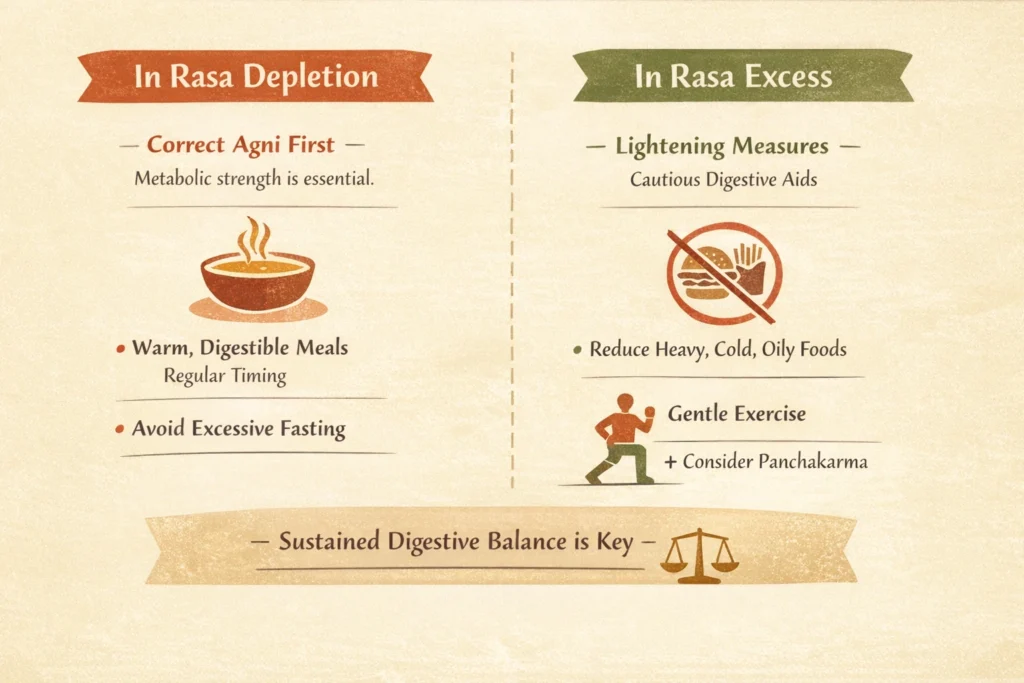
In Rasa Depletion
First correct Agni. Without metabolic strength, nourishment cannot be retained.
The diet emphasises warm, digestible, mildly unctuous preparations. Regular meal timing is important. Excessive fasting is avoided.
Restoration occurs gradually. Overfeeding weakens digestion further.
In Rasa Excess
Lightening measures are introduced. Digestive stimulants may be employed cautiously.
Heavy, cold, and excessively oily foods are reduced. Gentle exercise supports circulation.
Panchakarma is considered when Dosha involvement is clear and patient’s strength permits.
Long-term stability requires sustained digestive balance rather than short-term intervention.
Rasa imbalance frequently precedes chronic disorders.
Early dehydration patterns, unexplained fatigue, subtle menstrual irregularities, and metabolic congestion may begin at this level.
Intervening at the Rasa stage is simpler than addressing pathology in deeper Dhatus such as Meda or Asthi.
Recognition requires attentive clinical evaluation rather than reliance on advanced disease markers.
As we work hard to improve our services, your feedback is important to us. Please take a moment to help us serve you better.
Subscribe to our hospital newsletter for the latest health tips, updates on services, patient stories, and community events. Sign up today and stay informed!

Report Problem
Popular Searches: DiseasesTreatmentsDoctorsHospitalsWhole person careRefer a patientInsurance

