- AyurVAID Pharmacy
Shukra dhatu is the seventh and final dhatu (tissue) among the sapta dhatu—rasa, rakta, mamsa, meda, asthi, majja, and shukra. This sequence reflects a process called ‘dhatu parinama’, or progressive tissue transformation. Each dhatu is formed from the previous one through its own dhatvagni. By the time nourishment reaches the level of shukra, it has undergone repeated refinement. Because of this, shukra is considered the most subtle and evolved tissue. In clinical settings, this becomes quite relevant. Disturbance in Shukra rarely develops independently. It usually indicates long-standing issues in agni, earlier dhatus, or chronic stress.
The word “shukra” is derived from the root “shuch”, meaning clear, bright, or pure. It is used in different contexts with slightly different meanings:
In the classical texts, Shukra is described with reference to garbha utpatti, its role in conception.
“शुक्रं नाम धातु गर्भोत्पत्तिकरम्”
At first reading, this is taken as semen. That is only a part of it. In practice, the picture is not always straightforward. There are patients with semen values within normal limits who still do not conceive. There are others with less-than-ideal reports where conception does occur. This difference cannot be explained by semen alone. The term ‘shukra’ therefore includes the functional state of the reproductive system—its formation, its regulation, and its ability to sustain fertility.
Shukra is described as ‘sarvavyapi’, meaning it is present throughout the body. The classic examples—oil in sesame seeds, ghee in curd, juice in sugarcane—are used to show that it is not limited to one part. This does not mean semen is present everywhere. What is being referred to is the capacity for reproduction.
It is also described as soumya pradhana (predominantly cooling and nourishing in nature) and ‘kapha ashraya’ (supported by kapha). Because of this, it tends to be stable, unctuous, and not easily depleted in a healthy state.
In practice, this becomes clearer. A person may have no obvious problem in the reproductive organs but still show reduced fertility. The cause is often long-standing illness, poor nutrition, or general weakness. So the disturbance is not only at the local level. It reflects the overall condition of the body.
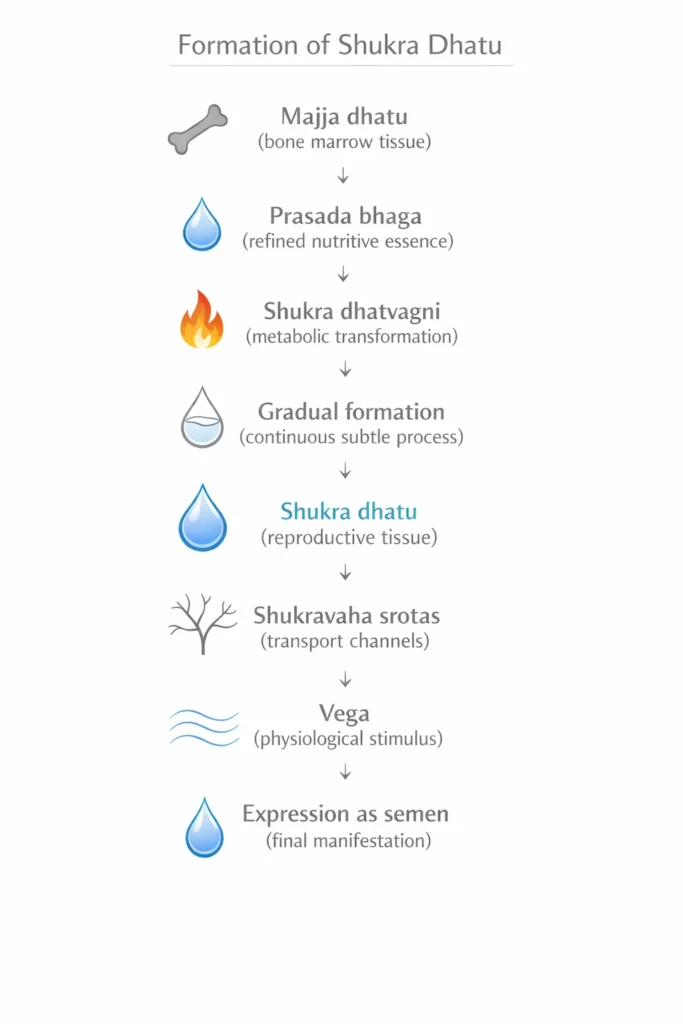
Shukra is formed from the prasada bhaga of majja dhatu through the action of shukra dhatvagni. The process is gradual. Ayurveda describes it as fluid slowly oozing out of a new clay pot. This reflects a subtle and continuous formation process.
The formation of shukra dhatu follows the sequential transformation from majja dhatu. This process depends on the action of shukra dhatvagni on the prasada bhaga (refined portion) of majja. That analogy becomes clearer when observing long-term depletion states. Patients with chronic nutritional deficiency or neurological exhaustion often show early compromise in reproductive capacity.
Another explanation states:
At the time of sexual excitation (vega), this circulating shukra is expressed as semen— similar to ghee melting under heat. The shukravaha srotas (channels of reproductive tissue) are described as having their moola (root) in the vrishana (testes) and medhra (penis). These are the main structures involved in the formation and release of shukra. Ojas (vital essence) is often closely linked with shukra. Some texts describe it as a byproduct, while others see it as the final essence of all dhatus. In clinical practice, both tend to behave together. Signs of reduced shukra and reduced ojas often appear simultaneously in patients with long-term weakness, fatigue, or chronic illness.

Classical texts describe the features of healthy reproductive tissue as shukla (whitish), snigdha (unctuous), picchila (viscous), madhura (sweet), bahu (adequate quantity), drava (fluid), and avisra (absence of foul smell).
These are not merely descriptive. They correspond quite closely with semen parameters. For example, madhura bhava (sweetness) is linked to fructose content in seminal fluid. Picchila reflects viscosity. Drava indicates proper liquefaction. In clinical settings, altered viscosity or foul smell is often reported by patients before a formal investigation is done.
Individuals with excellence of shukra (shukra sara purusha) show:
Classical descriptions also mention:
These features reflect overall tissue quality rather than isolated reproductive strength.
Shukra kshaya is commonly encountered. Causes include:
Clinical features develop gradually:
Some patients may also have:
Often, the earliest sign is reduced stamina.
Less frequently observed.
Features may include:
Vitiation of shukra (shukra dushti) alters its qualities. It may become:
Dosha-wise patterns:
Shukra dhatu imbalance is involved in conditions such as:
Disturbance of shukravaha srotas may lead to:
As we work hard to improve our services, your feedback is important to us. Please take a moment to help us serve you better.
Subscribe to our hospital newsletter for the latest health tips, updates on services, patient stories, and community events. Sign up today and stay informed!

Report Problem
Popular Searches: DiseasesTreatmentsDoctorsHospitalsWhole person careRefer a patientInsurance

