- AyurVAID Pharmacy
When a patient comes to the clinic, observation often begins before the physician formally assesses the patient. Some patients walk in slowly and sit with visible exhaustion. Some speak rapidly without pause. Some repeatedly clear their throat while talking. Others complain of only one problem, but their bodies show many more small changes quietly in the background.
Ayurveda pays attention to these details.
A person may come saying only, “I have acidity”. But during examination, the eyes appear slightly red, the palms feel warm, sleep is disturbed after midnight, appetite is unusually sharp, and there is irritability even during conversation. Another person may complain only of bodily pain, yet there is skin dryness,constipation, joint cracking, an irregular appetite ,and visible restlessness. These observations are studied together through Ashtasthana Pareeksha.
The word ‘Ashta’ means ‘eight’, ‘Sthana’ means ‘areas of examination’, and ‘Pareeksha’ means ‘careful observation’. The physician examines eight things:
The detailed description of Ashtasthana Pareeksha is found in Yogaratnakara, where these eight methods are used to understand changes occurring in the body during health and disease. The concept helps us understand both the disease and the patient before we plan treatment. The physician studies how these findings appear together to help understand Dosha Dushti (imbalance or vitiation of the Doshas) and the overall state of the body. In long-standing digestive disturbance, for instance, the tongue coating, bowel habit, smell of stool, heaviness of body, and lack of clarity in the eyes often change together. In chronic Vata imbalance, patients frequently report disturbed sleep and dryness months before any severe disorder appears.
Over time, experienced physicians begin noticing that the body gives warnings quietly. Ashtasthana Pareeksha is essentially the art of noticing those changes before disease becomes deeply established.
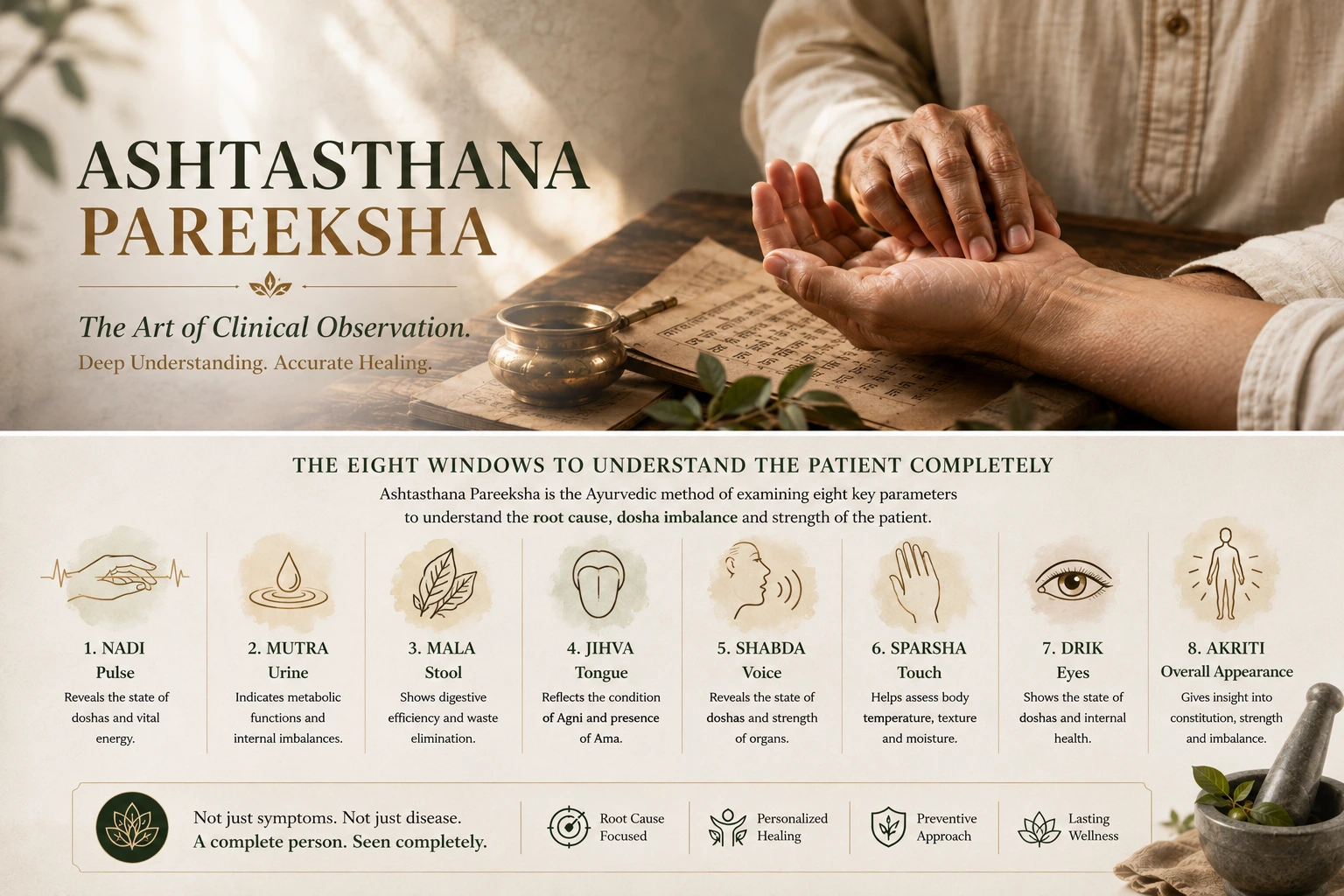
‘Nadi’ refers to pulse or arterial movement. In Ayurveda, pulse examination is not limited to counting beats per minute. The physician studies rhythm, stability, depth, tension, warmth, force, and movement pattern. The pulse is generally examined at the radial artery near the wrist. Three fingers are placed gently over the pulse.
Classical descriptions compare pulse movement to different animals. A Vata pulse may feel irregular and mobile, like a serpent. Pitta pulse tends to feel active and forceful, like a sparrow, crow, or frog. Kapha pulse is slower, deeper, and steadier and is associated with the swan.
These comparisons are descriptive aids meant to help the physician recognise patterns through repeated experience. Pulse changes significantly with fear, exhaustion, fever, pain, dehydration, emotional disturbance, and chronic disease. A depleted patient often shows a thin, unstable pulse before physical weakness becomes apparent.
In some patients with severe Vata aggravation, the pulse becomes difficult to sustain under pressure and appears inconsistent from one examination to another.
Pulse examination is ideally performed early in the morning before meals because digestion alters circulatory activity.

‘Mutra’ means urine. Ayurveda examines urine as an indicator of hydration, metabolism, heat, elimination, and internal physiological balance. The physician observes:
When the urine becomes dark yellow and patients complain of burning while passing urine, increased Pitta is often suspected. In some people with dominant Vata, the urine may become scanty, especially when there is dryness in the body, constipation, poor hydration, or irregular eating habits. People more commonly notice heaviness, cloudiness, or thick-appearing urine when Kapha disturbance and sluggish metabolism are present.
Ayurveda also describes Taila Bindu Pareeksha, in which a drop of oil is placed over urine, and the spreading pattern is observed. Traditionally, the result was interpreted to understand disease severity and prognosis. Whether or not this method is practised routinely today, it reflects an important clinical principle. Body fluids were being observed for alterations in physical properties.
Patients frequently notice urinary changes before seeking treatment. Increased frequency, burning, heaviness, altered colour, or strong odour often provide early clues regarding internal imbalance.
‘Mala’ refers to faecal waste. Ayurveda places considerable importance on bowel function because nourishment of tissues depends upon proper digestion and elimination. The physician examines:
In aggravated Vata, the stool is often dry, hard, and passed with difficulty. Many patients describe prolonged sitting, straining, or a sense that the bowel has still not cleared properly afterwards. With increased Pitta, motions usually become loose and frequent, and there may be burning, heat, or sudden urgency during evacuation.
Many chronic disorders reveal altered bowel patterns long before diagnosis becomes clear.
Patients suffering from anxiety, insomnia, joint pain, headaches, and fatigue often also report incomplete evacuation or constipation when questioned carefully. This relationship appears repeatedly in chronic Vata disorders.
Ayurveda also describes Ama, referring to incompletely processed metabolic residue. In practice, Ama frequently manifests through bloating, lethargy, a coated tongue, foul-smelling stool, heaviness after meals, and mental dullness.
‘Jihva’ means ‘tongue’. Tongue examination provides important insight into digestive and systemic function. The physician observes:
A dry, cracked tongue is commonly seen in chronic Vata aggravation, particularly in elderly patients with dehydration, insomnia, anxiety, and constipation. A tongue that appears red, hot, or inflamed is often seen when Pitta is increased in the body. A thick white coating over the tongue is more commonly associated with sluggish digestion and Kapha dominance. In some patients, the tongue loses its healthy colour and appears pale or dull, which may reflect poor nutrition or inadequate tissue support.
Changes in the tongue are frequently linked with digestion. Patients who regularly notice coating over the tongue often also complain of heaviness after meals, low appetite, bloating, or disturbed bowel habits.
Shabda refers to voice, speech, and bodily sounds. The physician listens not only to words but also to the quality of expression.
Speech affected by aggravated Vata may become weak, tremulous, rapid, or inconsistent. Increased Pitta often produces sharp, intense, forceful speech. Excessive Kapha tends to create slow, heavy, monotonous expression.
The physician also notices whether speech is clear or unclear, whether the voice becomes tired after talking for some time, whether there is a nasal quality to speech, or whether the patient pauses repeatedly while speaking. Patients with respiratory weakness often pause repeatedly while speaking. In certain neurological conditions, speech changes appear before obvious structural findings become apparent.
This aspect of examination remains clinically valuable even today.
‘Sparsha’ means ‘touch’. Through Sparsha Pareeksha (examination by touch), the physician observes changes in temperature, moisture, tenderness, swelling, skin texture, and the general feel of the tissues. Sometimes, even before investigations are done, the body gives clues through touch.
People commonly notice skin that feels cold, dry, and rough in aggravated Vata states. Increased warmth, sensitivity, or inflammatory tenderness usually points more toward Pitta involvement. In Kapha-dominant conditions, the skin may feel cool, soft, moist, and slightly heavy to the touch.
Sometimes the hand identifies pathology before investigation confirms it. A tense abdomen, dryness of tissues, abnormal warmth, or loss of muscle tone often becomes immediately perceptible during examination. Touch remains one of the most direct forms of clinical assessment.
‘Drik’ refers to the eyes and visual appearance. Ayurveda considers the eyes an important reflection of vitality, circulation, mental state, and tissue nourishment.
Dry sunken eyes commonly appear in aggravated Vata. Red, congested eyes frequently indicate excessive Pitta. Puffy, watery eyes are often associated with increased Kapha. The physician also studies:
Loss of brightness in the eyes is often observed in chronically exhausted individuals before significant weakness becomes obvious elsewhere. Yellow discolouration may indicate deeper metabolic or hepatic disturbance. The eyes frequently reveal more than the patient initially describes.
‘Akriti’ refers to body structure, posture, build, movement, and overall physical appearance. This includes observation of:
A lean, dry frame with prominent joints commonly reflects Vata predominance. Moderate muscular build with warmth and sharp features frequently indicates Pitta. A heavier, stable structure with smooth skin and slower movement usually corresponds to Kapha.
The physician also observes gait.
Slowness of movement, instability, and a guarded posture due to pain, tremors, stiffness, or imbalance often reveal underlying pathology even before a detailed examination begins. In some patients, the manner of sitting, standing, or walking provides immediate clues regarding exhaustion, neurological weakness, or chronic pain.
The purpose of Ashtasthana Pareeksha is ultimately to understand the disturbance of Dosha.
Diagnosis is never based upon one isolated sign. The physician studies recurring patterns across pulse, digestion, elimination, speech, skin, eyes, and body structure.
Dry skin alone does not establish Vata aggravation. But when dryness appears together with constipation, disturbed sleep, cracking joints, anxiety, irregular appetite, and unstable pulse, the pattern becomes clinically meaningful. Ayurveda diagnosis depends upon this pattern recognition.
One of the important strengths of Ashtasthana Pareeksha is that it trains the physician to observe before intervention.
Modern laboratory investigation is valuable and often necessary, but bedside observation remains equally important. Even today, experienced clinicians often gather substantial information before formal examination begins simply by observing posture, speech, facial expression, breathing pattern, gait, and overall vitality.
Ayurveda formalised this observational method systematically.
Early changes in digestion, sleep, elimination, tissue quality, circulation, and mental stability often precede established disease by many years. Recognition of these changes allows earlier correction.
For this reason, Ashtasthana Pareeksha continues to remain relevant not merely as a classical concept but as a practical clinical method for understanding physiological imbalance in the living patient.
As we work hard to improve our services, your feedback is important to us. Please take a moment to help us serve you better.
Subscribe to our hospital newsletter for the latest health tips, updates on services, patient stories, and community events. Sign up today and stay informed!

Report Problem
Popular Searches: DiseasesTreatmentsDoctorsHospitalsWhole person careRefer a patientInsurance

