- AyurVAID Pharmacy
Dashavidha Atura Pariksha (tenfold examination of the patient) is one of the classical methods of patient assessment described in Ayurveda. The term is formed from ‘Dasha’ (ten), ‘Vidha’ (types or methods), ‘Atura’ (patient) and Pariksha (examination or assessment). It refers to a systematic study of the person seeking treatment before deciding the line of management.
In clinical practice, identifying the disease alone rarely provides complete information. Two individuals can present with similar complaints while requiring different approaches. During consultation, the physician is not examining symptoms in isolation. Attention is directed toward the person in whom those symptoms have developed. A patient may present with recurrent indigestion and describe a persistent feeling of fullness after meals. Another patient sitting in the same consultation room may also use the term ‘indigestion‘ but mainly complain of excessive hunger, a burning sensation, and irritability when meals are delayed. The symptom label sounds similar. The background is different.
Ayurveda approaches this difference through patient examination.
The Dashavidha Atura Pariksha includes Prakriti (constitutional nature), Vikriti (current pathological state), Sara (tissue excellence), Samhanana (structural compactness), Pramana (body measurements and proportion), Satmya (adaptability and compatibility), Satva (mental strength), Aharashakti (digestive capacity), Vyayama Shakti (exercise capacity) and Vaya (age).
In actual practice, these factors do not function as ten independent boxes to be filled. One observation often helps explain another.
Ayurveda examination rests on the understanding that physiological function depends on the state of
Dosha, Dhatu (body tissues), Agni (digestive and metabolic activity), Mala (waste products) andSrotas (channels of transport and circulation).
The tenfold examination helps in understanding these components indirectly.Prakriti provides the constitutional background of the patient. It reflects the relative predominance ofVata, Pitta andKapha. Vikriti describes the present deviation from that baseline.
This distinction often becomes relevant during consultation. Some individuals report poor appetite as part of their normal nature, although a closer history reveals that their appetite had been satisfactory until several years earlier.
Disturbed sleep,constipation, bloating, and fatigue are also sometimes accepted as normal because they have existed for a long time.
The physician attempts to separate constitutional tendencies from acquired disturbances.
Assessment of Sara and Samhanana provides information regarding tissue status and physical strength.
Aharashakti and Vyayama Shakti help estimate functional capacity.
Satva and Satmya indicate psychological resilience and adaptability.
These observations gradually form a pattern.

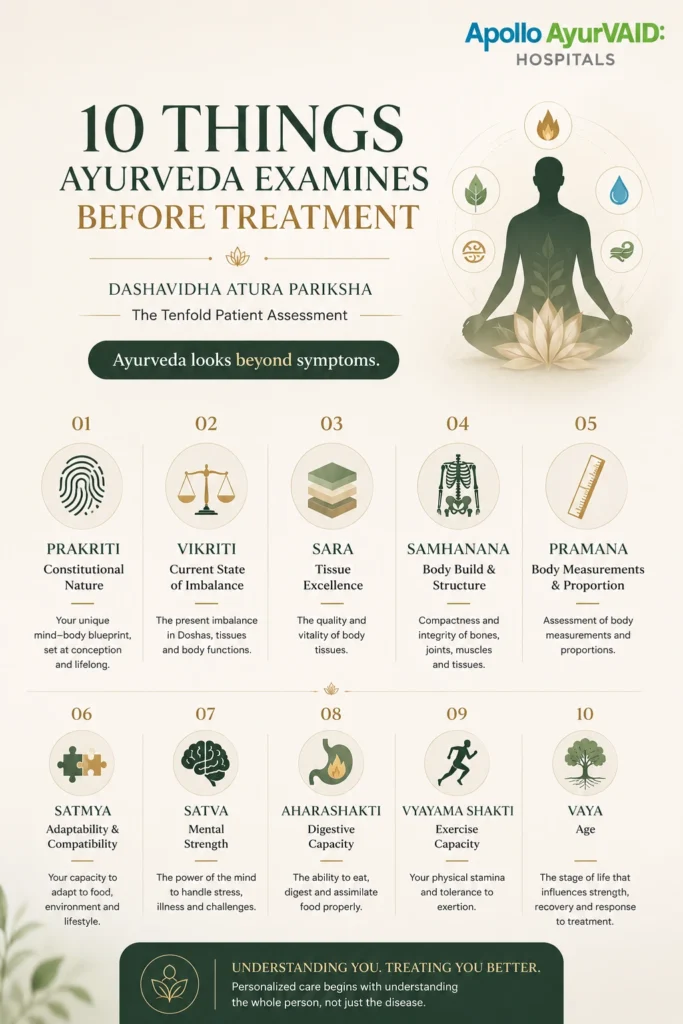
Ayurveda describes Prakriti as a person’s natural constitution, determined by the relative predominance of the Doshas. It is established at conception and generally remains unchanged throughout life. As a result, a person may have a Vataja (Vata-predominant constitution), Pittaja (Pitta-predominant constitution), Kaphaja (Kapha-predominant constitution), or balanced Tridoshaja Prakriti (balanced three-Dosha constitution).
These differences are often noticed in very ordinary ways. One person feels hungry at the same time every day and gets irritated if meals are delayed. Another can skip meals and barely notice it. Some people seem to keep going even after a long day, while others feel drained and need more time to feel normal again. People with Kapha predominance generally tend to have better physical strength and stamina, Pitta individuals often show moderate strength, while Vata individuals may get tired more easily.
The usefulness of Prakriti becomes clearer during treatment. What is Pathya (beneficial recommendations) for one person may not always suit another, and Apathya (things that are better avoided) also differs from person to person.
While Prakriti reflects what is natural for the individual, Vikriti describes what has shifted from that state. It represents the present imbalance.
Assessment does not stop with symptoms alone. Dosha involvement, Dushya (affected tissues), causative factors, disease location, time, and symptom severity are considered together. Two patients can describe similar complaints but have very different patterns underneath. This also helps assess Sadhyata — whether a condition appears Sukha Sadhya (easily manageable), Krichchha Sadhya (difficult to treat), or Asadhya (poor prognosis or difficult to cure).
Sara Pariksha assesses tissue quality and overall vitality. Ayurveda describes eight types of Sara: Twak (skin), Rakta (blood), Mamsa (muscle tissue), Medas (fat tissue), Asthi (bone tissue), Majja (marrow), Shukra (reproductive tissue), and Satva (mental strength).
In practice, this assessment is not judged from appearance alone. One person may maintain strength fairly well during illness, while another begins feeling exhausted much earlier. Such observations often provide clues about tissue quality and resilience. Based on overall findings, Sara is understood as Pravara (excellent), Madhyama (moderate), or Avara (low).
‘Samhanana’ refers to the overall compactness and development of the body. Bones, joints, muscles, and tissues are looked at together rather than individually.
Sometimes this becomes apparent simply from the way a person is built. Individuals with better compactness often tolerate physical strain more comfortably and generally show better endurance.
Pramana Pariksha assesses body proportions such as height, length, and overall body dimensions. Traditionally, Angula (finger-width measurement) was used as a reference.
The purpose is not only measurement. Body proportions can sometimes provide useful clinical clues. Ayurveda also discusses certain pronounced body variations under Ashta Nindita Purusha, which refers to eight undesirable body types, that may be relevant for understanding prognosis and health status.
Satmya refers to what the body has become accustomed to over time and what it tolerates comfortably.
This often becomes obvious during routine practice. Some individuals adjust to changes in food or routine without much difficulty. Others develop digestive complaints after even small changes. Those accustomed to a varied diet including all six Rasas (tastes) often show better adaptability.
‘Satva’ refers to mental strength and the way a person handles stress, illness, discomfort, and difficult situations. Ayurveda broadly describes it as Pravara (strong), Madhyama (moderate), and Avara (low).
These differences often become more obvious during illness itself. Some people remain fairly steady despite prolonged discomfort. Others may need more reassurance and support through treatment.
‘Aharashakti’ refers to digestive capacity and is assessed through ‘Abhyavaharana Shakti’ (capacity to consume food) and ‘Jarana Shakti’ (capacity to digest food).
Assessment of Aharashakti gives an idea about Agni (digestive and metabolic activity). People with Sama Agni (balanced digestion) usually do not notice major digestive complaints. Those with Tikshna Agni (strong digestion) often feel hungry sooner and digest food quickly. With Mandagni (reduced digestion), people commonly describe poor appetite or heaviness after meals. Vishama Agni (irregular digestion), often linked with Vata, tends to fluctuate.
Vyayama Shakti reflects tolerance to physical exertion.
Patients rarely say directly that their exercise capacity has reduced. More often, they mention getting tired of doing things that previously felt routine.
Vaya refers to the state of the body as it changes with time. Ayurveda broadly describes three stages.
Age influences much more than disease alone. Digestion, tissue state, recovery, and response to treatment can all vary across these stages.
The usefulness of Dashavidha Atura Pariksha becomes clearer once treatment decisions begin.
Dietary recommendations are not decided only by diagnosis. Digestive capacity, constitution, adaptability, and tissue state require consideration.
Physical activity recommendations also differ. Aggressive exercise may not be suitable for individuals with reduced Vyayama Shakti or depleted tissues.
The selection of Panchakarma depends on multiple observations, including strength, digestive state, and the present Dosha involvement. Drug selection follows the same principle. Two individuals presenting with similar symptoms may receive different formulations because the underlying physiological picture differs.
In acute situations, attention generally remains on controlling active disturbances. Long-term planning tends to focus on maintaining Agni, supporting tissue stability, and reducing recurrence.
The value of Dashavidha Atura Pariksha extends beyond diagnosis. Patients often seek consultation after symptoms become persistent. Earlier functional changes may have been present for a considerable period.
A person may notice that their appetite has become unpredictable or that routine work now produces more fatigue than before. Sleep quality changes. Adaptation to food becomes less stable. Individually, these observations may appear insignificant. Viewed together, they sometimes indicate developing physiological disturbances before clearer disease patterns emerge.
For this reason, the tenfold examination continues to remain clinically relevant. It allows assessment to move beyond symptoms alone and toward understanding the background in which those symptoms are appearing.
As we work hard to improve our services, your feedback is important to us. Please take a moment to help us serve you better.
Subscribe to our hospital newsletter for the latest health tips, updates on services, patient stories, and community events. Sign up today and stay informed!

Report Problem
Popular Searches: DiseasesTreatmentsDoctorsHospitalsWhole person careRefer a patientInsurance

