- AyurVAID Pharmacy
Two individuals may share the same diagnosis, yet their bodies respond very differently. One remains stable while the other rapidly develops complications. One tolerates heat; another cannot. Ayurveda explains this variation through Prakriti, the inborn constitutional blueprint.
The word ‘Prakriti’ is derived from ‘Pra’, meaning original or primary, and Kriti, meaning formation or creation. Together, the term denotes the original formation — the fundamental constitutional design established at the very beginning of life. Prakriti, therefore, means the original formation—the natural design established at the very beginning of life.
The Charaka Samhita defines it clearly:
“Prakritir nama swabhavah.”
Prakriti is the inherent nature.
Another classical statement describes:
“Vata pitta kaphanam samyogah prakritih.”
The specific proportion of Vata, Pitta and Kapha constitutes Prakriti.
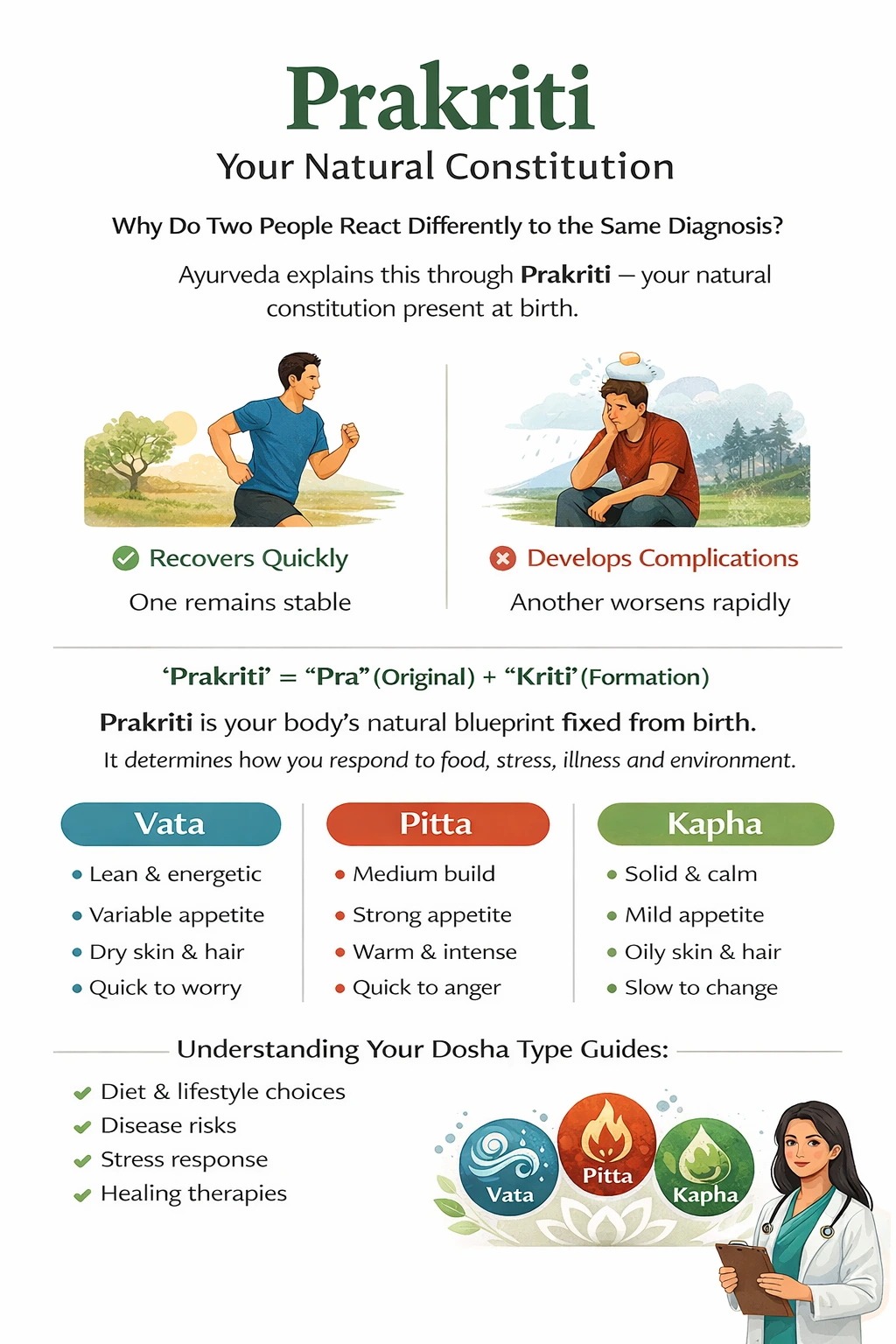
At the time of Shukra–Artava samyoga (fusion of sperm and ovum), the relative predominance of doshas becomes fixed in the embryo. That dosha ratio determines the constitutional identity of the individual.
Classical texts explain that this determination is influenced by:
Once established, Prakriti does not change. Lifestyle may disturb balance, but the constitutional framework remains constant.
Prakriti manifests as seven patterns:
Sama Prakriti is considered ideal in theory but is uncommon in clinical practice. Most individuals are dual-dominant.
Body Composition and Frame
| Parameter | Vata | Pitta | Kapha |
|---|---|---|---|
| Body Build | Thin, light, narrow frame | Moderate, muscular | Broad, dense, stable |
| Weight Trend | Low body weight | Stable weight | Gains weight easily |
| Muscle Mass | Low | Moderate | Well-developed |
| Joint Structure | Prominent, cracking sounds | Moderate | Well-lubricated |

Skin, Hair and Sensory Features
| Parameter | Vata | Pitta | Kapha |
|---|---|---|---|
| Skin Texture | Dry, rough | Warm, soft, sensitive | Thick, oily, smooth |
| Complexion | Darker or uneven | Reddish, flushed | Pale, clear |
| Hair | Dry, frizzy | Fine, early greying, straight usually | Thick, oily, curly usually |
| Sweating | Minimal | Profuse | Moderate |
| Body Odor | Mild | Stronger tendency | Minimal |
Digestive strength (Agni) is strongly linked to constitution.
| Parameter | Vata | Pitta | Kapha |
|---|---|---|---|
| Appetite | Variable or irregular | Strong, sharp | Mild |
| Agni Type (Digestive Capacity) | Vishama (irregular) | Tikshna (intense) | Manda (slow) |
| Bowel Pattern | Constipation tendency | Loose stool tendency | Sluggish elimination |
| Parameter | Vata | Pitta | Kapha |
|---|---|---|---|
| Thinking Speed | Fast | Analytical | Steady |
| Decision-Making | Variable | Precise | Slow but stable |
| Stress Response | Anxiety | Irritability | Withdrawal |
| Sleep | Light | Moderate | Deep |
| Memory | Quick grasp, poor retention | Sharp retention | Slow grasp, long retention |
Understanding Prakriti allows prediction of vulnerability:
Recent studies in integrative medicine have found links between body types and how our bodies process fats, inflammation, stress hormones, and some genetic patterns. The research is still ongoing, but these body-type groupings may reflect real biological differences.
Prakriti assessment guides:
Without constitutional clarity, management becomes generalised. With it, treatment becomes personalised.
This distinction is central to Ayurveda diagnosis.
Prakriti is the natural constitution a person is born with. It is stable and lifelong.
Vikriti is the current state of imbalance. It can change with diet, stress, seasons, age, and disease.
For example, a Kapha-dominant individual may naturally have a broader build, steady energy and a tendency to gain weight more easily than others. That is constitutional. It has usually been present since early life and, by itself, does not indicate disease.
However, if the same individual experiences progressive weight gain, marked lethargy, metabolic abnormalities, or persistent congestion, this reflects Kapha aggravation. That is Vikriti.
Similarly, a Pitta-dominant person may normally have a strong appetite and a warm body temperature. That is part of their constitutional makeup. But recurrent burning sensations, acid reflux, ulceration or inflammatory skin eruptions suggest a Pitta imbalance, not simply Pitta Prakriti.
A simple clinical understanding helps:
If a feature has been consistently present since childhood and does not cause dysfunction, it is likely Prakriti. If a symptom is recent, progressive, or functionally disturbing, it indicates Vikriti.
High-level principles include:
Prakriti is not corrected. It is respected.
Ayurveda does not aim to alter Prakriti. It aims to maintain equilibrium within its framework.
Failure to distinguish Prakriti from Vikriti results in inappropriate management. A constitutional trait may be mistaken for a disease, or a developing pathology may be ignored as “normal nature”. Accurate assessment requires clinical observation, correlation, and an understanding of Dosha principles.
The Charaka Samhita emphasises that strength (Bala), tolerance (Satmya), and vulnerability to disease are constitution-dependent. Therefore, individualised management is not optional in Ayurveda; it is foundational. Understanding Prakriti shifts healthcare from symptomatic correction to constitutional alignment. In preventive medicine, this distinction becomes critical.
As we work hard to improve our services, your feedback is important to us. Please take a moment to help us serve you better.
Subscribe to our hospital newsletter for the latest health tips, updates on services, patient stories, and community events. Sign up today and stay informed!

Report Problem
Popular Searches: DiseasesTreatmentsDoctorsHospitalsWhole person careRefer a patientInsurance

