Types of Agni

Table of Contents

Types of Agni

Ayurveda teaches that most illness begins when our inner fire (Agni) is out of balance. If you’ve ever felt heavy or sleepy after a meal, experienced unpredictable bloating, or noticed a burning sensation in your abdomen, you’ve encountered your Agni behaving differently. Agni is the practical, biological fire that transforms food into energy, builds our tissues, and helps maintain immunity. When Agni works well, you feel energetic, your skin glows, and your digestion is regular. When it falters, it produces Ama—a sticky metabolic residue that blocks the body’s channels (Srotas) and is the seed of many diseases.

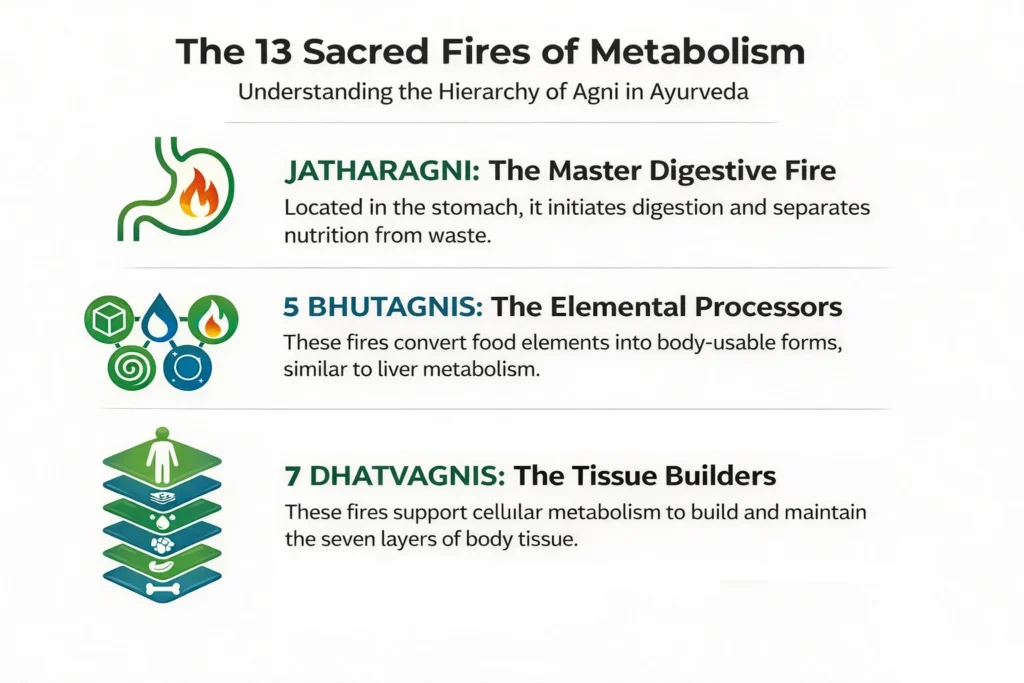
The 13 types of Agni

  • One Jatharagni represents the central digestive fire.
  • Five Bhutagnis are elemental fires tied to the five primordial elements (Panchamahabhutas).
  • Seven Dhatvagnis are tissue-level fires for the seven tissues (Dhatus).

Jatharagni — the master digestive fire

  • Location & role: Located in the stomach and duodenum, Jatharagni is the “central government” of digestion. It begins the breakdown of the food you eat into an assimilable form. It is mentioned as “agni” in Ayurveda in general.
  • Functions: Converts food into a homogeneous mass, then separates it into Prasada (nourishing essence for tissues) and Kitta (waste to be eliminated).
  • Modern correlation: Think of gastric acid, pancreatic enzymes, and bile—gross digestive processes that make digestion possible. All other Agnis depend on a healthy Jatharagni.

Bhutagni — the five elemental fires

  • What they are: Five Bhutagnis correspond to the elements—Parthiva (earth), Apya (water), Tejas (fire), Vayavya (air), and Nabhasa (space).
  • Function: After Jatharagni acts, Bhutagnis transform the elemental qualities in food into forms compatible with the body’s own constitution.
  • Tissue support example: The Parthiva Agni helps assimilate “earth” qualities needed for denser tissues like muscle and bone.
  • Modern correlation: These stages are similar to hepatic and intermediary metabolism—how the liver and related systems process carbohydrates, fats, and proteins into usable intermediates.
ElementAgni NameTarget Body Element
EarthParthivaSolid structures & minerals
WaterApyaFluids, plasma & cohesion
FireTejasTemperature & metabolic light
AirVayavyaMovement & gas exchange
SpaceNabhasaCellular pores & channels
Insurance Backed

Precision Ayurveda
Medical Care

Dhatvagni — the seven tissue fires

  • Where they act: Each of the seven Dhatus (Rasa/plasma, Rakta/blood, Mamsa/muscle, Meda/fat, Asthi/bone, Majja/marrow, and Shukra/reproductive tissue) has its Agni.
  • Function: Dhatvagni carries out the final transformation of nutrients into tissues—building, maintaining, and energising each tissue. It also governs the sequential nourishment from one tissue to the next (for example, Rasa nourishing Rakta).
  • This pattern relates to how our cells process energy (like the Krebs cycle), how different tissues create what they need, and how hormones manage the growth and function of those tissues.

Dhatvagni

Primary Function

Rasa Agni

Transforms nutrients into Plasma (Rasa Dhatu)

Rakta Agni

Governs formation of Blood (Rakta Dhatu)

Mamsa Agni

Builds and repairs Muscle tissue (Mamsa Dhatu)

Meda Agni

Regulates Fat & adipose metabolism (Meda Dhatu)

Asthi Agni

Metabolises minerals into Bone (Asthi Dhatu)

Majja Agni

Nourishes Bone marrow & nervous tissue (Majja Dhatu)

Shukra Agni

Refines essence for Reproductive tissue (Shukra Dhatu)

The four digestive patterns

Ayurveda teaches that our inner digestive fire (Agni) can take different forms. Below are four common digestive patterns that you can recognise in your own digestion.

1. Samagni (Balanced Fire)

This is the ideal and healthy condition when the tridoshas (three doshas) are balanced. The food is digested completely and on time, without fluctuations.

  • This condition is marked by a “steady, perfect flame” that burns fuel efficiently.
  • Example: You eat a normal meal at 1:00 PM, feel light and energetic afterward, and are naturally hungry again around 7:00 PM — with no gas, bloating, or acidity.

2. Mandagni (Sluggish Fire)

Linked with Kapha predominance, this Agni is weak and dull. It struggles to digest even small amounts well.

  • This Agni is similar to a “smouldering log”, producing more smoke than heat.
  • Example: You sip a light soup but feel heavy, sleepy, and full for 4 hours or more; you may also have excess salivation or mild nausea.

3. Tikshnagni (Sharp Fire)

Seen in those with Pitta predominance, this fire is intense and fast. It digests food very quickly.

  • It functions as a “roaring furnace”, consuming everything too quickly.
  • Example: After a heavy meal, you may feel hungry again in two hours and often experience a burning sensation in the throat or stomach.

4. Vishamagni (Erratic Fire)

Associated with Vata imbalance, Vishamagni is unpredictable and fluctuating. Digestion can be strong one day and poor the next.
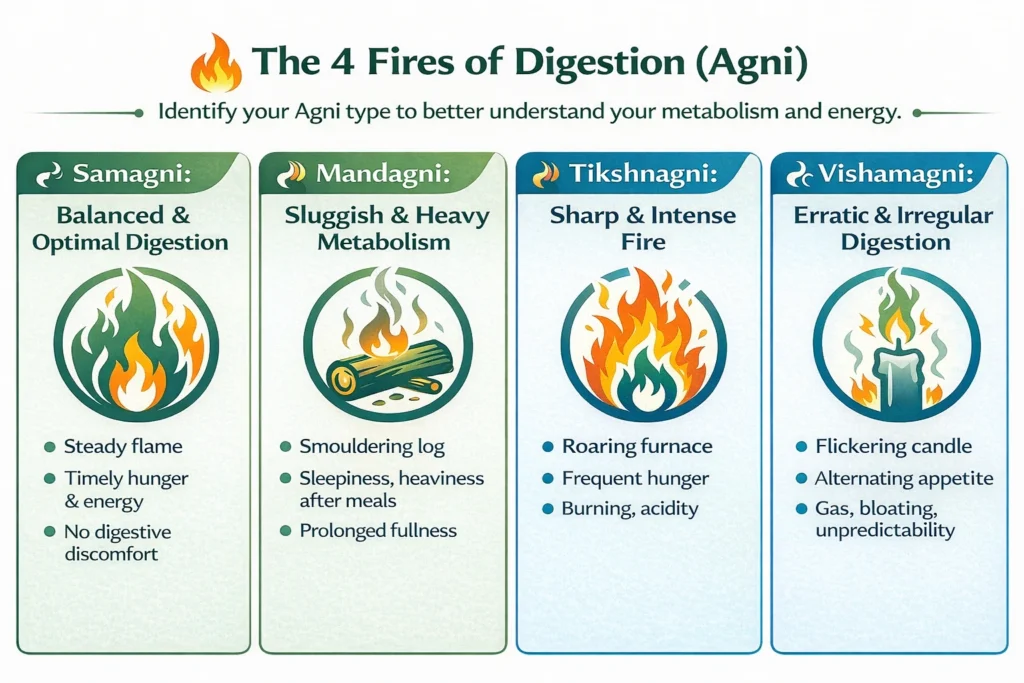
  • Agni fluctuates like a “flickering candle” in the wind, brightening and dimming without warning.
  • Example: One day, you easily digest a large pizza; the next day, a simple toast causes severe bloating, gas, or constipation.

Does Agni stay the same?

Agni is not fixed; it changes across life and with circumstances. The main influences are: 

  • Prakriti (Constitution): Your baseline tendency for a type of Agni is set by your constitution at conception. For example, a Pitta-predominant person tends toward Tikshnagni.
  • Age: Agni typically follows a life curve — strong in youth and middle age and often weaker in older age.
  • Time and seasons: The environment affects your internal fire. In winter, Agni is usually stronger (we feel hungrier); during the rainy season, it may weaken.
  • Lifestyle: Daily habits have a big effect. Overeating, eating before the previous meal has digested, suppressing natural urges, or emotional states such as anger, grief, or worry can all impair Agni.

Bhasmak Roga behaves like Tikshnagni (sharp fire) — you’ll notice intense hunger and very fast digestion. In medicine, this pattern frequently manifests as diabetes (polyphagia) or hyperthyroidism. While a person with regular Tikshnagni can mean robust digestion and immunity, the pathological form causes Dhatu Kshaya (tissue depletion) and burning sensations.

By contrast, Mandagni (sluggish fire) slows metabolism and favours Sthaulya (obesity) and hypothyroidism. The slow, weak Agni causes the body to store too much fat and creates Ama (toxic metabolic residue), along with blocked channels.

If you are noticing pattern changes in your digestion, like heaviness after small meals, sudden acidity, erratic hunger, or persistent bloating, these are signals from your Agni asking for attention. Gentle, individualised changes in diet and routine (and guidance from an Ayurveda practitioner when needed) can help bring your fire back to balance.

Ama — the sticky root of disease

When Agni is weak (Mandagni) or erratic (Vishamagni), food is not fully “cooked.” The result is Ama— a foul, sticky metabolic residue. Ama clogs the body’s channels and blocks nutrient delivery and waste removal. This obstruction creates local inflammation (Ama visha) and can progress to systemic illness. 

How Ayurveda restores and protects Agni

Ayurveda treatment aims to bring Agni back to Samagni (balanced digestion) using progressive, practical steps: 

  • Deepana: Gentle spices (e.g., ginger) to kindle the fire.
  • Pachana: Herbs/medicines to digest and clear Ama.
  • Langhana: Short fasting or very light diets to relieve the burden.
  • Sansarjana Krama: After illness or cleansing, food is reintroduced in a sequence to rebuild and stabilise Agni.
  • Shodhana: Therapeutic purifications (e.g., Vamana, Virechana) for deep imbalance.

Care for your inner fire

Your Agni is the foundation of vitality, immunity, and healthy ageing. Small daily choices, such as eating only when you feel hungry, using spices and herbs to aid digestion when needed, and avoiding overeating, can help prevent ama formation. If you experience bloating, fatigue, or irregular digestion, then it indicates that your Agni is compromised. Maintain your inner fire. Listen to your digestion, eat for your Agni, and you will cultivate proper digestion, the foundation for a healthy life.

FAQs

What are the main categories of Agni in the body?
Ayurveda recognises 13 distinct types of Agni, classified into three major sets based on their location and function: one Jatharagni (the central digestive fire), five Bhutagnis (elemental fires), and seven Dhatvagnis (tissue-level fires).
What is Jatharagni, and why is it called the "Master Fire"?
Jatharagni is the primary digestive fire located in the stomach and duodenum. It is considered the most important because it is the "central government" that governs and provides strength to all the other 12 micro-fires in the body.
What is the role of the five Bhutagnis?
These five fires correspond to the five primordial elements: Earth, Water, Fire, Air, and Space. They act on the elemental parts of the food you eat to transform them into substances that can be assimilated into your body's tissues.
How do the seven Dhatvagnis affect my tissues?
Dhatvagnis are functional fires located within the seven specific body tissues, such as blood, muscle, and bone. They are responsible for cellular metabolism, tissue synthesis, and the transformation of one tissue into the next in a sequential process.
What is "Samagni", and is it the ideal state?
Samagni is the balanced state of Agni where all three Doshas (Vata, Pitta, and Kapha) are in equilibrium. It ensures complete digestion of food at the proper time without any irregularities and is considered the ideal state for health and longevity.
Why is my digestion so unpredictable?
This is likely Vishamagni (erratic fire), which is influenced by the aggravation of Vata. It causes your digestive capacity to fluctuate, meaning you sometimes digest food quickly and other times very slowly.
Why am I always hungry, even after a large meal?
This condition is known as Tikshnagni (sharp fire), which is dominated by Pitta. Because Pitta and Agni share similar intense properties, food is "burnt" through extremely quickly, often leading to intense hunger and burning sensations in the throat.
Why do I feel heavy and sluggish even after eating very little?
This indicates Mandagni (weak fire), which results from the dominance of Kapha. In this state, the Agni is subdued and unable to process even small quantities of food, leading to heaviness and slow metabolism.
Are Agni and Pitta the same thing?
While they are closely related, they differ in certain qualities; for instance, Agni is dry and moves upward, while Pitta is liquid and moves downward. However, some authorities suggest that Agni is situated within Pitta to perform essential digestive and metabolic functions.
Do my age or the seasons affect my Agni?
Yes, Agni is dynamic and influenced by several factors. It is typically at its peak during middle age but becomes weaker in old age. Additionally, Agni's strength is naturally favourable in the winter but lowers during the rainy season.
Did the information meet your needs?

As we work hard to improve our services, your feedback is important to us. Please take a moment to help us serve you better.

Stay Connected to Health and Wellness

Subscribe to our hospital newsletter for the latest health tips, updates on services, patient stories, and community events. Sign up today and stay informed!

Homepage B RCB

Please fill out the form below to Request a call back

Patient details

Select Preferred Center

Content Details

We update our articles as new material becomes available, and our specialists keep a close eye on the health and wellness industry.

Written by
Dr Shobitha Madhur
Share this article on
Last updated on:
Do you have concerns with the content?

Report Problem

Table of Contents

Last updated on:

Report Problem

Do you have concerns with the content?

We’d Love to Hear from You!

Feedback form(disease page)

Can we help?

Something wrong with our medical content?
 
Report Problem form

Popular Searches: DiseasesTreatmentsDoctorsHospitalsWhole person careRefer a patientInsurance

Hours of Operation:
8am – 8pm (Mon-Sat)
8am – 5pm (Sun)

Follow Apollo AyurVAID hospitals