- AyurVAID Pharmacy
In Ayurveda, Vata Dosha is the principle of movement. It conducts, regulates and integrates everything in the body and mind that moves from breathing and circulation to nerve signals, thoughts, and creativity. Vata initiates all activity in the living body; without it, no function can occur. When Vata is balanced, we feel energetic, light, creative, and alert. Imbalance can transform the same qualities into restlessness, dryness, anxiety, or irregularity.
In classical Ayurveda, the word “Vata” originates from the root “Va”, expressed as “Va gati gandhanayoḥ”. In simple terms, this means that Vata is responsible for movement (gati) and awareness or perception (gandhana).
This idea fits naturally with how Vata behaves in the body. It not only drives physical motion — like breathing, circulation, and muscle activity — but also supports how we sense, think, respond, and communicate. Because of this, Vata is closely linked to the neuroendocrine system, sensory functions and catabolic activities.
This dual role is why Vata is considered central to both physical activity and mental alertness in Ayurveda.
In Ayurveda, the Guṇas are the essential characteristics that determine how something behaves, manifests, and engages with the world. They are used to explain every facet of life, nature, and even the human mind. Guṇas are the invisible threads that give character and texture to everything around us, from the elements in the body to the food we eat and the emotions we feel. Vata is made up of the air and space elements, which give it the following Guṇas:
| Acharya / Ayurveda Scholars | How Vata is Described |
|---|---|
| Vagbhata | Ruksha (dry), Laghu (light), Sheeta (cold), Khara (rough), Sukshma (subtle), Chala (mobile) |
| Sushruta | Ruksha (dry), Laghu (light), Sheeta (cold), Khara (rough) |
| Charaka | Ruksha (dry), Laghu (light), Sheeta (cold), Daruna (coarse), Chala (mobile), Sukshma (subtle), Vishada (non-sliminess), Khara (rough) |
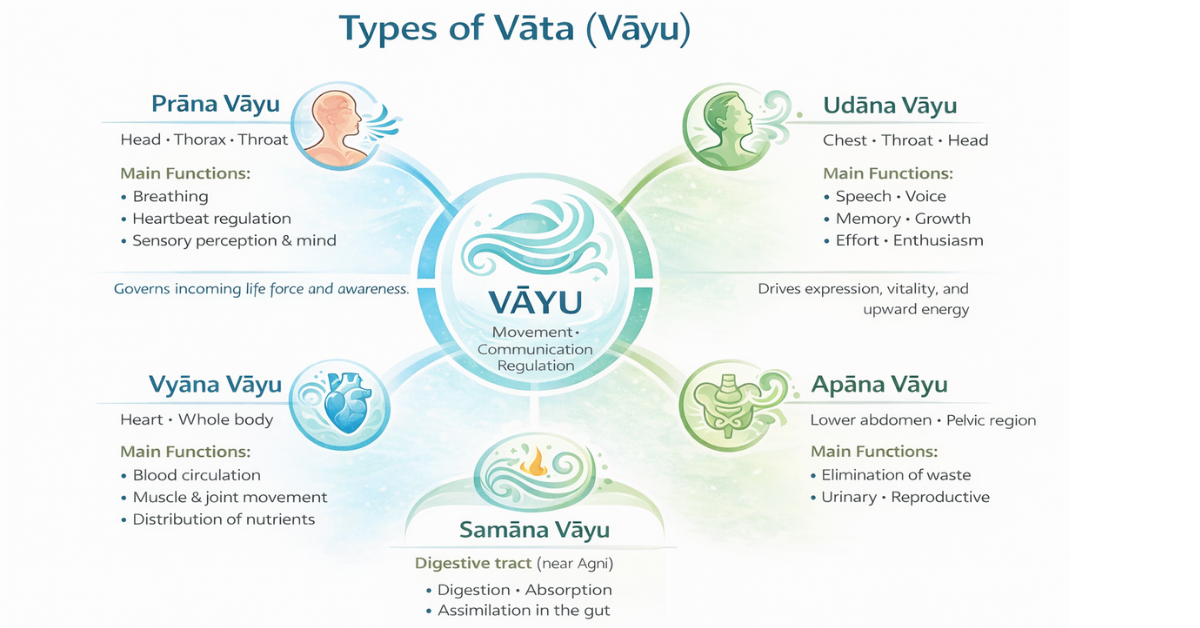
| Type of Vata (Vāyu) | Primary Location | Main Functions |
|---|---|---|
| Prāṇa Vāyu | Head, Thorax, Throat | Breathing, swallowing, heartbeat regulation, sensory perception, mental clarity, intelligence, voluntary sensory and motor functions |
| Udāna Vāyu | Chest, throat, head | Speech, voice, expression, effort, memory, enthusiasm, upward movement, growth |
| Vyāna Vāyu | Heart, whole body | Blood circulation, movement of muscles and joints, coordination, distribution of nutrients |
| Samāna Vāyu | Digestive tract (near agni) | Digestion, absorption, assimilation, separation of nutrients and waste, neuro-hormonal influences of digestion |
| Apāna Vāyu | Lower abdomen, pelvis | Elimination (urine, stool), menstruation, ejaculation, childbirth, downward movement |
| Stage | Ayurveda Term | Description | Typical Vata Symptoms |
|---|---|---|---|
| 1 | Sanchaya (Accumulation) | Vata accumulates in its normal sites (Pakvāśaya) | Mild dryness, cold sensation, slight bloating, lightness of body, desire for warmth and oiliness, aversion towards causes of increase and desire towards opposite properties |
| 2 | Prakopa (Aggravation) | Accumulated Vata becomes provoked and spreads in the wrong channels (unmarga gamana) | Pricking type of pain, prolapse, tremors and movement of Vata in the GI tract |
| 3 | Prasara (Spread) | Vata overflows from its site to the whole body | Vata moving in opposite direction, gurgling sound in abdomen, moving pain, tremors, palpitations, giddiness, irregular digestion, generalised body aches |
| 4 | Sthāna-Saṁśraya (Localisation) | Vata lodges in weak tissues producing disease | Prodromal symptoms appear e.g., joint stiffness/cracking, tingling, numbness, low back pain |
| 5 | Vyakti (Manifestation) | Clear disease manifestation | Well-exhibited general and specific symptoms like Santapa (increased body temperature) in Jwara, joint pain in Sandhigatavata etc. |
| 6 | Bheda (Complication) | Chronicity and complications | Deformities, muscle wasting, severe pain, neurological deficits |
In the long term, Vata imbalance is associated in Ayurveda with conditions such as osteoarthritis and neurological disorders like stroke, Parkinson’s disease, neuropathy, sciatica, tremors, and paralysis.

According to Ayurveda, elements like Pitta and Kapha, along with body tissues and waste products, cannot move or function properly on their own. They depend on Vata — the principle of air and movement.
Vata is what keeps everything in motion. It carries nutrients to where they are needed, helps remove waste from the body, and supports breathing, circulation, digestion, and even the flow of thoughts and nerve signals. Without vata, the body’s systems would simply stop working.
This is why Ayurveda places such importance on Vata. When Vata is balanced, the body feels light, active, and coordinated. When it is disturbed, various problems can arise, not because other elements are weak, but because movement itself is disrupted.
The verse reminds us that health is not only about having the right components in the body but also about having proper movement and direction. Supporting Vata means supporting the body’s natural intelligence to function smoothly.
Balancing Vata typically focuses on introducing the opposite qualities — warmth, stability, and nourishment. At a general level, these steps may include:
Individual recommendations differ and should always be customised by an Ayurveda physician.
As we work hard to improve our services, your feedback is important to us. Please take a moment to help us serve you better.
Subscribe to our hospital newsletter for the latest health tips, updates on services, patient stories, and community events. Sign up today and stay informed!

Report Problem
Popular Searches: DiseasesTreatmentsDoctorsHospitalsWhole person careRefer a patientInsurance

