- AyurVAID Pharmacy
‘Vikriti’ refers to the body’s present state of imbalance. It is not fixed. It reflects what is actively disturbed right now. A helpful way to understand it is this: Vikriti is like today’s weather in the body, while Prakriti is the long-term climate. Your Prakriti is the constitutional background, representing the stable tendencies with which you are born. Metabolic pace, tissue structure, appetite rhythm, stress response. These usually remain consistent across life.
Vikriti is the current weather report. It can become “humid” with fluid retention, “dry” with depletion, “stormy” with inflammation, or “heavy” with metabolic sluggishness. Diet, stress, sleep disruption, infection, and seasonal shifts — all can alter it.
Weather changes faster than the climate. It needs short-term correction. In the same way, Vikriti often requires targeted, situation-specific intervention to restore balance, while the underlying constitution remains unchanged. The term is formed from “Vi” (altered or changed) and “Kriti” (formation). It means a changed state. In practical terms, “Vikriti” refers to the present imbalance of Vata, Pitta, and Kapha—whether they are increased, decreased, or functioning abnormally at a given time.
Unlike Prakriti, which remains constant throughout life, Vikriti is not fixed. It changes with diet, routine, stress, seasonal exposures, and age. When the Doshas, which are the three fundamental energies in Ayurvedic medicine, are in their natural proportion, digestion (Agni) functions properly, tissues (Dhatus) are nourished, and waste elimination (Malas) is regular. This balanced state is health. When Doshas move away from their normal proportion or location, imbalance begins. That altered state is Vikriti.
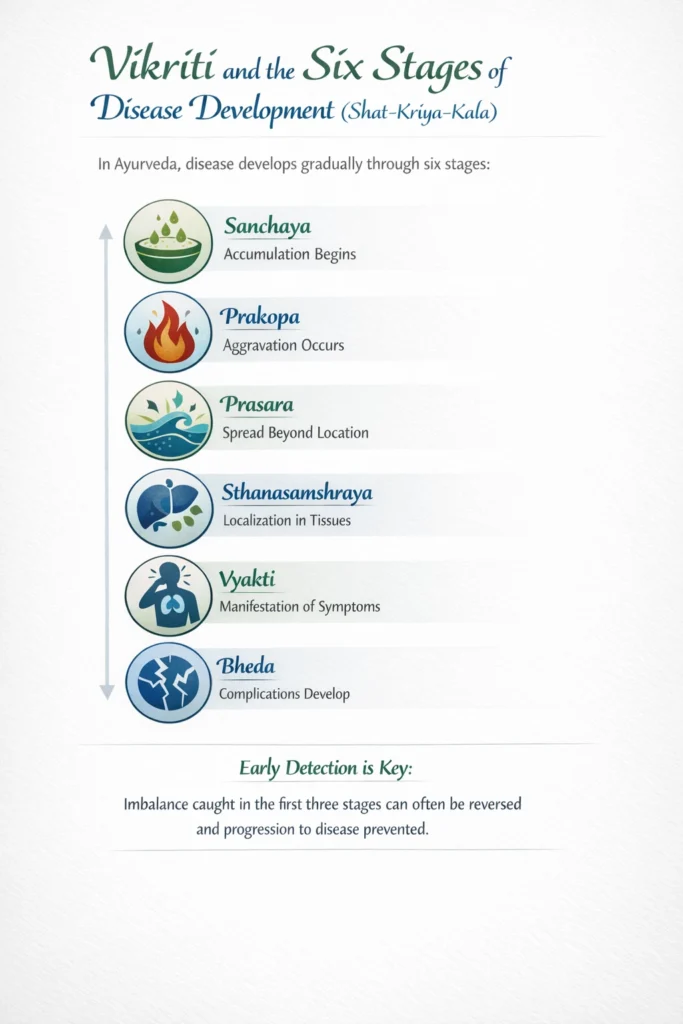
Ayurveda further explains that this imbalance develops gradually—first as Sanchaya (accumulation), then as Prakopa (aggravation), Prasara (spread), Sthanasamshraya (localisation in weak tissues), Vyakti (clear manifestation of disease), and finally Bheda (complication). Vikriti may exist in the earlier stages of this process, even before a disease is clearly diagnosed. For this reason, identifying Vikriti early is central to Ayurveda diagnosis and prevention.
Vikriti does not appear suddenly. It builds gradually. Repeated dietary errors are common causes:
But diet alone is not responsible. Irregular sleep, nighttime work, travel, mental strain, and suppressed emotions—these disturb Vata. Competitive stress and anger aggravate Pitta. Sedentary habits and emotional stagnation increase Kapha.
Season also plays a predictable role. Classical teaching states:
If seasonal discipline (Ritucharya) is ignored, imbalance progresses.
No discussion of Vikriti is complete without Agni. When digestion becomes irregular (Vishama), sharp (Tikshna), or slow (Manda),Doshas move out of equilibrium. Persistent digestive impairment may produceAma, which refers to incompletely processed metabolic byproducts that can accumulate in the body. Once Ama combines with aggravated Dosha, pathology becomes more complex.
In practice, correcting Agni is often the first step in managing Vikriti.
| Parameter | Vata Vikriti | Pitta Vikriti | Kapha Vikriti |
|---|---|---|---|
| Appetite | Irregular, fluctuating | Excessive, sharp hunger | Reduced, slow |
| Digestion | Bloating, gas, constipation | Burning, acidity, loose stools | Heaviness after meals |
| Energy | Variable, fatigues easily | Intense but irritable | Slow, lethargic |
| Sleep | Disturbed, light | Moderate but disturbed by heat | Excess sleep |
| Mental State | Anxiety, restlessness | Irritability, impatience | Withdrawal, dullness |
| Body Tendency | Dryness, weight loss | Heat, inflammation | Weight gain, congestion |

This is where confusion usually happens.
A person with Pitta Prakriti naturally has strong digestion and warmth. That is baseline. If the same person develops persistent acid reflux, recurrent mouth ulcers and a burning sensation beyond their usual tolerance, that is Pitta Vikriti.
A Kapha constitution, which is characterised by a predominance of the earth and water elements, may show stable weight and a calm temperament. That is natural. Progressive obesity with metabolic disturbance reflects Kapha aggravation — not just constitutional tendency.
A simple clinical rule helps:
If it has been present since childhood and does not impair function, it is likely Prakriti.
If it is recent, progressive, or functionally disturbing, it indicates Vikriti.
Ayurveda explains that Vikriti progresses predictably. Disease does not appear suddenly. It develops through six stages, known as Shat-Kriya-Kala:
Vikriti may be present in the first three stages, when changes are functional and potentially reversible. If an imbalance is identified at this point, progression to overt disease can often be prevented.
In treatment, we correct Vikriti first.
Diet is adjusted according to the aggravated Dosha. Lifestyle is stabilised. Digestive fire is strengthened. Where necessary, Panchakarma is advised. Prakriti guides long-term preventive strategy. Vikriti determines immediate intervention.
Ignoring Vikriti leads to symptomatic treatment only. Ignoring Prakriti leads to recurrence. Both must be understood.
Many chronic metabolic and inflammatory disorders show subtle imbalance years before diagnosis. Contemporary integrative research has begun exploring links between constitutional types, inflammatory markers, lipid metabolism and stress response patterns. Though frameworks differ, the idea of biological individuality overlaps.
Ayurveda recognised this long ago. Vikriti is the window where intervention is still reversible.
Once structural damage develops, management becomes longer and more complex.
As we work hard to improve our services, your feedback is important to us. Please take a moment to help us serve you better.
Subscribe to our hospital newsletter for the latest health tips, updates on services, patient stories, and community events. Sign up today and stay informed!

Report Problem
Popular Searches: DiseasesTreatmentsDoctorsHospitalsWhole person careRefer a patientInsurance

