Ahara

Table of Contents

In Ayurveda, Ahara is much more than food or a meal. It is one of the Trayopastambha (the three pillars of life), along with Nidra (sleep) and Brahmacharya (conduct). Among these, Ahara plays a central role by nourishing the body, supporting the mind, and sustaining vitality. When chosen and eaten wisely, food becomes a daily source of balance, strength, and healing apart from filling your stomach.

What does Ahara mean?

The Sanskrit word ‘Ahara’ comes from the root हृ with the prefixआ, meaning ‘to bring in’ or ‘to take in’. It refers to anything taken into the body through the mouth and swallowed.

The importance of Ahara

Ayurveda looks at food in a deeply holistic way. A proper diet does not merely produce energy, it supports the whole person.

When food is suitable and properly digested, it helps to build

  • Bala – strength and endurance
  • Varna – healthy complexion and glow
  • Ojas – vitality, immunity, and steadiness
  • Mental clarity – better focus, memory, and emotional balance
  • Ayu – a longer and healthier lifespan

What we eat influences not only the body but also mood, concentration, and overall emotional stability. In that sense, diet becomes a quiet but powerful force shaping daily health.

Insurance Backed

Precision Ayurveda
Medical Care

Role of Agni in food transformation

Ayurveda makes an important point: we are not just what we eat but what we digest. Food must be transformed by Agni, the digestive fire, before it can nourish the body.

This change occurs through the action of 13 different Agnis. They are:

  • Jatharagni, the main digestive fire which acts on the food in the stomach and the intestines;
  • Five Bhutagnis, the elemental fires which refine the five basic elements present in the food;
  • Seven Dhatvagnis, the fires which act on the different tissues in the body one by one.

When the process of digestion is normal, the food is transformed into Prasada, the essence which provides nutrition to the body. When digestion is weak, undigested material may turn into Ama, a toxic, heavy, poorly processed substance that contributes to disease.

How Ayurveda classifies food

Ayurveda classifies food in several useful ways.

1. Based on how it is taken

  • Ashita – solid food that is eaten
  • Peeta – liquids that are drunk
  • Leedha – foods that are licked
  • Khadita – foods that are chewed, such as nuts or dry items

2. Based on mental quality (Triguna)

  • Satvika foods are fresh, natural, and nourishing. They support clarity, calmness, and balance.
  • Rajasika foods are very spicy, salty, or stimulating. They can increase restlessness and overactivity.
  • Tamasika foods are stale, heavy, overprocessed, or dulling. They may reduce energy and cloud the mind.

The freshness and quality of food influence not only digestion but also your mental state.

The eight factors that shape a healthy meal

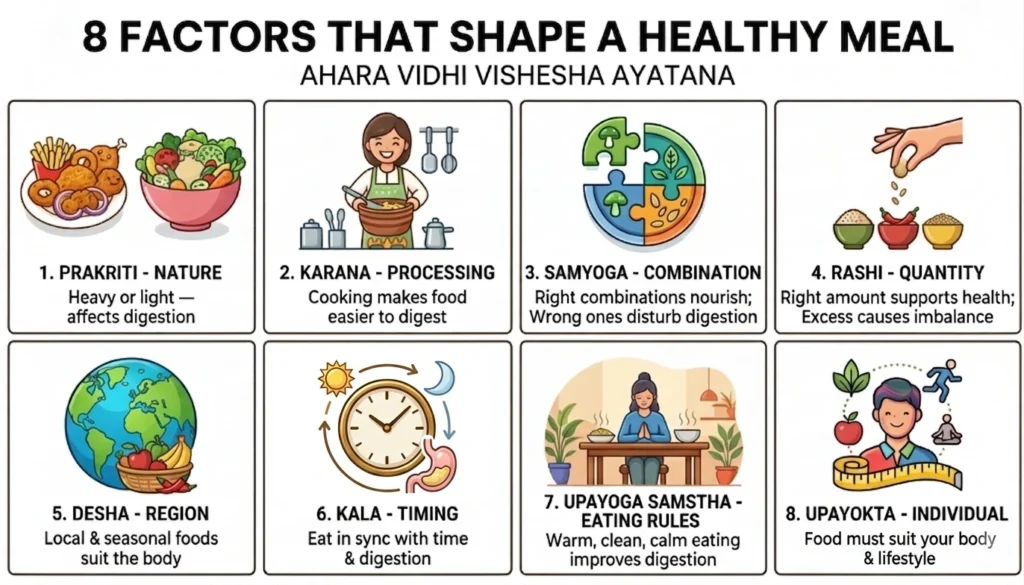
Ayurveda says that before eating, we should consider eight important factors known as Ahara Vidhi Vishesha Ayatana.

Prakriti: Every food has a natural quality. Some are heavy, some are light, and each one affects digestion differently.

Karana: The way food is processed can change its effect. Cooking, boiling, roasting, or churning may make it easier to digest.

Samyoga: Food combinations matter. Some are nourishing, while others may disturb digestion and should be avoided.

Rashi: Quantity is important. Even healthy food can become harmful if eaten in excess.

Desha: Food should suit the region, climate, and season. Local and seasonal foods usually support a better balance.

Kala: Timing matters. Eating in sync with the time of day, season, and digestion helps maintain health.

Upayoga Samstha: Food should be eaten warm, clean, and in a calm setting, with proper eating habits.

Upayokta: The person matters too. Age, constitution, digestion, and lifestyle decide what food suits best.

This is one of Ayurveda’s strengths. It never gives a one-size-fits-all diet. Food is always assessed in relation to the individual, the season, and the state of digestion.
The role of Samskara in food preparation

Karana, also called Samskara, refers to the transformation of food through processing. Ayurveda recognises that the way food is prepared can change how it behaves in the body.
For example, raw rice may be heavy and harder to digest, but after cooking, it becomes lighter and more suitable for digestion. Similarly, washing, soaking, churning, heating, fermenting, or storing food in certain ways can alter its qualities.
Sometimes the food itself is not the issue; the method of preparation makes the difference.

The rules of eating

Ayurveda provides ten important guidelines for eating, known as Ahara Vidhi Vidhana.

Food should be:

  • eaten warm, because warm food supports Agni
  • moderately unctuous, with some natural healthy fat
  • taken in the right quantity
  • eaten only after the previous meal has digested
  • compatible in potency and nature
  • consumed in a clean, pleasant setting
  • eaten neither too fast nor too slowly
  • eaten with awareness, not while distracted
  • taken calmly, without excessive talking or laughing
  • chosen with self-observation and intelligence

One of the most important ideas is Matravat Ashniyat—eat in proper quantity. Ayurveda often uses the practical guidance of dividing the stomach roughly into three parts: one part for solid food, one part for liquids, and one part left empty for movement and digestion.

This space is necessary. Digestion needs room to work.

Another key principle is Jirne Ashniyat—eat only after the previous meal is digested. A healthy meal should create lightness, clarity, and a natural sense of hunger at the right time. If we eat again too soon, the digestive fire becomes overloaded.

What is Viruddha Ahara?

One of the most important concepts in diet in Ayurveda is Viruddha Ahara, or incompatible food combinations.
This does not mean bad food. It means food combinations, food habits, or food preparations that disrupt the body’s balance and cause strain in the body. This can, over time, weaken digestion, produce ama, and eventually lead to disease.
Some of these combinations include hot and cold, or those that confuse the digestive system.
The concern is not only immediate discomfort. Such repeated intakes of incompatible foods can cause disturbances in the tissues, weaken Agni, and increase the susceptibility of the body.
From a contemporary perspective, this concept can be related to the understanding that poor food combinations and unhealthy cooking styles can cause inflammation in the body.

Indicators of proper digestion

According to Ayurveda, there are several signs of the digestion of food consumed in the previous meal. They are called Jeerna Ahara Lakshanas.

They include:

  • clear, pure belching without lingering smell or taste
  • natural hunger
  • thirst
  • lightness of the body
  • proper bowel movement and elimination of gas
  • renewed energy and enthusiasm
  • clarity of the senses and mind
  • a sense that digestion is complete and comfortable

These signs are very useful in daily life. Instead of eating by the clock alone, Ayurveda encourages listening to the body. Hunger, lightness, and clarity are better guides than habit or emotional impulse.

Drinking water during meals

According to Ayurveda, drinking water during meals is not strictly prohibited. The correct amount, temperature, and time should be followed to optimise the effect.

समस्थूलकृशा भुक्तमध्यान्तप्रथमाम्बुपाः ।
(Ashtanga Hrudaya)

Before Meals (Bhuktadau)

Excessive intake of water before a meal is said to weaken the digestive fire, resulting in improper digestion. This practice, if followed over time, will result in improper nourishment and weakening of the body.

During Meals (Madhye)

Taking small amounts of water with food is always advantageous. This helps in the proper digestion of food, along with the maintenance of proper balance in the stomach.

After Meals (Bhuktopari)

Excessive intake of water immediately after food is said to dampen the Agni, resulting in improper digestion and the formation of Ama. This practice will result in weight gain and obesity over time.

Warm water is generally preferred because it supports Agni. Cold water, especially during meals, may dull digestive activity in people with weak digestion.

A healthy person is usually best served by choosing a drink that supports digestion rather than suppressing it.

The order of foods during a meal

Ayurveda also provides guidance on the sequence of eating.
A common traditional sequence is:

  • Begin with sweet, heavy, and nourishing foods
  • Take sour and salty foods in the middle
  • Finish with pungent, bitter, and astringent foods

The digestive strength is strongest at the beginning of the meal, so heavier items are better tolerated early. Lighter and more cleansing tastes are better toward the end. Ayurveda always tries to support the natural rhythm of the body.

How to choose the right diet for your Prakriti

Your Prakriti is determined at conception and remains essentially constant throughout life. Understanding it helps you choose foods that support your balance rather than disturb it.

  • If you are predominantly Vata, you may do better with warm, moist, nourishing foods that are grounding and soothing.
  • If you are predominantly Pitta, cooling, mild, and less spicy foods are often better suited.
  • If you are predominantly Kapha, lighter, drier, and more stimulating foods may be helpful.

Along with Prakriti, Ayurveda asks us to observe our digestive strength, our tolerance to different foods, our lifestyle, and the season. This process is called Atmanam Abhisamikshya—careful self-observation.

That is the heart of Ayurveda. It teaches us to become intelligent participants in our health.

Conclusion

In Ayurveda, Ahara is described as Mahabhaishajya, or the supreme medicine. It reminds us that health does not start in a clinic or a pharmacy. It starts in the dining room, in the kitchen, and in the manner in which we engage with food. When food is fresh, proper, and in season, and we cook and eat it optimally, we not only nourish our physical body but also our digestive system, our brain, and our immune system. The next time you sit down to eat, eat thoughtfully. Eat with gratitude. Eat with respect for your Agni. In this simple act, we find not only nutrition but also healing.

FAQs

What is the concept of Ahara?
Ahara is one of the three supporting pillars of life (Trayopastambha) alongside sleep and regulated conduct. It is considered the "supreme medicine" (Mahabhaishajya) because it nourishes the body, mind, and soul while maintaining biological equilibrium. The human body is viewed as a direct product of the food consumed.
What does Ahara mean?
Ahara is one of the three supporting pillars of life (Trayopastambha) alongside sleep and regulated conduct. It is considered the "supreme medicine" (Mahabhaishajya) because it nourishes the body, mind, and soul while maintaining biological equilibrium. The human body is viewed as a direct product of the food consumed.
What is Ayurveda Aahara?
Ayurveda Aahara is a disciplined dietary framework that accounts for individual constitution (Prakriti), digestive capacity (Agni), and environmental factors. It is governed by eight specific factors of food intake (Ashta Ahara Vidhi Vishesha Ayatana) and ten dietary rules (Ahara Vidhi Vidhana). This system ensures food is properly transformed into nutritive essence (Ahara Rasa) rather than metabolic toxins (Ama).
What is Ahara in Ayurveda in English?
In English, it is commonly translated as "diet" or "food", but it more accurately represents "personalised nutrition" or "biological fuel". It focuses on the holistic impact of substances on physical tissues and mental clarity.
Why is water timing important during meals?
Drinking water immediately before food causes emaciation, while drinking right after food causes obesity by extinguishing the digestive fire. Small sips taken during a meal are ideal for moistening food and aiding the mechanical breakdown of nutrients.
What is the "One-Third Rule" for stomach capacity?
Ayurveda recommends filling one-third of the stomach with solid food, one-third with liquid, and leaving the final third empty. This empty space is critical for the free movement of bio-energies and the proper churning of food.
How does cooking transform food qualities?
Known as Samskara or Karana, processing methods like heating, boiling, or churning alter the inherent nature of a substance. For instance, raw rice is naturally heavy and hard to digest, but boiling transforms it into a light and easily assimilable food.
What are the health risks of Viruddha Ahara?
Incompatible combinations (Viruddha Ahara) disturb the bodily humours without expelling them, leading to internal toxicity and molecular inflammation. Frequent consumption is linked to skin diseases, reproductive issues, digestive disorders, and even death.
What is the recommended sequence of tastes in a meal?
A meal should begin with sweet and heavy foods to satisfy peak hunger and balance Vata, followed by sour and salty tastes in the middle. It should conclude with pungent, bitter, and astringent tastes to balance the natural increase of Kapha that occurs at the end of digestion.
Did the information meet your needs?

As we work hard to improve our services, your feedback is important to us. Please take a moment to help us serve you better.

Stay Connected to Health and Wellness

Subscribe to our hospital newsletter for the latest health tips, updates on services, patient stories, and community events. Sign up today and stay informed!

Homepage B RCB

Please fill out the form below to Request a call back

Patient details

Select Preferred Center

Content Details

We update our articles as new material becomes available, and our specialists keep a close eye on the health and wellness industry.

Written by
Dr Shobitha Madhur
Share this article on
Last updated on:
Do you have concerns with the content?

Report Problem

Table of Contents

Last updated on:

Report Problem

Do you have concerns with the content?

We’d Love to Hear from You!

Feedback form(disease page)

Can we help?

Something wrong with our medical content?
 
Report Problem form

Popular Searches: DiseasesTreatmentsDoctorsHospitalsWhole person careRefer a patientInsurance

Hours of Operation:
8am – 8pm (Mon-Sat)
8am – 5pm (Sun)

Follow Apollo AyurVAID hospitals