- AyurVAID Pharmacy
Dinacharya is derived from dina (day) and charya (conduct). It refers to actions that are to be performed daily in a regular and structured manner.
“प्रतिदिनं कर्तव्यं चर्या दिनचर्या।”
That regimen, which is to be done every day, is called Dinacharya.
Dinacharya is a part of Swasthavritta, the branch of Ayurveda concerned with the preservation of health. The aim of it is clearly stated:
“स्वस्थस्य स्वास्थ्य रक्षणम्, आतुरस्य विकार प्रशमनम्।”
To maintain the health of the healthy and to manage disease in the affected.
Dinacharya belongs primarily to the first objective. It is not designed as a treatment protocol. It is meant to prevent imbalance from developing in the first place.
In clinical settings, disturbances rarely begin as clear disease entities. They appear first as irregularity. A patient may report that appetite is unpredictable, bowels are not fully satisfactory, or sleep is not refreshing. These are often long-standing but not severe enough to be labelled as a disease. When you look closely, these patients usually do not have a stable daily pattern. Meal timing varies. Sleep is inconsistent. Evacuation is delayed or forced. Dinacharya addresses this irregularity. It helps maintain:
Its effect is gradual. It works by reducing fluctuation rather than producing a strong immediate change.
If you look at the steps of Dinacahrya, they simply follow what the body needs in the morning. First comes cleaning the mouth and sense organs. Only after that do you move to oiling, exercise, and bathing. There’s a clear progression that matches the bodyis readiness to function at that time.

“ब्राह्मे मुहूर्त उत्तिष्ठेत् स्वस्थो रक्षार्थमायुषः।”
Waking is advised in the early morning, ideally during Brahma muhurta, which is roughly one and a half hours before sunrise. This is the time when the body is lighter, and elimination reflexes are more readily initiated. If waking is delayed much beyond this, a sense of heaviness is often noticed, and bowel movement may not occur as easily. That said, the exact clock time is less important than maintaining a regular waking pattern. Irregular timing tends to disturb the rest of the routine.
Natural urges or vegas should be attended to without delay. This point is often understated, but clinically it is central. When bowel movement becomes irregular, other disturbances follow. Patients begin to experience bloating, incomplete evacuation, or alternating patterns. Over time, these symptoms contribute to vata imbalance in the lower gastrointestinal tract.
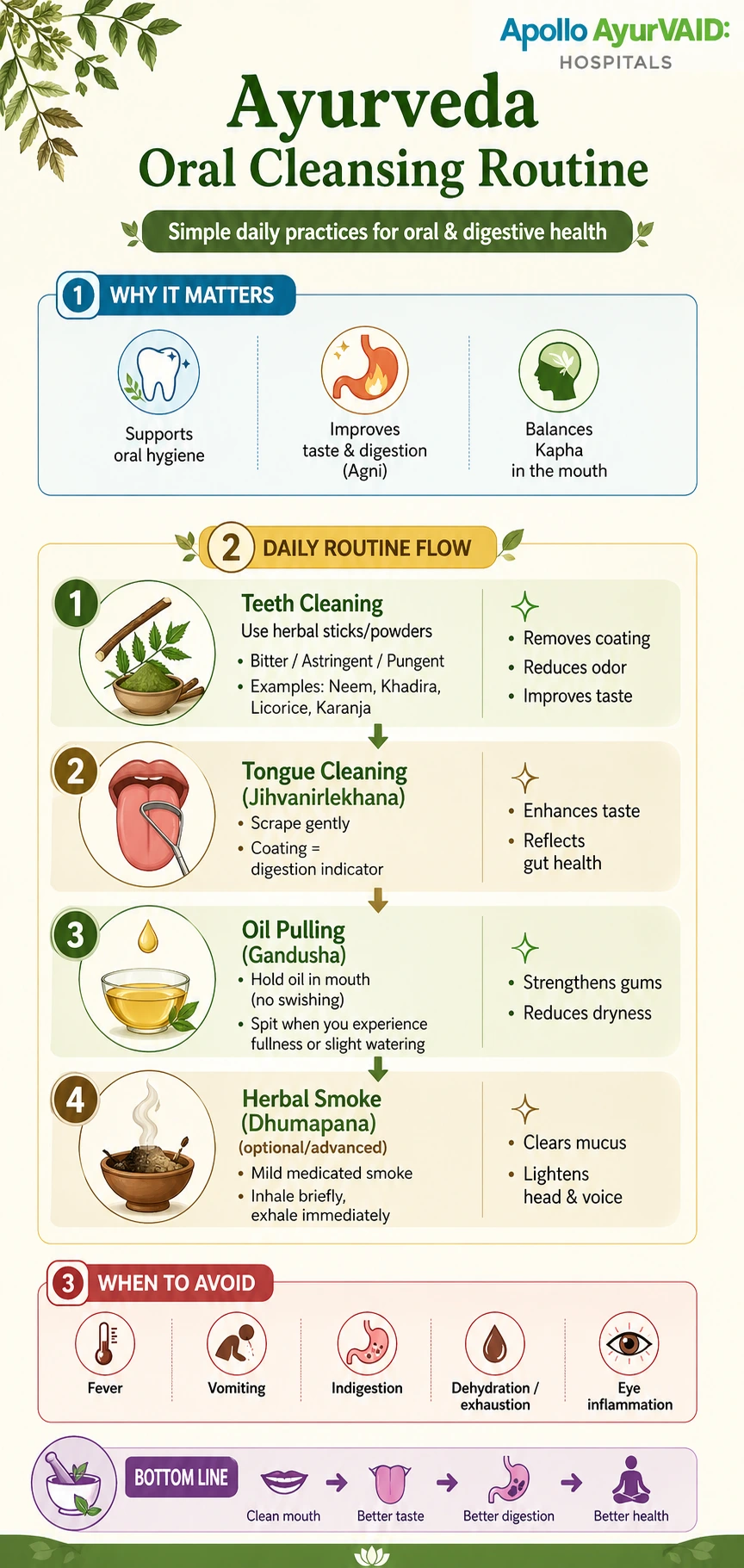
Oral cleansing includes cleaning of the teeth and tongue. Teeth are recommended to be cleaned using substances that are predominantly bitter, astringent, or pungent in taste, such as neem (Azadirachta indica), khadira (Acacia catechu), Madhuka (Glycyrrhiza glabra), and Karanja (Pongamia pinnata). This removes the coating, reduces the odour, and improves taste perception. The choice of substance is not arbitrary; these tastes counter kapha accumulation in the oral cavity.
Jihvanirlekhana or Tongue cleaning follows. The coating on the tongue often reflects the state of digestion. When thick, it usually correlates with impaired agni. Removing it improves both taste and oral cleanliness. Ayurveda also recommends avoiding brushing under certain conditions, such as vomiting, fever, or severe indigestion.
After oral cleaning, gandusha, or oil pulling, should be performed. A liquid is held in the mouth without movement. Oil is commonly used for daily practice. The liquid is retained until fullness develops or until there is slight watering from the eyes and nose, and then it is expelled. This helps in managing dryness of the mouth, supports the gums, and reduces accumulation within the oral cavity. After this procedure, dhumapana is used to clear residual kapha from the head, throat, and sinuses. Mild medicated smoke is inhaled briefly and expelled immediately. This helps reduce head heaviness, excess mucus, dull voice, and throat congestion. Daily use is gentle; stronger preparations are reserved for occasional kapha accumulation. It is contraindicated in bleeding disorders, dryness, eye inflammation, exhaustion, or dehydration.
Application of mild collyrium is advised for maintaining the clarity of the eyes. Daily application is done with sauvira anjana, which is mild and suitable for regular use. It helps maintain clarity of vision and keeps the eyes clean without irritation. Stronger preparations, such as rasanjana, are not used every day. These are applied at intervals, usually once every seven days, to facilitate expulsion of accumulated kapha from the eyes.
Abhyanga is the daily practice of massaging the body with warm, sometimes medicated, oil. It usually starts with the arms and legs, moving upward. Joints are rubbed in gentle circular motions. The head, ears, and soles receive a bit more attention. The aim is to keep tissues nourished, support circulation, and maintain flexibility without making it feel like a chore. People often report feeling steadier, with better sleep and a lighter sense of body tension. It is important not to overdo it. Strong, vigorous massage can disturb balance rather than support it. Abhyanga is generally avoided during conditions of high kapha, acute indigestion, or immediately after purification therapies. The goal is gentle stimulation and nourishment, not force. It supports circulation, maintains neuromuscular function, and keeps the skin supple. It also indirectly enhances sensory perception and tissue strength over time.
Exercise should match the person’s strength, age, and season. Moderate activity helps digestion, moves tissues, reduces fat, and keeps the body agile. Overdoing it can cause fatigue, thirst, weight loss, cough, fever, or worsen bleeding tendencies. In cooler seasons, use about half your strength; in hot seasons, keep it lighter. After exercise, rest briefly or use a gentle self-massage. Children, the elderly, and those with vata-pitta or digestive issues should avoid intense routines and stick to gentle movement.
Snana is more than hygiene; it is a regulated practice that supports body homeostasis. Bathing in the morning stimulates the body, removes accumulated sweat, dirt, and impurities, and enhances strength, digestion, and Ojas (vital essence). The classical texts distinguish between hot and cold water applications: cold water in the morning invigorates the nervous system, stimulates endorphin release, and can improve mood, immune function, and circulation. Hot water or steam baths help open pores, mobilise toxins, and relieve respiratory congestion. Ayurveda strictly advises using hot water only below the neck. Pouring hot water on the head is believed to drain strength from the hair and eyes, potentially leading to hair loss, premature greying, and weakened vision. Snana is contraindicated in acute fever, facial paralysis, eye or ear infections, gastrointestinal upsets, diarrhoea, indigestion, or immediately after meals.
‘Anulepana’ refers to the application of medicated pastes or unguents to the skin for localised or systemic benefit. Depending on the formulation, the paste may have properties that improve complexion (Varnya), neutralise toxins (Vishaghna), or correct doshic imbalances (Doshaghna). The choice of herbs and base materials is guided by the patient’s constitution, dosha status, and therapeutic goal. Anulepana enhances absorption of active compounds, nourishes tissues, supports skin integrity, and can serve as an adjunct to systemic treatments.
The daily regimen advises restraint and moderation in physical and mental activities. Actions that disturb body equilibrium, such as overexertion, exposure to harsh environmental conditions (extreme heat, cold, dust, or wind), or unsafe places, are discouraged. Speech should be measured and truthful, avoiding quarrels, gossip, or harmful words. Mental steadiness is emphasised: unnecessary worry, anger, or agitation is seen as a factor that can disturb dosha balance. Social behaviours should reflect respect for elders, peers, and the community. Following such conduct stabilises the mind, supports digestion and metabolism, and indirectly preserves tissue integrity and vital energies.
Disturbance does not present immediately as a disease. It appears first as variability. A patient may feel well on some days and unwell on others without a clear reason. Appetite may fluctuate. Sleep may be inconsistent. Over time, such behaviour leads to the accumulation of dosha. Once that stage is reached, symptoms become more defined—acidity, heaviness, dryness, or irregular bowel habits, depending on the dominant imbalance. At that point, routine correction alone may not be sufficient, but it remains necessary.
Dinacharya is primarily preventive. It reduces the likelihood of functional disturbance progressing to disease. In current settings, irregular sleep, delayed meals, and lack of routine are common. These do not directly cause disease but create a background where regulation is lost. Reintroducing structure often produces measurable changes even before specific treatment is started.
As we work hard to improve our services, your feedback is important to us. Please take a moment to help us serve you better.
Subscribe to our hospital newsletter for the latest health tips, updates on services, patient stories, and community events. Sign up today and stay informed!

Report Problem
Popular Searches: DiseasesTreatmentsDoctorsHospitalsWhole person careRefer a patientInsurance

