Sama and Nirama

Table of Contents

The concepts of Sama and Nirama occupy an important place in Ayurveda diagnosis and treatment. In clinical practice, two patients may present with similar complaints, yet the physician may approach them very differently depending on whetherAma (toxic metabolic residue formed from incomplete digestion) is present.

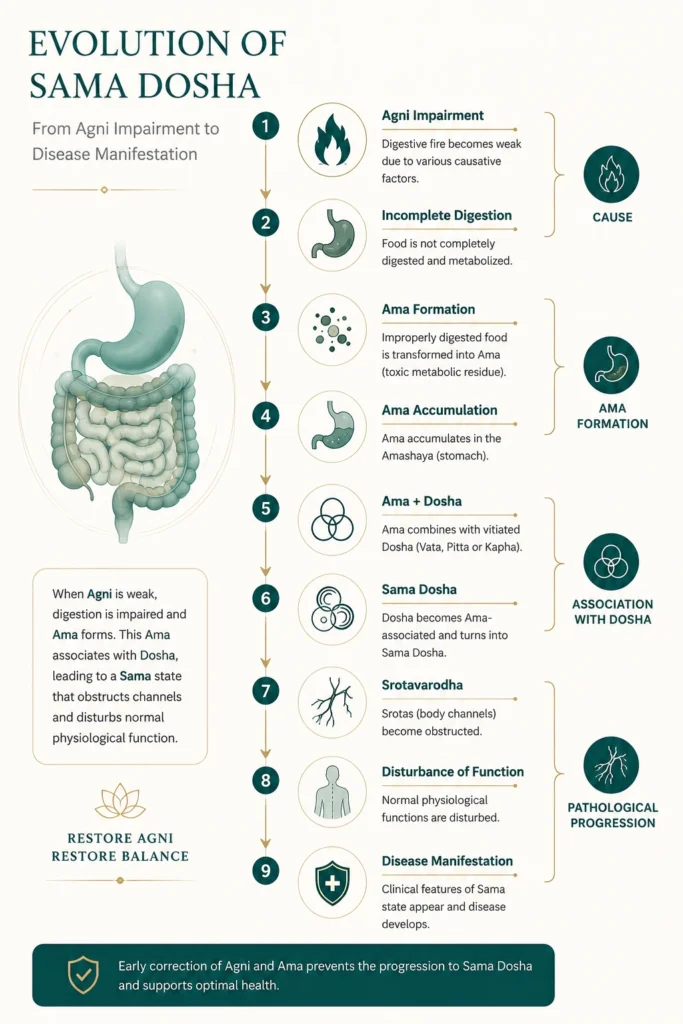
Sama refers to a condition in which Ama is present and has combined with Dosha, Dhatu, or Mala. Such a state reflects impaired digestion and metabolism, resulting in a disturbance of normal physiological function. Nirama refers to a condition in which Ama is absent. In this state,Dosha, Dhatu, and Mala remain free from metabolic obstruction and can be assessed according to their own characteristics. The distinction between Sama and Nirama is therefore considered before deciding upon diet, medicines, or Panchakarma procedures.

Concept of Ama

Sama–Nirama Dosha: Functional Interpretation

When Dosha is associated with Ama, it becomes Sama Dosha. When free from Ama, it is Nirama Dosha. This is not a structural change but a functional modification. In general, Sama Dosha causes Srotavarodha (obstruction of channels), Bala Bramsha (loss of strength), Gaurava (heaviness), Anila-Mudhata (underactivity of Vata), Aalasya (laziness), Apakti (indigestion), Nishthiva (spitting), Mala-Sanga (constipation), Aruchi (anorexia) and Klama (exhaustion).

The same Dosha behaves differently depending on its association with Ama. A practical clinical observation is predictability. Nirama states respond clearly to treatment. Sama states do not respond linearly. For example, a patient withKapha aggravation in Nirama state may improve with standard Kapha-reducing measures. The same Kapha aggravation in the Sama state may worsen or fluctuate untildigestion is corrected first.

Insurance Backed

Precision Ayurveda
Medical Care

Classical Characteristics of Sama and Nirama Dosha

Dosha Sama State Nirama State
Vata constipation, loss of appetite, stiffness, intestinal gurgling, pain, aggravation with Sneha (oil therapies) absence of constipation, dryness, milder pain, responds appropriately to treatment with opposite qualities
Pitta foul smell, greenish-black discolouration, sourness, burning in throat or cardiac region absence of foul smell, coppery-yellow discolouration, excessive heat, and proper digestion
Kapha turbid, thread-like, sticky, dense, heavy, adherent to the throat, loss of appetite, aggravation in the morning, night, and cloudy weather odourless, frothy, well-formed, promotes oral cleanliness, desire for food, and strength-promoting

Sama–Nirama in Dhatu and Mala

The concept of Sama and Nirama is not restricted to Dosha alone. Ayurveda extends this distinction to both Dhatu (tissues) and Mala (waste products), making it an important consideration during clinical assessment.

When a Dhatu becomes associated with Ama, it is referred to as Sama Dhatu or Sama Dushya. In such situations, the tissue no longer functions normally and may begin to exhibit features similar to the corresponding Dhatu Pradoshaja Vikara. From a therapeutic perspective, this distinction is important because tissue-nourishing or tissue-specific interventions often produce limited results while Ama remains present. The initial focus is therefore directed towards Ama Pachana and the restoration of metabolic function before deeper tissue involvement is addressed.

A similar distinction is described for Mala. Stool, urine, and other waste products may also exist in either a Sama or Nirama state, depending on the presence of Ama.

Sama Purisha (stool associated with Ama) is typically heavy, sticky, foul-smelling, and poorly formed. It is often accompanied by symptoms such as Aatopa (intestinal gurgling), Vishtambha (retention of undigested material), Shoola (abdominal pain), and Praseka (excess salivation). In contrast, these associated symptoms are generally absent in a Nirama state. Sama Mala may tend to sink while Nirama Mala may float. However, these findings are not considered absolute. Variations in stool consistency, water content, and Kapha involvement can alter these observations. For this reason, Ayurveda diagnosis does not rely on a single sign. The overall clinical picture, particularly digestive status and associated symptoms, remains more important than any isolated observation.

Recognition of Sama and Nirama states in Dhatu and Mala helps the physician understand the depth of Ama involvement and determine whether treatment should begin with metabolic correction or proceed directly to more specific interventions.

Significance of Ama in Treatment

In the case of Sama Dosha, treatment measures should be adopted that help in the digestion of Ama, so Apatarpana or fasting therapy is considered the best treatment. Any medicines other than Pachana (digestive stimulant) should not be used in the condition of Ama Dosha because it is not able to alleviate the disease, but may cause complications. After the digestion of Ama, other palliative or purification (Panchakarma) measures should be administered.

Sama Dosha can be managed or treated by focusing on detoxifying the body and eliminating Ama through the following:

  • Pachana, restores digestion by breaking down metabolic residue.
  • Dipana strengthens digestive capacity.
  • Snehana is not only lubrication; it prepares obstructed material for movement.
  • Swedana helps mobilise stagnation and opens blocked channels.
  • Shodhana is applied only when the system is ready to be eliminated properly.

The Sama–Nirama concept is not a theoretical classification. It directly affects:

  • treatment choice
  • drug response
  • suitability of Panchakarma
  • dietary planning
  • prognosis estimation


In clinical practice, ignoring this distinction often leads to incomplete or temporary results.

Preventive Meaning

Repeated formation of Ama reflects unstable digestion. Over time, this affects tissue formation and leads to chronic imbalance patterns. Prevention is not separate from treatment in Ayurveda. It is continuous maintenance of metabolic clarity through stable Agni.

Conclusion

In clinical practice, clinicians often assess Sama and Nirama long before they reach a final understanding of the disease process. Changes in Agni, appetite, bowel habits, tongue coating, and the overall behaviour of symptoms frequently provide clues about the presence of Ama. These observations help the physician judge the condition of Dosha, Dhatu, and Mala and determine whether the body is ready for interventions such as Panchakarma. For this reason, the evaluation of Sama and Nirama continues to remain a practical and relevant component of Ayurveda clinical examination.

FAQs

What is the difference between Sama and Nirama?
Sama refers to a condition where Ama is present and has mixed with Dosha, Dhatu, or Mala. Nirama means this metabolic obstruction is absent, allowing the body to function and respond to treatment more normally.
What exactly is Ama?
Ama is a toxic metabolic residue formed when digestion and metabolism are incomplete. In Ayurveda, it is considered a major contributor to disease because it can obstruct channels and disturb the normal function of Dosha and tissues.
Can two people with the same symptoms have different treatments?
Yes. Two individuals may both complain of fatigue, heaviness, or poor appetite, yet one may be in a Sama state while the other is Nirama. This difference often changes the treatment plan completely.
How can I tell if Ama is present in my body?
Signs commonly associated with Ama include heaviness, poor appetite, indigestion, a coated tongue, sluggishness, and irregular bowel habits. However, Ayurveda relies on the overall pattern of symptoms rather than any single sign.
Why is digestion so important in Ayurveda?
Ayurveda considers Agni the foundation of health because every tissue depends on proper digestion and transformation of food. When Agni weakens, Ama can form and interfere with normal physiological processes.
Can Panchakarma be done in a Sama condition?
Generally, active Ama is addressed before major purification procedures are undertaken. The body is first prepared through measures that improve digestion and reduce metabolic obstruction so that Panchakarma can be performed more effectively.
Does Ama affect only the digestive system?
No. Although it originates from impaired digestion, Ama can influence Dosha, Dhatu, and Mala throughout the body. This is why its effects may appear as joint symptoms, fatigue, heaviness, or tissue-related disorders rather than digestive complaints alone.
How can the formation of Ama be prevented?
Maintaining a stable Agni is considered the most important preventive measure. Regular eating habits, appropriate food choices, and avoiding overeating or incompatible foods help reduce the likelihood of Ama formation.
Did the information meet your needs?

As we work hard to improve our services, your feedback is important to us. Please take a moment to help us serve you better.

Stay Connected to Health and Wellness

Subscribe to our hospital newsletter for the latest health tips, updates on services, patient stories, and community events. Sign up today and stay informed!

Homepage B RCB

Please fill out the form below to Request a call back

Patient details

Select Preferred Center

Content Details

We update our articles as new material becomes available, and our specialists keep a close eye on the health and wellness industry.

Written by
Dr Archana
Share this article on
Last updated on:
Do you have concerns with the content?

Report Problem

Table of Contents

Last updated on:

Report Problem

Do you have concerns with the content?

We’d Love to Hear from You!

Feedback form(disease page)

Can we help?

Something wrong with our medical content?
 
Report Problem form

Popular Searches: DiseasesTreatmentsDoctorsHospitalsWhole person careRefer a patientInsurance

Hours of Operation:
8am – 8pm (Mon-Sat)
8am – 5pm (Sun)

Follow Apollo AyurVAID hospitals