- AyurVAID Pharmacy
In Ayurveda, Samprapti refers to the way a disease takes form inside the body. It is not just about the symptoms that appear at the end. It is more about the entire process: how things begin, how they move forward, and how they finally show themselves. The classical definition is given as:
“यथा दोषाः दुष्टाः यथा चानुविसर्पतः
।निवर्तन्ते आमयस्यासौ संप्राप्तिः जातिरागतिः ॥”
This verse essentially explains that Samprapti describes the movement of vitiated Doshas, their spread across the body, and the way they interact with tissues to produce disease.
So in a way, it is like tracing a story from its beginning rather than only looking at the ending.
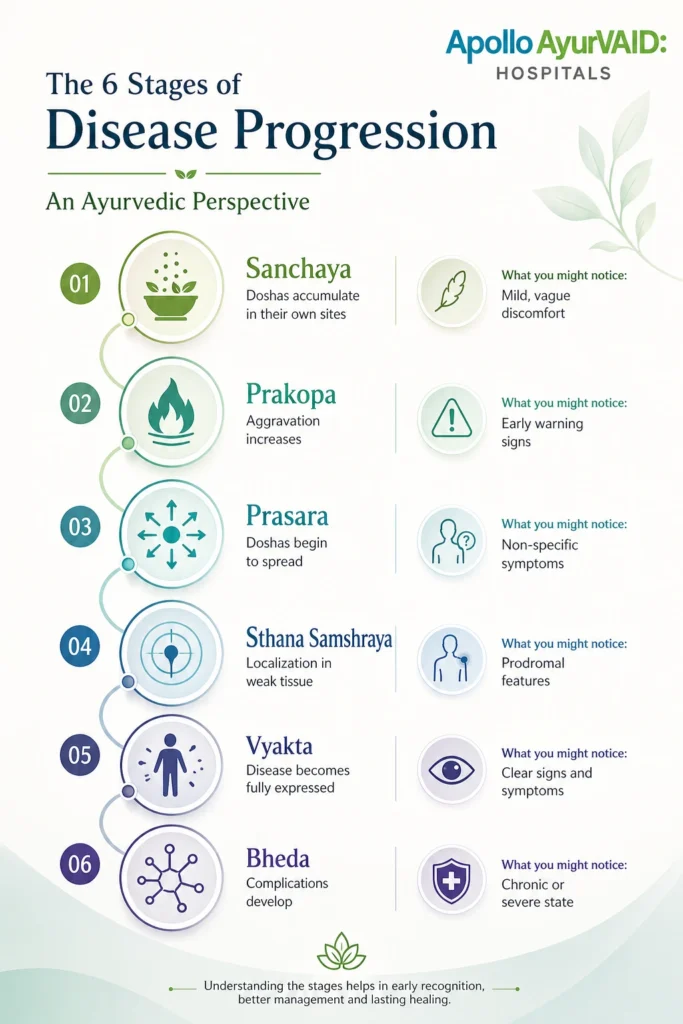
Disease does not suddenly appear overnight. It builds up slowly. Sometimes it happens so slowly that it almost goes unnoticed in the beginning.
Ayurveda explains this gradual development through six stages, known as Shatkriyakala. Each stage reflects a shift in the internal environment of the body.
At the centre of Samprapti lies the interaction between the Doshas and the Dhatus. Disease begins when Doshas lose their natural balance. This can happen due to diet, lifestyle, seasonal influences, or even small daily habits that seem harmless at first. Once disturbed, Doshas do not stay still. They begin to move. And when they move, they search for a place where resistance is low. This weak point in the body is called Kha Vaigunya.
When vitiated Doshas reach such a site and interact with Dhatus, the actual disease process begins. This interaction is known as Dosha Dushya Sammurchhana. It sounds technical, but in practice, it simply means that disturbed functional elements combine with vulnerable tissues. For example, Vata aggravated by dryness and excessive activity may settle in joints and lead to conditions resembling osteoarthritis.
In another situation, Kapha may obstruct pathways, indirectly disturbing Pitta and resulting in conditions like obstructive jaundice. So, it is not just about which Dosha is involved. It is also about where it acts and how.

Before going deeper, it helps to remember that not all diseases follow the same pattern. There are variations, and Ayurveda accounts for them through different types of Samprapti.
Samanya Samprapti
This is the general understanding of disease formation. It focuses on the primary Dosha involved. For instance, fever is mainly associated with Pitta. Prameha or diabetes is largely linked with Kapha. Even this basic level of understanding can guide initial treatment.
Vishesha Samprapti
This is where things become more detailed. It explains why the same disease may present differently in different individuals.
In real clinical settings, these categories often overlap. Things are rarely as neat as they appear in theory.
This is where Samprapti becomes truly useful. When a patient comes in, the goal is not just to label the disease. The aim is to understand the process behind it. What started it? How did it progress? Where has it settled? These questions matter. This is because treatment depends on answers to these questions.
A disease in its early stage behaves very differently from one that has already reached complications. Similarly, a Kapha-dominant condition may respond quickly, while Vata involvement often makes things more prolonged and complex. So Samprapti helps in seeing beyond symptoms. It connects the dots.
Treatment in Ayurveda is not just about removing symptoms. It is about interrupting the process that created them. This is called Samprapti Vighatana.
If the chain of events is understood properly, it can be reversed. Not all at once, but step by step. In early stages, simple dietary corrections may be enough. In later stages, more active intervention is needed. Sometimes the Doshas need to be redirected. Sometimes the focus is Srotoshodhana, or cleansing the channels.
In certain cases, one Dosha blocks another. Here, treatment becomes slightly tricky. The obstruction must be handled first. Only then can the primary imbalance be corrected. And when tissues are depleted (Dhatukshaya), nourishment becomes essential. So the approach keeps changing depending on the stage. There is no single fixed method. That is what makes it thoughtful rather than mechanical.
The importance of Samprapti becomes even clearer in chronic conditions. Most long-standing diseases do not begin as serious problems. They develop gradually. Stage by stage. Often, this happens without drawing much attention in the beginning. By the time clear symptoms appear, the disease has usually progressed through multiple levels.
If Samprapti is understood early, we can notice these subtle changes. That allows intervention before the condition becomes established. In chronic diseases, multiple Doshas are often involved. Sometimes all three. Different tissues may also be affected over time. Without understanding this sequence, treatment may remain incomplete or inconsistent. Samprapti provides that missing link. It helps decide what needs to be addressed first and what can follow later. Even modern conditions can be viewed through this lens. It offers a broader way of understanding disease—not just as a label, but as a process.
As we work hard to improve our services, your feedback is important to us. Please take a moment to help us serve you better.
Subscribe to our hospital newsletter for the latest health tips, updates on services, patient stories, and community events. Sign up today and stay informed!

Report Problem
Popular Searches: DiseasesTreatmentsDoctorsHospitalsWhole person careRefer a patientInsurance

