Childhood is a tender, busy stage of life. Bodies grow fast, minds learn a thousand small skills, and curious minds keep exploring. It’s normal for children to push limits, speak back, or have days when nothing seems to go right. But when difficult behaviors become constant and interfere with learning, friendships, or family life, we need to slow down. Around 10–20% of children and adolescents worldwide experience mental health difficulties at some point, so you are not alone in this concern.
If you find yourself asking, ‘Is my child simply energetic or truly hyperactive?’ Am I practising gentle parenting the right way? Is the home environment I’m creating helping my child learn, or could I be over-indulging them? They deserve thoughtful answers because they are honest and important.
When difficult behaviours are frequent, long-lasting, or harm learning, friendships or family life, they may point to behavioral disorders in children or persistent behavioral problems in children; the best first steps are calm observation, a compassionate professional assessment, and simple, consistent routines that support change.
What are behavioral disorders in children?
When we say behavioral disorders in children, we mean patterns of behaviour that are more intense, lasting and disruptive than typical age-related testing of limits. These common childhood behavioral problems cover several diagnoses –
- Attention-Deficit Hyperactivity Disorder (ADHD): A condition where a child finds it challenging to focus, sit or move constantly, act without thinking, and struggle to complete tasks much more than other children of the same age.
- Oppositional Defiant Disorder (ODD): A condition where a child frequently argues with adults, refuses to follow rules, gets angry easily, and shows stubborn or challenging behaviour much more than what is normal for their age.
- Conduct Disorder (CD): A serious behaviour problem where a child repeatedly hurts others, breaks rules, damages things, lies or steals, and shows little concern for consequences.
- Autism Spectrum Disorder (ASD): A developmental condition where a child has difficulty communicating and connecting with others, prefers repetitive actions or routines, and shows a strong interest in a limited number of activities.
Conditions like Unmada and Apasmara are frequently used to describe the behavioral problems in children in Ayurveda.
The causes of behavioral disorders
There is rarely a single cause. Biology, early life, and the child’s daily environment play a major role.
Biological & developmental
- Brain chemistry and wiring differences (attention, impulse control) are often seen with common childhood behavioral problems like ADHD.
- Family history and genetic vulnerability: consanguinity can increase risk.
- Birth and newborn complications (prematurity, low birth weight, neonatal problems).
Prenatal & early-life influences
- Maternal stress, poor nutrition or illness in pregnancy shape the child’s early temperament.
- Disrupted early caregiving or insecure attachment can weaken emotional regulation.
Everyday environmental drivers
- Chronic family stress, conflict or economic hardship.
- Poor sleep, irregular routines and high, unsupervised screen time.
- Diets low in regular nutrition and low in physical activity.
Toxins & adverse experiences
- Lead, pesticides or other environmental neurotoxins.
- Repeated adverse childhood experiences — neglect, trauma or exposure to violence.
Social and school factors
- Bullying, academic pressures without support, or chaotic schedules.
- Limited access to early identification and help increases the risk of persistent behavioral problems in children.
In Ayurveda, these disturbances are primarily attributed to imbalances in the mental gunas (Rajas and Tamas), which lead to impaired mental strength (Manasika Bala). Additionally, prenatal factors, including the mother’s diet, emotional state, and behavior during pregnancy, as well as heritable genetic traits (Vikritbeejadosha), significantly influence a child’s psychological health.
All these are valid causes of behavioral disorder — and because multiple factors usually interact, our care must be broad and individually tailored.
Signs to watch for
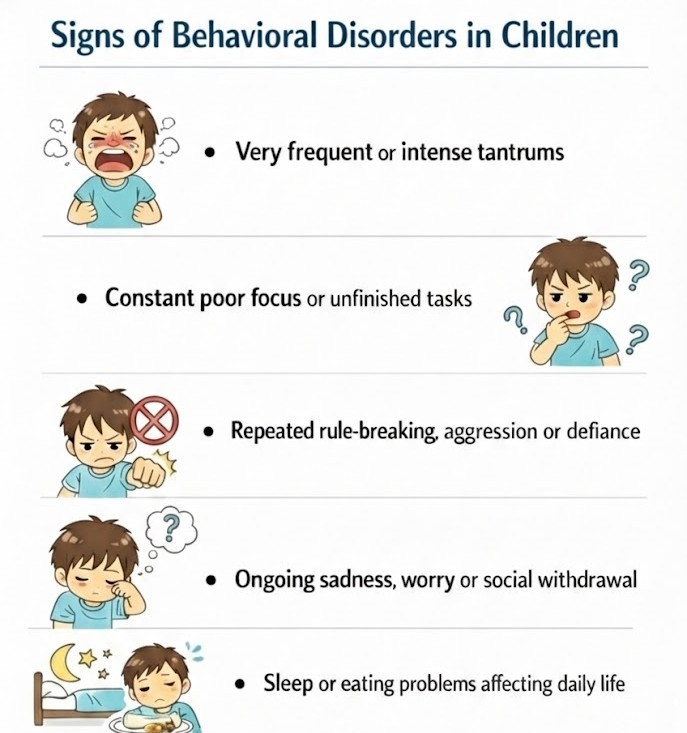
Tantrums and restless days are normal. Seek an evaluation when behaviours are intense or frequent, happen in many settings (home and school), or harm learning, friendships, or safety. Look for:
- Repeated, severe tantrums that don’t calm with normal comforting.
- Persistent inattention or task incompletion across settings.
- Ongoing disobedience, cruelty, or repetitive rule-breaking.
- Withdrawal, unrelenting sadness or anxiety, or frequent unexplained physical pains.
- Sleep or appetite changes that affect daytime functioning.
How we support children
The best outcomes come from combining clear practical steps with professional support and family coaching.
- Safety, routines and small wins
Break tasks into short steps, use brief movement breaks, and celebrate small successes. This stable framework often reduces the intensity of behavioral problems in children.
- Targeted professional help
Behavioural therapies, parent training and school supports teach skills that make daily life easier. Early communication between families and teachers prevents misunderstandings and supports learning.
- Parent coaching
Children observe their parents and learn. Thus, parents have an important role to play in shaping the child. Consistently setting calm limits, providing clear praise, establishing predictable consequences, and modelling self-regulation are effective strategies for reshaping behaviour.
- Ayurveda and Integrative Care
Ayurveda and integrative care manage behavioral disorders in children and prevent further progression and improve quality of life. The comprehensive approach includes traditional methods, modern psychological therapy, special education, and yoga to maintain emotional stability.
The focus of the integrated treatment is on the following three pillars:
- Satvavajaya Chikitsa (Psychotherapy) involves mental disciplines and thought restructuring, which can help replace negative behaviours with healthy thoughts.
- Yukti Vyapashraya (Rational Therapy) uses Medhya Rasayanas (nootropics) to improve cognitive functions, and techniques like Virechana, Nasya, Shirodhara, Shiroabhyanga, Shirolepa, and Vasti calm and strengthen the mind-body system.
- Daivavyapashraya Chikitsa uses spirituality-based rituals and mantras to balance mental energy.
- Milk, ghee, and whole grains in a disciplined lifestyle also help to further nourish the mind and develop it for the long run.
- Avoiding white flour, preserved, junk food, sugar, and baked food items also helps to further nourish the mind and develop it in the long run.
Real families, real hope
We often meet families who arrive exhausted and anxious, unsure whether change is possible, and witness drastic positive changes in their children after the treatment. The compassionate, personalised care can bring real change in behavioral problems in children.
Master K (15 years), who struggled with poor focus, emotional outbursts, anxiety, and learning difficulties linked to ADHD and autism spectrum features, experienced better sleep, reduced anger and agitation, and improved overall well-being within weeks of structured therapy.
Similarly, Master B (17 years), affected by developmental delays (ASD), hyperactivity, repetitive behaviours and disturbed sleep, showed a marked reduction in hyperactivity and impulsivity and improved sleep quality and calmer emotional responses. The details are given below.
Master K (15 years) — Emotional & Behaviour Regulation Outcomes
| Standard Measure | Before Treatment | After Treatment | Clinical Meaning |
|---|---|---|---|
| Emotional instability scale (0–10) | 8/10 (Severe) | 3/10 (Mild) | Strong improvement in emotional control |
| Anger intensity | High | Low | Marked reduction in outbursts |
| Anxiety level | High | Low | Improved calmness |
| Attention & focus | Severe difficulty | Moderate improvement | Better learning engagement |
| Wellbeing scale (1–5) | Low | Moderate–Good | Overall emotional recovery |
| Sleep duration | ~8 hours disturbed | ~11 hours restful | Nervous system regulation improved |
Master B (17 years) — Neurodevelopmental & Behavioural Outcomes
| Standard Measure | Before Treatment | After Treatment | Clinical Meaning |
|---|---|---|---|
| Childhood Autism Rating Scale (CARS) | 36.5 (Severe ASD range) | 34.5 (Moderate ASD range) | Shift toward milder symptom severity |
| Hyperactivity grading | High | Medium | Noticeable calming |
| Repetitive behaviours | Severe | ~50% reduction | Improved behavioural flexibility |
| Sleep quality | Poor (5–6 hrs) | Improved (6–7 hrs) | Better regulation |
| ADL independence | Needed assistance | Mostly independent | Functional improvement |
| Emotional regulation | Poor | Improving | Reduced impulsive reactions |

When to seek urgent help
Key takeaways
- Behavioral disorders in children are a very common phenomenon, and the best news is that they are treatable.
- Causes of behavioral disorder are multiple. Brain differences, genetic factors, prenatal and early-years factors, and family and environmental stresses are contributing factors.
- Symptoms of behavioral problems in children include hyperactivity, difficulty concentrating and agitation, etc.
- The comprehensive approach for common childhood behavioral problems includes Ayurveda therapies, modern psychological therapy, special education, and yoga to maintain emotional stability.
References
- Patil AC, Syamily P. Decoding Pediatric Behavioral Issues: The Influence Of Raja And Tama Doshas In Ayurveda. Int J Curr Sci. 2025;10.
- Kushwaha PK, Dash D, Kumar A, Gupta S, Kumar V. Ayurvedic Management of Behavioural Disorders in relation to Unmada and Apasmara in children: A Review. Int J Indig Herbs Drugs. 2025;10(2):1-7.
- Athira M, Jithesh M, Aparna PM. Ayurvedic Management of Attention Deficit Hyperactive Disorder with Comorbid Conduct Disorder: A Case Report. Int J AYUSH Case Rep. 2025;9(3).
- Bodake S, Chougule M, Patil D. Exploring Role Of Panchakarma In Pediatric Disorders: An Overview. IJCRT. 2025.
- Srivastava N, Saxena V. Role of Medhya Rasayanas (Nootropic Drugs) in Developmental Disabilities of Children. Int J Health Sci Res. 2019;9(6):315-322.