Every parent watches, astonished, as a tiny human learns to see, speak, solve problems and build friendships. Cognitive development is how children grow the mental tools they need to understand the world – attention, memory, language, reasoning and self-control. The early years lay down most of the blueprints for lifelong learning, emotional balance, and social success. Below, I explain the key brain development ages and stages, important milestones, and practical ways you can support your child’s growing mind.
The foundations: brain development ages and stages
Brain growth begins long before birth. By the sixth month of pregnancy, the cerebral cortex undergoes rapid structural changes, and what happens in the womb — maternal nutrition, stress levels and rest influences early wiring. After birth, the pace only quickens: neurones make millions of connections, shaped by experience and caregiving.
Broadly, we can describe stages this way:
- Infancy (birth–1 year): Rapid sensory learning and basic problem-solving. Babies learn through touch, sight, sound and movement.
- Early childhood (1–6 years): Explosive language growth, pretend play, and the beginnings of symbolic thought. This is a crucial window for vocabulary and social rules.
- Middle childhood (6–12 years): Logical thinking, classroom learning, planning and stronger memory skills emerge.
Understanding these brain development ages and stages helps parents set realistic expectations and offer the right experiences at the right time.
Milestones to watch in cognitive development in early childhood
Milestones are helpful checkpoints. Some typical signs during the first year include social smiling (about 6–8 weeks), good head control by 3–4 months, and responding to their name by 9–12 months. Between 1 and 3 years, children begin to use words, follow simple instructions, and show early pretend play. Around 3–6 years, symbolic thinking grows rapidly: children tell stories, ask “why”, and use imagination to solve simple problems.
One foundational skill to watch is object permanence. The concept that objects persist even when they are out of sight signifies the development of memory and reasoning. If you have concerns about delayed milestones, discuss them with your paediatrician or a developmental specialist early; early support matters.
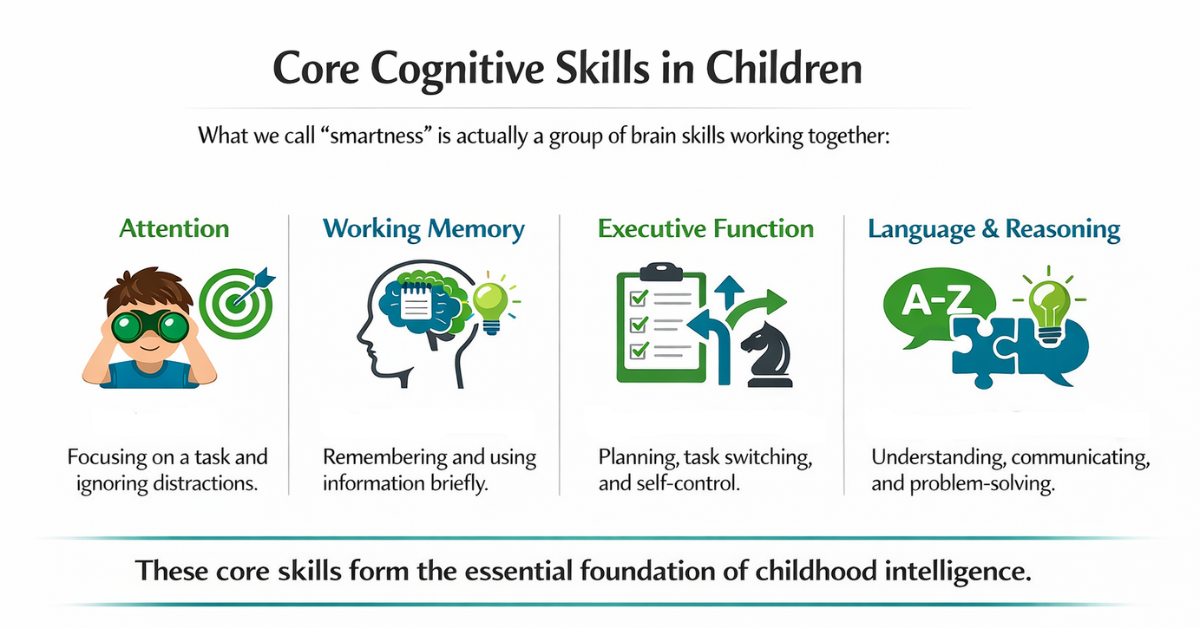
What we are really building: core cognitive skills in children
When we say a child is “smart”, we mean a set of building blocks that work together:
- Attention: The ability to focus and ignore distractions.
- Working memory: Holding and manipulating a small amount of information (for example, remembering a two-step instruction).
- Executive functions: planning, switching between tasks, and self-control— the brain’s traffic controller.
- Language and reasoning: Using words, understanding cause and effect, and solving problems.
In Ayurveda, these concepts map to classical concepts such as Dhee (perception), Dhriti (retention), and Smriti (memory). Combining modern developmental science and traditional wisdom gives a rounded approach to nurturing the mind.
Ayurveda offers time-tested practices designed to support the intellect and memory. Medhya rasayanas, the herbs and formulations thought to support cognitive function, are frequently mentioned in traditional texts. Commonly cited herbs for attention and memory include Brahmi (Bacopa) and Shankhapushpi. Simple dietary recommendations, such as using a small amount of cow ghee (for children over three), are part of classical guidance because they are believed to support digestion and nervous system nourishment.
Important safety note: while traditional herbs have a long history, modern dosing, quality control and individual responses vary. Always consult your child’s paediatrician before starting herbal preparations, especially if your child takes other medicines or has health concerns.
Practical tips to boost cognitive development in early childhood
Here are gentle, evidence-informed steps parents can use every day:
- Talk and read often. Conversation and shared reading build vocabulary and strengthen neural pathways. Describe what you’re doing, ask open questions, and listen.
- Play deliberately. Memory games, simple puzzles, matching cards, building blocks and pretend play all reinforce different cognitive skills in children. Games that ask a child to remember and act (Simon Says, hide-and-seek) train working memory and attention.
- “Use it or lose it.” Practice matters. Repetition—through stories, songs, and problem-solving—deepens learning.
- Healthy routine and sleep. Consistent sleep (8–10 hours for younger children, adjusted by age), regular meals and predictable daily rhythms help memory consolidation and emotion regulation.
- Physical activity and mind–body work. Movement supports brain health. Simple yoga, outdoor play and coordinated activities improve attention, motor planning and emotional control.
- Limit processed foods and screens. Excess sugar, highly processed snacks, and long screen times can affect attention and behaviour. Choose whole foods and interactive, age-appropriate screen time with limits.
- Teach emotional skills. Naming feelings, modelling calm, and practicing simple breathing help children manage impulses — a key part of executive function.

Daily edible foods to support the young mind
When we aim to nurture cognitive development across the brain development ages and stages, everyday foods are powerful allies. Below are practical choices backed by evidence
- Cow ghee (small amounts, age-appropriate): Traditionally valued for nourishing agni and the nervous system; modern reviews note anti-inflammatory fatty acids and fat-soluble nutrients in ghee that may support brain health when used sparingly. Consult your paediatrician about quantity.
- Walnuts: Rich in ALA (a plant omega-3), antioxidants and polyphenols. Trials suggest walnuts may help attention and cognitive markers when consumed regularly, though results vary by age and adherence. Offer in safe forms to avoid choking.
- Eggs (regular, age-appropriate servings): A practical source of choline and lutein — nutrients linked to memory and learning. Including eggs in a child’s diet can help meet choline needs, which are important for early brain wiring.
- Centella asiatica leaves (gotu kola / brahmi): Widely used traditionally and studied for neuroprotective and cognitive effects in preclinical and some human studies; including small amounts as chutney or flavoured buttermilk (tambuli) is a safe, food-first option.
- Ivy gourd (Coccinia, used as a vegetable): Nutritious vegetable in many Indian diets; adds fibre, micronutrients. This vegetable plays a crucial role in providing comprehensive nutrition that supports the brain.
Introduce allergenic foods, like eggs and nuts, according to paediatric guidelines. Never give whole nuts to toddlers (choking risk). Small portions and dietary variety beat “single-food cures.” These everyday foods, combined with sleep, play and responsive caregiving, most reliably boost cognitive skills in children
Conclusion
References

FAQ
- Sensorimotor (0–2 years): Learning through senses and movement.
- Preoperational (2–7 years): Rapid language development, imagination, and symbolic play.
- Concrete Operational (7–11 years): Logical thinking about concrete events.
- Formal Operational (12+ years): Abstract and hypothetical reasoning.
- Brain maturation: Natural growth and development of the brain.
- Building mental frameworks: Formation of cognitive structures to understand the world.
- Adaptation: Fitting new information (assimilation) and modifying ideas (accommodation).
- Equilibrium: Moving toward balance and understanding.
- Increasing thinking complexity: Gradual development of more advanced reasoning over time.