Living with diabetes requires constant attention to a delicate internal balance, including blood sugar, circulation, and nerve health. One of the most feared complications is a wound that won’t heal: the diabetic foot ulcer. If ignored, they can lead to infection, gangrene, and even amputation. The good news is that early detection can prevent most of the damage. This blog is about diabetic foot ulcer symptoms, diabetic foot ulcer treatment and what to do when you suspect an early stage diabetic foot ulcer.
Why are these ulcers a silent threat?
A major reason foot wounds become more problematic in people with diabetes is neuropathy — nerve damage that reduces or eliminates pain. Pain is our body’s warning system; when it’s muted, small injuries go unnoticed. Add to that poor blood flow from peripheral arterial disease, a sluggish immune response, and a persistently high sugar level—and you have an environment where a tiny blister can quietly deepen into a chronic wound.
The following list outlines the stages of diabetic foot ulcers:
Pre-ulcer stage: dry skin, cracks, callus formation, colour changes or numbness — warning signs that the foot is at risk
Early superficial ulcer: a small open sore or blister that may ooze fluid but is usually painless
Deep ulcer: wound extends into deeper tissue, sometimes exposing tendon or bone, with redness, swelling or discharge
Infected ulcer: foul smell, pus, increasing warmth and pain, sometimes fever — urgent medical care needed
Gangrene/critical stage: blackened tissue due to poor blood flow and severe infection — often leading to amputation if untreated.
These ulcers typically occur on the plantar aspect (bottom) of the foot, particularly in the ball of the foot and the heel.
Statistically, up to one-third of people with diabetes will develop a foot ulcer at some point. Yet many are unaware of the earliest changes. That is why vigilance matters. Visual inspection, daily care, and early diabetic foot ulcer treatment prevent amputation.
The early diabetic foot ulcer symptoms
Because pain may be absent, you must rely on observation. Look daily for the signs that commonly indicate a problem. These are the early clues that a small issue is becoming something more.
- Localised swelling (oedema) or prolonged redness may be the first indication of tissue stress or a low-grade infection. In Ayurveda, this equates to Paka (inflammation) and Ragata (redness), early signals that the local doshas are disturbed.
- Thickened skin or calluses at pressure points (ball of foot, base of great toe) can hide deeper tissue breakdown. Darkening of the skin, pigeon-grey or blackish hues suggests ischemia and poor circulation.
- Any fluid, staining of socks, or persistent foul smell must alert you. Clear, bloody, or purulent exudate — especially with odour — is a sign of infection.
The five local signs
Ayurveda gives a concise bedside checklist: Gandha (smell), Varna (colour), Srava (discharge), Vedana (pain—often absent but when present alarming), and Akriti (shape/size). Use these as a practical daily checklist when examining the foot.
If you discover any of these signs, do not assume it will “go away.” Early identification of a diabetic foot ulcer or of the precursors to one is the moment when intervention is most effective.
What drives progression
Persistent high blood sugar causes microvascular damage and poor oxygen delivery to tissues. Cells necessary for healing, such as fibroblasts and keratinocytes, become less effective. The wound environment becomes more hospitable to bacteria and less hospitable to repair.
From an Ayurveda perspective, the body’s tissues become laden with Meda (abnormal adipose changes) and Kleda (excess moistening/degenerative waste), while Sirashaithilya (vascular laxity) and Kathinya (sclerosis) make the limb a poor place to heal. Both language systems point to the same clinical fact: the “soil” is favourable for infection.
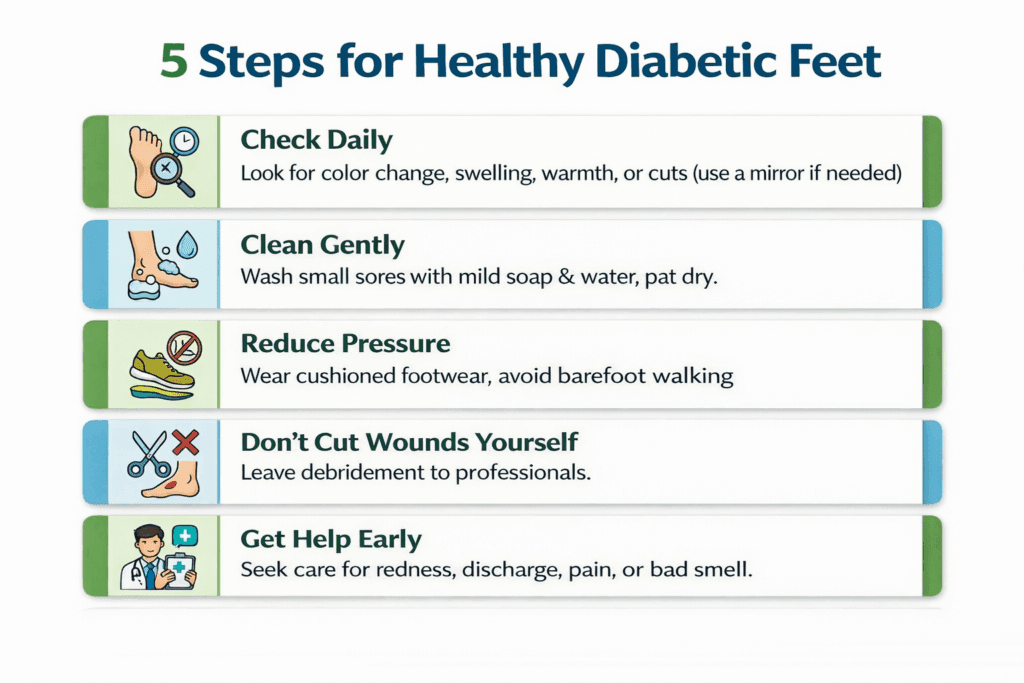
What you can do today
- Inspect daily. Use a mirror or ask a family member. Note any changes in colour, temperature, swelling, or the presence of breaks in the skin.
- Clean gently. If you notice a small sore, wash with mild soap and water. Pat dry; do not rub.
- Avoid pressure. Do not walk barefoot. Offload the area using cushioned footwear or temporary immobilisation if advised. Pressure is the single most important mechanical cause of progression.
- Do not self-debride aggressively. Removing dead tissue is beneficial, but improper home attempts may worsen the wound. Leave surgical debridement to professionals.
- Seek care promptly. If you see discharge, increasing redness, or any smell, contact your healthcare provider immediately for assessment.
These measures are helpful and reduce harm, but they are not a substitute for professional assessment and coordinated diabetic foot ulcer treatment.

Ayurveda and integrative measures
Ayurveda offers approaches that complement modern care when applied judiciously and by skilled practitioners. Traditional interventions for chronic ulcers include:
- Vrana Shodhana (cleansing) with herbal decoctions, which have antimicrobial and anti-inflammatory properties.
- Vrana Ropana (healing) involves the use of medicated oils and ghritas to promote granulation and epithelialisation.
- In carefully selected cases, Jalaukavacharana (leech therapy) is used to improve local microcirculation and remove congested blood. The leech saliva contains bioactive compounds that can be useful in chronic, non-healing ulcers.
Reducing pressure on the wound by resting the foot, using supportive footwear, and making small daily habit changes can help the ulcer heal faster and prevent worsening.
Integration means stabilising the patient with modern medical essentials — glucose control, antibiotics when needed, surgical debridement, and then using Ayurveda wound care as part of a healing plan. This collaborative approach can be particularly helpful in chronic, difficult-to-heal wounds.
How we treat these cases at Apollo AyurVAID
When a patient presents with an early stage diabetic foot ulcer, our approach is precise, evidence-based and staged: first, we stabilise the limb and the metabolism, then we restore a clean wound bed, and we support tissue regeneration while preventing recurrence.
We add local Vrana Shodhana and Vrana Ropana under strict asepsis and reserve parasurgical options (for example, Jalaukavacharana) only after careful case selection. Every treatment we use is evaluated based on clear measurements (like wound size, pain level, and healing progress) and health goals (like blood sugar levels), so we can track each week if the wound is improving from a bad state to a healed one. This combined, stepwise plan protects limb function and restores quality of life.
Mr KVA — age 58 presented with chronic non-healing ulcers of the great toe/sole. During treatment, he showed progressive granulation and reduced wound depth.
Mr K — age 61 presented with a medial right-foot ulcer with associated neuropathic symptoms. Over two weeks of integrative care, he experienced drastic improvements.
| Patient Name | Features Before Treatment | Key Outcome After Treatment |
|---|---|---|
| Mr KVA | Slough, poor granulation | Granulation tissue present, slough cleared, wound depth reduced |
| Mr K | Medial right-foot ulcer > 2 cm; VAS pain 5/10 | Ulcer reduced to ~1 cm (regular round); VAS 1/10; discharge and tenderness resolved |
When to seek urgent help
To conclude
An early stage diabetic foot ulcer may show up as a swelling, a stiff callus, or a faint odour. The absence of pain is not comfort; it is risk. Daily inspection, pressure relief, timely professional care, and an integrative approach combining the best of modern medicine and Ayurveda can change the story for many patients.
KEY TAKEAWAYS
- An early stage diabetic foot ulcer is often painless — daily foot inspection is the most powerful tool for prevention
- Swelling, redness, calluses, discharge, or a foul smell are the first signs of a diabetic foot ulcer, which should never be ignored
- High levels of blood glucose, together with impaired circulation, hinder the healing process. It is as important to deal with the diabetic condition as it is to deal with the wound itself.
- Timely treatment of diabetic foot ulcers involves wound management, infection control, and pressure relief measures. These have the potential to prevent amputation.
- Incorporating modern medicine with Ayurveda wound-healing modalities can improve the outcomes of chronic non-healing ulcers.
References
- Shindhe PS, Kale AP, Killedar RS. Integrative management of diabetic foot ulcers – A case series. J Ayurveda Integr Med. 2023;14(5):100770.
- Kim J, Nomkhondorj O, An CY, et al. Management of diabetic foot ulcers: a narrative review. J Yeungnam Med Sci. 2023;40(4):335-342.
- Banothe GD, Pawar C, More S. Comprehensive Ayurvedic Management of Diabetic Foot Ulcer -A Case Report. Indian J Nat Sci. 2024;15(85):77149-77152.
- Bopparathi S, Raju KVN. Diabetic foot ulcer with osteomyelitis, successfully treated with the holistic approach of multiple ayurvedic treatment modalities – A case report. Int J Surg Case Rep. 2023;107:108315.
- Rawekar SC, Bandwal PJ, Ansari YALA. Bridging the Gap: A Review of Ayurvedic Principles and Therapies for Integration into Contemporary Wound Care. Int J Res AYUSH Pharm Sci. 2025;9(3):1-8.