What is a learning disability — and why does it matter?
When a bright child struggles again and again with reading, writing, or maths, parents and teachers naturally worry: is this a phase, a motivation problem, or something deeper? A learning disability is not a sign of low intelligence or laziness. It is a neurodevelopmental condition that affects how the brain receives, processes, stores, or expresses information. The child’s potential (what they are capable of) and their actual school performance do not match in specific areas. In many communities, these differences are still misunderstood as “bad behaviour“, which adds stigma and unnecessary pain. This blog explains, in gentle and practical language, how to recognise difficulties, what causes them, and how a combined modern Ayurveda approach can help a child thrive.
Understanding the types of learning disabilities
The term ‘learning disabilities’ is an umbrella that covers specific, often lifelong patterns of difficulty. Each has its profile:
- Dyslexia (reading disability): The most frequently seen problem in children with learning challenges. Dyslexia affects reading, decoding, spelling, and sometimes working memory. Children may reverse letters (for example, ‘b’ and ‘d ’) or find it hard to map sounds to letters (phonologic processing).
- Dysgraphia (writing disability): This shows up as inconsistent, cramped, or illegible handwriting and difficulty organising written ideas. The child may understand a concept verbally but struggle to express it on paper.
- Dyscalculia (mathematics disability): Children with dyscalculia find number sense hard — for example, estimating quantities, remembering arithmetic facts, or following multi-step calculations.
- Intellectual disability: Defined by an IQ below 70, along with difficulties in daily adaptive skills. Many cases are mild, but support is essential for independence.
- ADHD (Attention-Deficit/Hyperactivity Disorder): Often co-occurs with other learning challenges. It involves inattention, impulsivity, and hyperactivity, which can make structured learning difficult.
Identifying symptoms of learning disabilities
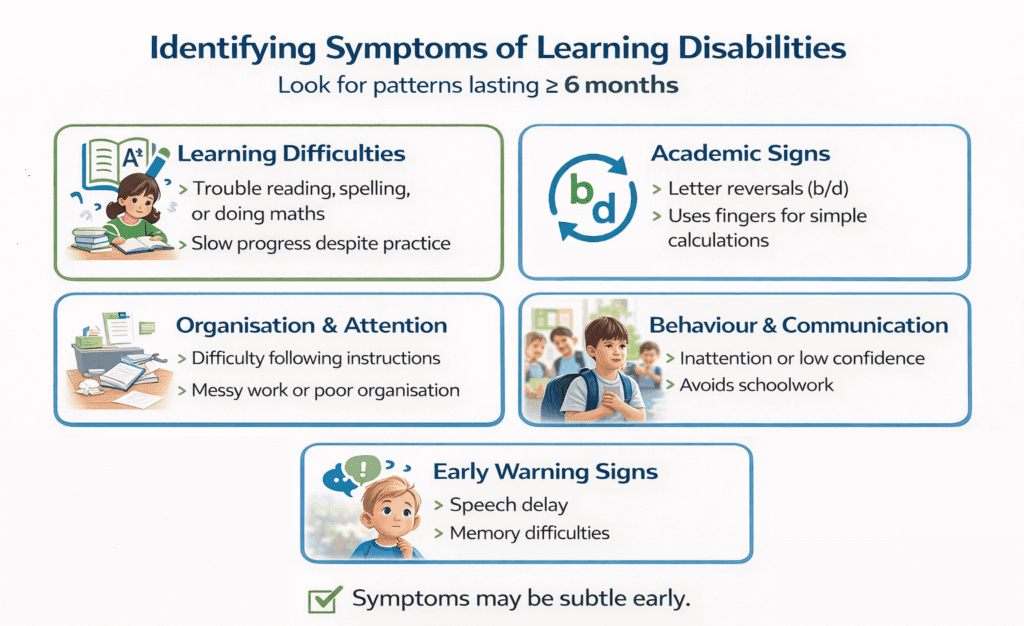
To identify symptoms, look for consistent patterns that have been present for at least six months, including:
- Difficulty in learning to read, spell, or perform math calculations after extensive instruction.
- Frequent reversal of letters (b and d), poor reading skills, or the use of fingers to perform simple arithmetic calculations.
- Trouble following complex directions, disorganisation of schoolwork, or messy handwriting.
- Behavioural symptoms, including inattention, lack of confidence, avoidance of schoolwork, or difficulties with nonverbal communication.
- Speech or memory delays may be the first signs.
These learning disabilities symptoms may first appear quietly and become more obvious as classroom demands increase.
What causes a learning disability?
In my clinical experience, learning difficulties usually come from a mix of biological and environmental influences rather than a single cause.
- Genetics matter: a family history often shows the pattern — conditions like dyslexia frequently run in families.
- Before birth, the mother’s health is important. Illnesses or exposure to toxins, alcohol, or cigarette smoke can affect how the baby’s brain develops.
- Around the time of birth, complications such as prematurity or reduced oxygen (hypoxia) can increase the risk of later learning problems.
- After birth, serious infections (for example, meningitis) or head injuries in early childhood may have a permanent effect on learning.
- Finally, a deprived or unstimulating early environment can make existing vulnerabilities worse, though by itself it rarely causes a specific neurodevelopmental disorder.
Knowing these factors helps us focus on prevention, early detection, and supportive care and strengthening the child’s developmental potential.
Integrative care — combining modern strategies with Ayurveda
There is no single “cure” in conventional medicine, but there are powerful interventions: special education, tailored teaching strategies, occupational therapy, speech therapy, and when needed, medication for co-occurring ADHD. Integrating supportive Ayurveda practices can offer additional, holistic benefits, particularly in calming the nervous system and improving attention and memory.
In Ayurveda, learning isn’t considered one single event but as a delicate teamwork between many parts of you — your senses and actions (Indriyas), the things those senses connect with (Indriyartha), your mind (Mana), the self (Atma), and your understanding or judgement (Buddhi). At the practical level, this whole process depends on three mental powers: Dhi (the ability to take in new information), Dhriti (the power to hold and stabilise that learning), and Smriti (the ability to remember and recall what you’ve learned).
These mental functions work best when your basic bodily forces are in balance. Ayurveda describes this balance through the Tridosha (Vata, Pitta, Kapha) and the Triguna (Sattva, Rajas, Tamas). When these balances are disturbed—especially when Vata (which governs movement and neural communication) becomes irregular—the smooth coordination between Dhi, Dhriti, and Smriti can falter. Ayurveda calls this loss of proper coordination Vibhramsha.
Classical Ayurveda books do not have a direct phrase that matches modern “learning disability”, but they do describe similar states under terms like Buddhimandya (reduced intellectual function) or Manovikaras (disorders of the mind). The Ayurveda approach is essentially psychosomatic: it aims to calm and nourish the nervous system, correct imbalances, and strengthen the mental faculties. This procedure is done with targeted nootropic herbal formulations called Medhya Rasayanas and with supportive therapies.
Therapies that may help:
- Panchakarma (detoxification procedures) in a pediatric-appropriate format can be recommended when an imbalance is identified.
- Shirodhara (gentle oil flow to the forehead) may calm an overactive mind and improve sleep and attention.
- Vasti (medicated enemas) — specifically Matravasti with ghrita formulations — is used to pacify Vata (which governs nervous function).
- Nasya (nasal administration of medicated oils) — since the nose is considered a direct route to the brain, selected oils may be used carefully to support cognition.
- Abhyanga (therapeutic oil massage) — improves circulation, reduces stress, and supports body–mind regulation.

A practical plan for parents and teachers
- Get a proper assessment early. A child’s difficulties deserve a clear diagnosis and an individualised education plan.
- Combine evidence-based school interventions (structured literacy programs for dyslexia, multisensory maths teaching for dyscalculia, and occupational therapy for dysgraphia) with lifestyle supports: regular sleep, balanced meals, and predictable routines.
- Consider Ayurveda support only with professional supervision and as an adjunct to classroom and therapeutic interventions.
- Focus on the child’s strengths. Build confidence through small, achievable goals, praise effort, and use practical accommodations (extra time, alternative formats, oral testing).
- Explain the condition simply to family, classmates, and teachers so the child feels supported, not blamed.
Conclusion
References