Every few weeks in the clinic, a woman will pause halfway through explaining her symptoms and say something like, “I know this sounds vague, but I just don’t feel like myself.”
It’s not always easy for her to describe. Nothing dramatic has happened. No sudden illness. Just small changes that slowly add up — lower energy, heavier moods, strange sleep patterns, weight behaving differently, maybe hair fall that wasn’t there before.
Individually, these things seem minor. Together, they often turn out to be signs of hormonal imbalance in women.
Hormones rarely get the attention they deserve until something goes wrong. Yet they regulate a surprising number of everyday functions: metabolism, mood, sleep cycles, reproductive health, thyroid activity, appetite, and even how the skin behaves.
When they lose balance, the body doesn’t usually fail suddenly. It drifts a little first. And the early signals are easy to dismiss.
Hormones Don’t Only Affect Periods
Most women still associate hormones mainly with menstruation. That’s understandable, but it’s only part of the story.
Hormones influence the brain, metabolism, sleep rhythms, digestion, and energy production. A small shift in thyroid hormones can change how energetic someone feels throughout the day. Changes in stress hormones can affect appetite and sleep. Reproductive hormones influence mood, body temperature, and concentration. Because of this, hormonal imbalance symptoms in females can appear in very different ways.
One woman comes in because her periods have become irregular. Another complains mainly of fatigue. A third patient says she suddenly feels anxious for no obvious reason. On paper, the symptoms look unrelated, but often they lead back to the same underlying hormonal imbalance.Ayurveda tends to view these changes as a gradual disturbance in internal balance. When lifestyle habits strain the body—irregular meals, chronic stress, poor sleep— Kapha and Vata may become aggravated. Over time, digestive efficiency (Agni) weakens, allowing metabolic residue known as Ama to accumulate.
That process can eventually disturb tissues such as Rasa dhatu and Medo dhatu, which play a role in metabolism and hormonal regulation. It’s rarely a sudden event. More like a slow shift.
Understanding the Causes of Hormonal Imbalance
- Chronic stress
- Irregular eating schedules
- Poor sleep patterns
- Sedentary lifestyles
- Thyroid disorders
- Polycystic ovarian syndrome
- Insulin resistance
- Natural hormonal transitions like menopause
Signs of Hormonal Imbalance
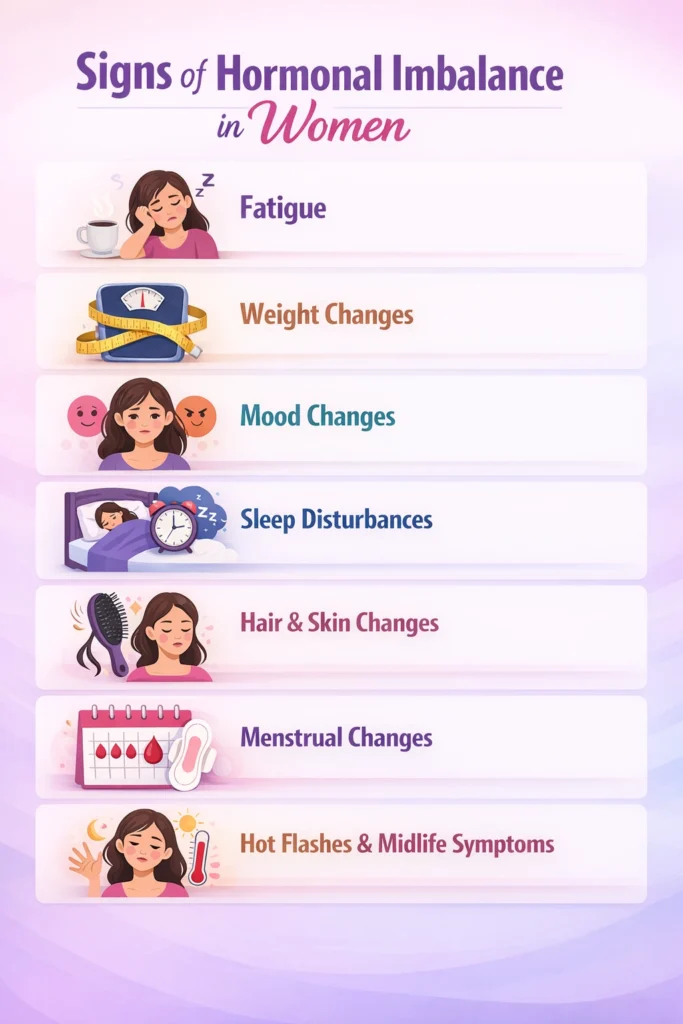
Fatigue That Feels Out of Proportion
One of the earliest symptoms of hormonal imbalance in women is fatigue — but not the ordinary kind.
Patients often say something like, “I’m sleeping, but I still feel tired.”
Or they wake up with reasonable energy and then crash by mid-afternoon. Concentration becomes harder. The brain feels slightly foggy. Even simple routines require more effort than usual. Sometimes thyroid imbalance is involved. Sometimes, prolonged stress hormones are part of the picture. The body is technically functioning, but it’s not generating energy efficiently.
People feel it long before blood tests change.
Weight Changes That Don’t Add Up
Another familiar pattern is gradual weight gain that doesn’t seem to match lifestyle habits.
A patient will say, “I’m eating the same way I always have, but something is different.”
Weight tends to gather around the abdomen. Sugar cravings become stronger. Losing weight becomes unexpectedly difficult.
These are common hormonal imbalance symptoms in females, often linked to thyroid hormones, insulin regulation, or metabolic signalling. Once metabolism shifts, hormones often follow.
Mood Changes That Feel Unfamiliar
Emotional changes are another piece of the puzzle, though they’re often misunderstood.
Women sometimes describe irritability they can’t explain or a kind of restlessness that wasn’t there before. Small frustrations suddenly feel larger. Occasionally, there’s a persistent low mood without a clear reason.
Hormones play a significant role in brain chemistry. Oestrogen, progesterone, cortisol, and thyroid hormones all influence mood regulation.
When these signals fluctuate, emotional resilience can shift too. It doesn’t mean something is “wrong” psychologically. Often, the body is simply adjusting to a hormonal change.
Sleep That Stops Feeling Restful
Sleep issues show up quietly in many women experiencing hormonal disruption.
Some take longer to fall asleep. Others wake at 3 or 4 in the morning and struggle to return to sleep. And sometimes people say the sleep itself feels shallow — they wake up feeling as though they barely rested.
Hormonal fluctuations can influence circadian rhythms, especially during prolonged stress or the hormonal transition of perimenopause.
Sleep disturbances then feed back into a hormonal imbalance, making everything else feel a little heavier.
Hair, Skin, and Other Subtle Signals
The body sometimes shows hormonal shifts through small physical clues.
Hair fall increases. Skin behaves differently — acne appears unexpectedly, or dryness becomes persistent. Hair may thin near the temples or along the parting.
These changes often feel cosmetic at first. But hair follicles and sebaceous glands respond quickly to hormonal signals.
Menstrual Changes Still Matter
Although hormones affect many systems, menstrual patterns remain one of the clearer signs and symptoms of hormonal imbalance in women.
Cycles may become irregular. Bleeding patterns change. Some women experience stronger premenstrual symptoms than they used to.
Sometimes the connection is obvious. Other times, menstrual changes appear months after fatigue or mood changes begin. The body’s rhythms tend to shift together.
Hormonal Changes Around Midlife
Perimenopause introduces another layer of hormonal variation.
Women may experience hot flushes, sleep disruption, mood fluctuations, or a kind of mental fog that’s difficult to describe. Memory feels slightly slower. Concentration slips more easily.
Not everyone experiences this stage the same way. Some women move through it with minimal discomfort. Others feel the effects much more strongly.
Lifestyle habits and metabolic health often influence how smooth that transition becomes.
What Can Be the Challenges of Hormonal Disruption?

How to Check Hormonal Imbalance
When symptoms persist, proper evaluation becomes important.
Understanding how to check hormonal imbalance usually begins with a consultation and laboratory testing. Doctors may assess thyroid hormones, reproductive hormones, and metabolic markers depending on symptoms.
Just as important is the conversation about sleep, stress levels, menstrual history, and eating patterns. Numbers provide information. Context explains them.
Apollo AyurVAID Approach
At Apollo AyurVAID, hormonal disorders are approached by looking beyond isolated symptoms.
Consultations explore metabolic health, lifestyle habits, stress patterns, and systemic imbalances. Treatment plans typically combine dietary guidance, structured therapies, and customised care aimed at restoring metabolic balance.
The intention is not quick symptom suppression but helping the body regain its natural regulatory rhythm over time.
A Closing Thought
Hormonal imbalance usually begins subtly.
More often, it starts with small signals — tiredness that lingers, sleep that changes, emotions that feel slightly unfamiliar, and a metabolism that behaves differently.
Those signals are easy to overlook in the middle of busy lives.
But they are also the body’s quiet way of asking for attention.
References