There is a phase many women go through without realising it.
You start noticing small shifts. Your periods aren’t as predictable. Some nights you sleep deeply; other nights you’re awake at 3 a.m. for no clear reason. You may feel more irritable than usual, or suddenly low, or just… different. It doesn’t feel dramatic enough to be considered a “problem.” But it doesn’t feel like your old normal either.
So you wait it out. You blame stress. Work. Age. Maybe diet. Weeks pass. Then months. The pattern doesn’t settle. This is often where perimenopause begins—not as a clear event, but as a quiet, confusing transition that slowly becomes harder to ignore.
If you’ve been asking yourself what is perimenopause, or wondering why your body feels unpredictable lately, you’re not alone. Many women enter this phase without clear information, and that uncertainty can make everything feel more overwhelming than it actually is.
What Is Perimenopause?
At its core, perimenopause is the transition phase before menopause. Your ovaries are still functioning, but hormone levels, especially oestrogen, start to fluctuate. Not decline in a straight line. Fluctuate. That’s an important difference.
Because of this, symptoms don’t follow a neat pattern. One cycle may feel normal. The next might feel entirely different. Ovulation becomes irregular. Some months it happens. Some months it doesn’t. And your body responds to that inconsistency in different ways.
From an Ayurveda lens, this phase is often linked with an imbalance of Apana vata dosha. Vata governs movement, variability, and change. When it increases, the body tends to become less predictable—physically and mentally. You may notice that unpredictability before you can explain it.
Why It Can Be Hard to Recognise
Understanding what is perimenopause doesn’t always make it easier to identify in real life. Because the symptoms don’t arrive all at once. They come in pieces. A late period here. A restless night there. A sudden drop in patience that surprises even you. None of these feels serious on its own. So they’re often dismissed. Sometimes, even by doctors, especially in the early stages. And if you’re in your late 30s or early 40s, it may not even cross your mind that this could be hormonal. That delay in recognition is common.

What Are the First Signs of Perimenopause?
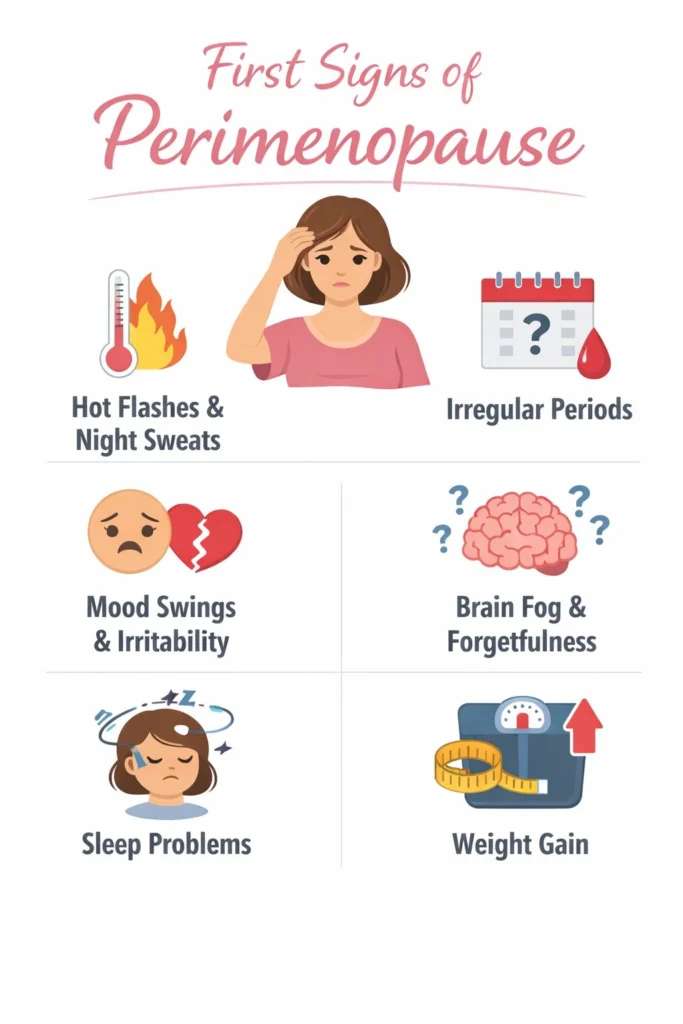
The first signs are usually quiet. Easy to overlook. Cycle changes are often the earliest clue. Your period may come sooner than expected or get delayed without warning. Flow can change too—lighter some months, heavier others.
Sleep is another early signal. You might fall asleep without difficulty but wake up in the middle of the night, alert and unable to drift back. It doesn’t always feel like insomnia. Just… interrupted rest. Some women also notice a sluggish metabolism, which may lead to weight gain.
Mood shifts can appear before anything physical feels obvious. You may feel more reactive. Small things irritate you more than they used to. Or you feel a kind of emotional sensitivity that’s difficult to explain.
In Ayurveda, this reflects shifts in vata dosha and sometimes pitta dosha, influencing both the nervous system and emotional balance.
Perimenopause Symptoms You Should Know
When people discuss perimenopause symptoms, they often expect a fixed list. But it rarely shows up that neatly.
Hot flashes are common, yes. Sudden warmth, flushing, sometimes sweating. But not everyone experiences them early. Fatigue can creep in quietly. Not extreme exhaustion. Just a steady drop in energy that doesn’t fully recover with rest. Then there’s brain fog. You walk into a room and forget why you’re there. You lose track of conversations. Words don’t come as quickly. It can feel unsettling.
Physical changes may show up in subtle ways. Dry skin. Slight joint stiffness in the morning. Hair that feels thinner than before. These are easy to dismiss, but they’re part of the broader picture of perimenopause symptoms.
Digestion can change. Foods you tolerated easily before may now cause bloating or discomfort. Your appetite might feel irregular. Weight distribution may shift too. Even without major lifestyle changes, fat may accumulate more around the abdomen. This can feel frustrating, especially when nothing obvious has changed in your routine.
Libido doesn’t stay consistent either. It may drop. Then return. Then drop again. That fluctuation is part of the hormonal pattern, not something separate. Stress tolerance often changes as well. Situations that once felt manageable may now feel overwhelming or draining. In Ayurveda understanding, this can relate to reduced ojas, the body’s reserve of strength and stability.
What Causes Perimenopause?
The main driver of perimenopause is the gradual shift in ovarian function.
Hormones don’t shut down overnight. They become irregular first. Oestrogen and progesterone rise and fall in unpredictable ways. This irregular signalling affects multiple systems in the body—sleep, mood, metabolism, and more. Age plays a role, but it’s not the only factor.
Chronic stress can intensify symptoms. Poor sleep makes everything feel worse. Nutritional gaps may also influence how strongly symptoms show up.
Why Symptoms Feel Inconsistent
One of the hardest parts about perimenopause symptoms is not just the symptoms themselves but their unpredictability. You might feel fine for a while. Then suddenly, everything feels off at once. It’s not your imagination.
Hormones are still active during this phase. They’re just less stable. That instability creates waves of symptoms rather than a steady pattern. This is why it can feel confusing. And sometimes frustrating.
The Emotional Side
There’s also an emotional layer that doesn’t always get talked about. You may feel less like yourself at times. More restless. More inward. Or just slightly disconnected from your usual rhythm. Some days are fine. Others feel heavier, without a clear reason. In Ayurveda, this connects to shifts in manas (the mind), influenced by vata and rajas guna. When these are elevated, mental activity can feel scattered or intense. It’s not just emotional. There’s a physiological basis underneath it
When to Pay Attention
Not every symptom needs immediate action. But some things shouldn’t be ignored. Very heavy bleeding. Cycles that come very close together. Persistent fatigue that interferes with daily life. These are worth checking. It’s also important to rule out other conditions that can look like perimenopause symptoms, such as thyroid issues or anaemia. Being aware helps. You don’t have to jump to conclusions—but you don’t have to dismiss everything either.
Living Through It
Final Thoughts
References