Most people rarely think about their kidneys. They sit quietly in the background doing an enormous amount of work — filtering blood, balancing fluids, and removing metabolic waste. This happens continuously. Day and night. Usually, without any obvious signal to us.
That’s partly why World Kidney Day exists. It encourages people to pause and pay attention to kidney health before problems become noticeable. This year’s theme for World Kidney Day is “Kidney Health for All – Caring for People, Protecting the Planet.” At first glance, the second part of that theme may seem unusual. What does the planet have to do with kidney health? In reality, quite a lot.
Environmental conditions can influence kidney function in ways that are easy to overlook. Repeated dehydration during extreme heat puts strain on the kidneys. Over time, that stress can contribute to kidney damage. Similarly, water quality matters. In some regions, contaminated drinking water contains toxins or heavy metals that gradually affect kidney tissue. These environmental risks often overlap with limited access to healthcare. When that happens, kidney disease may remain undetected for years.
So the theme of World Kidney Day highlights two connected ideas: caring for people through early detection and treatment, while also protecting the environmental conditions that influence kidney health in the first place.bbj j0j
Understanding Kidney Disease
Kidney disease isn’t a single condition. Clinically, we see a range of problems — kidney stones, infections, autoimmune disorders, and sudden kidney injury after severe illness. Some resolve. Others require longer treatment.Chronic Kidney Disease, usually abbreviated CKD, is different. The change happens slowly. Months. Often years.
In Chronic Kidney Disease, the kidneys gradually lose their ability to filter waste products from the blood. The decline is usually subtle at first. Patients often feel well. A routine blood test shows something slightly abnormal. Perhaps creatinine has crept up (a waste product in the blood that kidneys normally filter out). Or eGFR is lower than expected for age (an estimate of how well the kidneys are filtering blood). Sometimes protein appears in the urine.
From the perspective of Ayurveda, kidney function relates to Mutravaha Srotas — the channels involved in urine formation and excretion. Disturbances in these pathways may occur when Kapha obstructs Mutravaha srotas or micro-channels or when aggravated Vata contributes to progressive tissue degeneration. Descriptions differ. The general idea of gradual loss of function is not very far apart.
Chronic Kidney Disease Symptoms
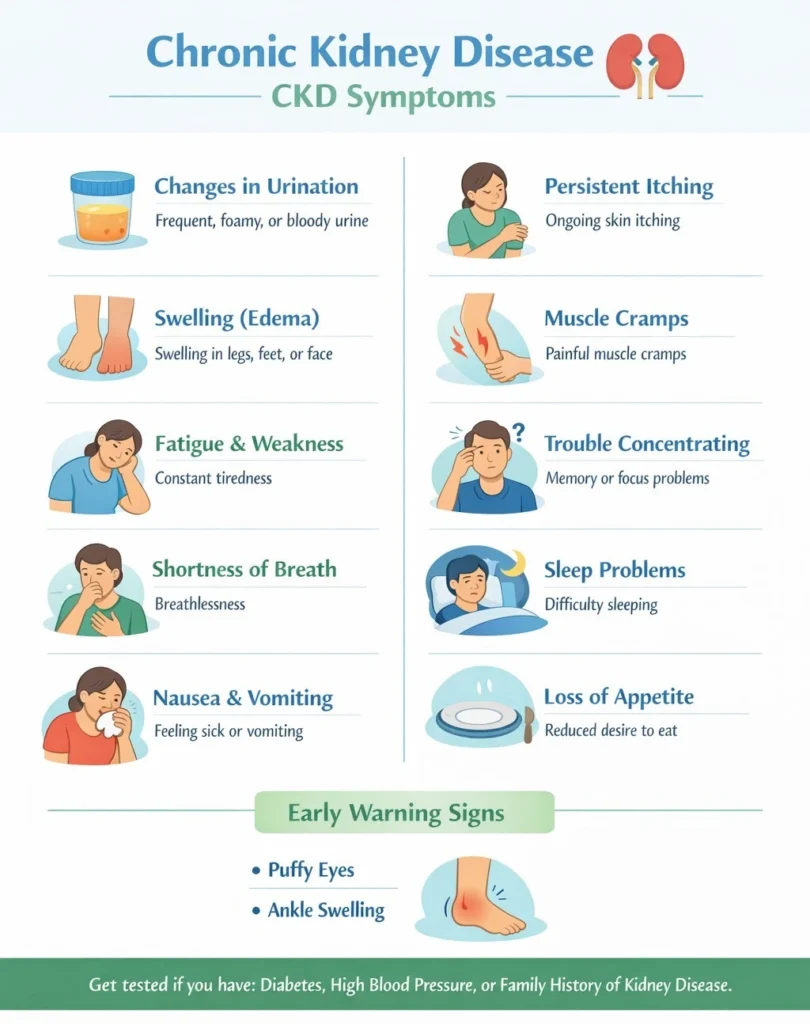
Early chronic kidney disease symptoms are not dramatic.
People mention fatigue. Not severe, just persistent. Ankle swelling by evening comes up occasionally. Some notice it when their footwear feels tight.
Nighttime urination can appear as well, though that has many possible causes, such as fluid retention during the day or underlying medical conditions like diabetes or urinary tract infections. Loss of appetite sometimes shows up later. Nausea, less common in the early stages.
As kidney function worsens, other symptoms arise.
Doctors often detect kidney disease symptoms indirectly through testing rather than complaints.
Blood tests may show:
- rising creatinine
- higher blood urea
- declining eGFR
Urine testing can reveal proteinuria, which may appear long before obvious symptoms develop. Many individuals with early CKD continue their normal routines without realising anything has changed.
Chronic Kidney Disease Causes
Chronic kidney disease causes usually involve long-standing medical conditions.
Two show up repeatedly in clinical practice. Diabetes is one. High blood pressure is the other.
Over the years, elevated blood sugar damages the filtration units of the kidney (diabetic nephropathy). Persistent hypertension affects the small blood vessels supplying those structures. Other causes exist. Chronic kidney inflammation, side effect of some medications, environmental toxins, recurrent urinary infections, autoimmune diseases, and certain inherited disorders.
How CKD Stages Progress
Complications of Chronic Kidney Disease
When chronic kidney disease progresses, the effects extend beyond the kidneys themselves.
Fluid balance becomes harder to maintain. Swelling appears in the legs or around the face. Blood pressure frequently rises.
Some patients develop anaemia because the kidneys produce less erythropoietin. Bone and mineral disturbances can occur as well. Electrolyte imbalance is another concern — particularly high potassium, which physicians monitor closely. Cardiovascular risk also increases in advanced kidney disease.

Simple Ways to Support Kidney Health at Home
Daily habits influence kidney health more than most people realise. A few practical adjustments can help reduce long-term strain on these organs.
- Keep hydration steady through the day. Many people drink very little water during busy hours and then try to compensate later. Regular intake tends to be easier on the kidneys than long gaps followed by large amounts at once.
- Salt intake deserves attention. Packaged snacks, processed foods, and restaurant meals often contain far more sodium than expected. Excessive salt intake puts an undue workload on the kidneys.
- Meals built around whole foods usually place less metabolic stress on the body. Vegetables, fruits, grains, and moderate protein create a more balanced dietary pattern than diets dominated by ultra-processed foods.
- Don’t make a habit of holding urine for long periods. Busy schedules sometimes lead people to ignore the urge, but doing this repeatedly isn’t ideal for the urinary system.
- Be cautious with frequent painkiller use. Some medications that seem routine — particularly when taken often or without supervision — can affect kidney function over time.
- Try to limit everyday exposure to environmental contaminants where possible. In some settings, this may involve paying attention to water quality, workplace chemicals, or long-term contact with pollutants. Over many years, certain heavy metals and industrial toxins have been associated with kidney injury.
- People living with diabetes or high blood pressure already know how much routine monitoring matters. These conditions affect the kidneys gradually, often long before symptoms appear, so regular check-ups and good day-to-day control become part of protecting kidney function over time.
- Routine health checks occasionally reveal early kidney changes. Blood tests and urine analysis can detect problems long before symptoms appear.
A Closing Reflection on World Kidney Day
One of the challenges with chronic kidney disease is how gradually it develops. For long periods, there may be very little to signal that kidney function is changing. Changes often begin long before symptoms draw attention. By the time fatigue, swelling, or appetite changes appear, kidney function may already be reduced.
This is why World Kidney Day focuses so much on awareness and early testing. A simple blood test or urine test can reveal changes that would otherwise remain hidden. The theme also draws attention to something broader. Kidney health does not exist in isolation from the environment. Heat exposure, access to safe drinking water, and working conditions all influence how much stress the kidneys face over the years.
For most people, protecting kidney health does not involve dramatic interventions. It often comes down to ordinary decisions repeated daily — drinking enough water, managing blood pressure, keeping chronic conditions under control, and paying attention to routine health checks.
The kidneys handle an enormous workload every day. A little attention to their health early on can make a real difference. Most of the time, they simply ask for a bit of attention before problems develop.
References
- Sharma B, Shukla GD, Sharma P. Management Of Chronic Kidney Disease By Ayurveda wsr To Basti. International Ayurvedic Medical Journal {online}. 2020.
- Rachana MS, Totad M., Girish KJ, Vasantha B, Powar Vibhu. Ayurvedic management of Chronic Kidney Disease : A Case Report. J Ayurveda Integr Med Sci 2019;6:285-290.
- Levey, A. S., Coresh, J., Balk, E., Kausz, A. T., Levin, A., Steffes, M. W., … Eknoyan, G. (2003). National Kidney Foundation Practice Guidelines for Chronic Kidney Disease: Evaluation, Classification, and Stratification. Annals of Internal Medicine, 139(2), 137.
- Kidney Disease: Improving Global Outcomes (KDIGO) Acute Kidney Injury Work Group.KDIGO clinical practice guideline for acute kidney injury.KidneyIntSuppl. 2012; 2(suppl 1):1–138.
- Gaikwad S. Ayurvedic management of chronic renal failure: A non-randomized ayurvedic clinical trial. Indian J Appl Res. 201