Sleep is one of those things people rarely think about… until it stops coming easily. Some nights it happens naturally. You lie down, close your eyes, and before long, the alarm rings in the morning. Other nights are different. The body feels tired, but the mind keeps wandering. A small memory from earlier in the day pops up. Tomorrow’s tasks suddenly feel urgent. The pillow gets turned over. The blanket adjusted. Eventually, sleep arrives. But it feels lighter somehow. Most of us recognise that experience. This is part of the reason World Sleep Day is observed every year. In 2026, it falls on 13 March, carrying the theme “Sleep Well, Live Better”, a gentle reminder to pay attention to how well we actually sleep — not just the number of hours, but whether the body truly feels rested.
One restless night is usually manageable. But when poor sleep continues for several days or weeks, people start noticing small changes. Energy becomes unpredictable. Mood fluctuates. Even digestion may begin to feel slightly off. Ayurveda recognised this connection long ago.
In Ayurveda, Nidra (sleep) is described as one of the three pillars that support health, along with Ahara (food) and Brahmacharya (regulated lifestyle). A verse from the Charaka Samhita explains this quite directly:
Nidraayattaṁ sukhaṁ duḥkhaṁ puṣṭiḥ kārṣyaṁ balābalam
Vṛṣatā klībatā jñānam ajñānaṁ jīvitaṁ na ca.
It suggests that happiness and distress, strength and weakness, nourishment and depletion — even life itself — are closely linked with sleep. That may sound dramatic at first. But if someone has experienced long-term sleep disturbances, the idea begins to make sense.
Why Sleep Becomes Disturbed
Sleep rarely becomes irregular without a reason. Most of the time, it is the result of small changes in daily life that gradually add up. Stress is one of the most common triggers. When the mind stays busy — replaying conversations, planning tomorrow’s work, or worrying about something unfinished — it can take longer for sleep to arrive. Many people recognise that feeling: the body is tired, but the mind refuses to slow down.
Daily habits also play a role. Late or heavy dinners, irregular sleep schedules, or too much screen time in the evening can quietly interfere with the body’s natural sleep rhythm. Bright light from phones or laptops, for instance, can delay the signal that tells the body it is time to rest.
Sometimes the cause is simpler. A cup of strong coffee late in the afternoon. Long travel days. A sudden change in routine. Even a lack of physical movement during the day can make sleep feel lighter at night.
Emotional experiences can influence sleep as well. Anxiety, grief, excitement, or ongoing tension often make the mind more alert than usual. When that happens, sleep may become fragmented or shallow. Because of this, sleep disturbance rarely has a single explanation. It is usually a mix of small factors — routine, stress, environment, and daily habits — gradually affecting the body’s ability to settle into rest.
How Ayurveda Describes Sleep
Ayurveda approaches sleep in a calm and almost poetic way. When the senses withdraw and the mind settles, sleep arises naturally. Some Ayurveda texts describe it beautifully — like a lotus flower gradually closing at dusk.
Sleep begins when the mind and senses gradually withdraw from activity. At the same time, the qualities associated with Kapha and Tamas increase within the body. These qualities bring heaviness, stability, and stillness. When they become dominant, the body naturally moves toward rest. Sleep is therefore not something that can be forced. It tends to appear when the body feels settled enough to release activity.
In everyday clinical conversations, many people describe the same pattern. The body feels tired. Yet the mind continues moving from one thought to another. Sleep waits until the mind slows down.
Different Types of Sleep in Ayurveda
Type of Sleep | Explanation |
Swabhavika Nidra | Natural sleep occurring in healthy individuals |
Shrama Sambhava Nidra | Sleep following physical or mental exertion |
Kaphaja Nidra | Heavy sleep due to Kapha dominance |
Tamobhava Nidra | Sleep linked with lethargy |
Manasika Nidra | Sleep influenced by emotional factors |
Vyadhija Nidra | Sleep associated with illness |
Doshas and Sleep Patterns
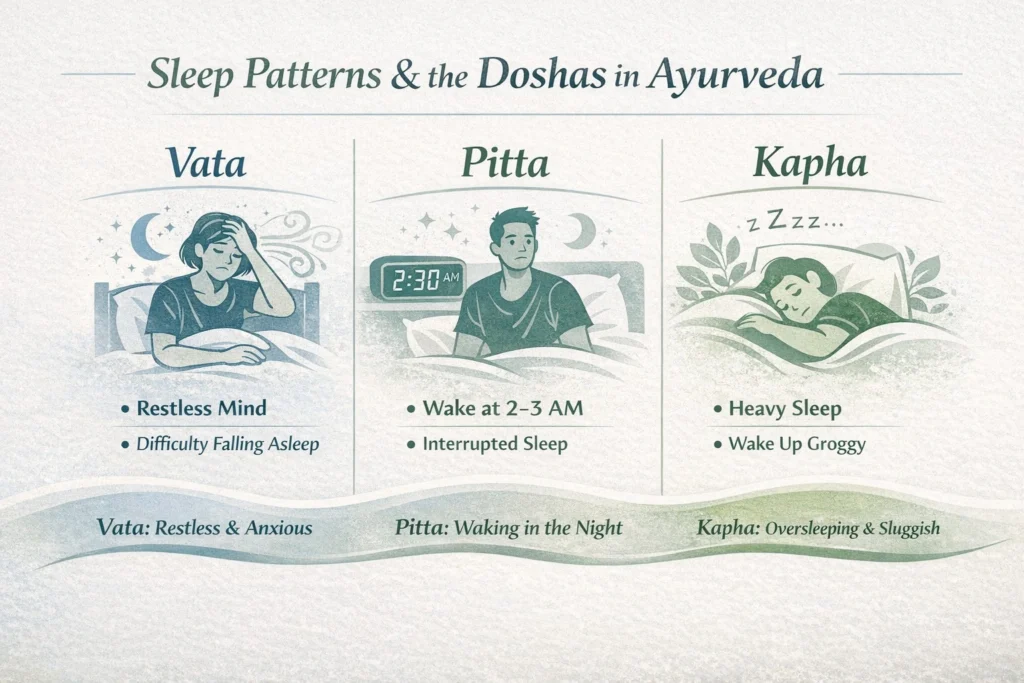
From an Ayurveda perspective, sleep patterns often reflect the balance of the three doshas—Vata, Pitta and Kapha.
When Vata becomes aggravated, people often report difficulty falling asleep. The mind feels restless. Thoughts move quickly. With Pitta, the pattern can be different. Sleep may begin normally, but becomes interrupted later in the night. Waking around two or three in the morning is something clinicians hear quite often. Kapha shows almost the opposite tendency. Sleep becomes heavy. Some people sleep long hours yet wake up feeling slow or slightly dull.
Of course, real life is rarely that neat. Many people experience a mix of these patterns depending on stress, diet, travel, and daily routine.

Sleep Duration Is Not Fixed
- Prakriti (constitution)
- Age
- Level of physical activity
- Mental workload
- Season
- State of health
Daytime Sleep in Ayurveda
Ayurveda texts discuss daytime sleep as well. It is called Divaswapna.
Generally, regular daytime sleeping is discouraged. It tends to increase Kapha in the body and may lead to heaviness, sluggish digestion, or difficulty sleeping later at night. But Ayurveda rarely applies rules without exceptions.
There are situations where daytime rest is considered appropriate. One important example is summer (Grishma Ritu). During this season, heat gradually reduces physical strength. Nights may feel shorter, and sleep may be lighter. Because of this, short periods of daytime sleep are permitted. Daytime sleep may also be helpful for:
- children
- elderly individuals
- people exhausted from travel
- those recovering from illness
- individuals who are underweight or weak
- people experiencing aggravated Vata
In these circumstances, rest helps restore balance rather than disturbing it.
Recovering From Lost Sleep
Sometimes people remain awake at night for unavoidable reasons. Travel, work schedules, or excessive screen time can interrupt sleep. Ayurveda refers to this situation as Ratrijagarana, or night awakenings.
When this happens, the body may be allowed to recover through daytime sleep on the following day. The classical guideline is simple.
Sleep during the day for half the duration of sleep that was lost at night.
For instance, if you lost four hours of sleep at night, resting for around two hours during the day could help your body regain equilibrium. Traditionally, this rest is taken earlier in the day and before meals. It is meant as a temporary recovery, not a daily habit.
Simple Practices That Support Better Sleep
Ayurveda usually recommends small adjustments rather than dramatic changes.
- Maintaining a consistent sleep schedule can help your body recognise when it’s time to rest.
- Evening meals should ideally be lighter than lunch and taken at least 2-3 hours before bedtime.
- Quiet activities before sleep also make a difference. Reading, gentle breathing exercises, or simply reducing stimulation can help the mind slow down.
- One traditional practice that many people find helpful is Padabhyanga, or foot massage before bed. Warm Ksheerabala oil is often used. The soles of the feet contain many nerve endings connected to the nervous system. Gentle massage here tends to calm Vata and relax the body.
For individuals who continue to struggle with sleep despite making small lifestyle adjustments, a more structured approach may be helpful. At AyurVAID Hospitals, sleep concerns are often evaluated as part of a broader health assessment through the AyurVAID Peak Health Sleep Programme. The programme looks at sleep patterns alongside digestion, stress levels, and daily routines to better understand the underlying imbalance.
A Final Thought
Modern life rarely slows down on its own.
Work often continues into the evening. Messages arrive late at night. Even relaxation time tends to involve screens. Sleep needs the opposite. A slowing down.
Ayurveda has long described sleep as a natural restorative process. When sleep improves, people often notice unexpected benefits — steadier mood, better digestion, clearer thinking.
Perhaps that is the real reminder behind World Sleep Day. Protecting sleep is not only about rest. It is about protecting health.
References