Pain is one of the most common reasons people visit a doctor today, especially when the problem involves the joints, spine, muscles, or nerves. In many cases, the pain starts after long periods of sitting, physical strain, poor posture, injury, or age-related wear and tear. Some episodes improve with rest or medication. In recurrent conditions, however, pain tends to return more frequently over time and may begin to affect sleep, movement, sitting tolerance, physical activity, and routine daily functioning.
Some episodes improve with rest or medicines for a few days. But for many people, the pain comes back after travel, work, long periods of sitting, poor sleep, or physical strain. Slowly, simple activities like bending, climbing stairs, sitting for long periods, or even getting out of bed in the morning may start feeling difficult.
In the beginning, most people try temporary pain relief measures. Non-steroidal anti-inflammatory drugs (NSAIDs), painkillers, sprays, gels, hot fomentation, muscle relaxants, and other conventional pain management techniques are commonly used to reduce pain, stiffness, and discomfort for some time. In some people, these measures are enough during acute episodes. In others, relief may last only while the treatment is continued. Depending on the severity and cause of the condition, management may also involve physiotherapy, steroid injections, neuropathic pain medications, opioid-based analgesics, or surgery, especially where there is nerve compression, disc-related changes, structural damage, weakness, or reduced movement.
This is one reason why pain management in Ayurveda is increasingly being explored alongside conventional care, particularly in chronic inflammatory, degenerative, musculoskeletal, and nerve-related conditions where pain tends to recur over time.
Why Has Pain Become So Common Today?
Pain is increasingly being seen across all age groups. One of the biggest reasons is a sedentary lifestyle. Even people who exercise regularly may still spend long, uninterrupted hours sitting. Many people now spend hours sitting at desks, in cars, or looking down at screens without moving much in between. Slowly, that constant strain starts affecting the lower back, neck, shoulders, hips, and the muscles around the spine. Even things people barely notice, behaviours like sitting crookedly, leaning to one side, or pushing the head forward while working, can start contributing to problems over time. Recovery also becomes slower when sleep quality is poor.
Stress plays a major role as well. Not always as the primary cause, but as a strong aggravating factor. Chronic stress affects muscle tension, nervous system regulation, sleep quality, inflammatory pathways, and recovery capacity.
Many patients with chronic pain also have associated factors such as:
- Low vitamin D levels
- Weight gain
- Poor metabolic health
- Reduced mobility
- Irregular dietary patterns
- Fatigue
Ayurveda recognises that long-standing pain is rarely caused by a single issue. It is usually the result of multiple overlapping factors.

What is Pain in Ayurveda?
In Ayurveda, pain is called ‘Vedana’. In texts like the Amarakosha, Vedana is not limited to meaning pain. The term is also used for sensation, feeling, perception, and stimulus (Samvedo Vedana). This broader meaning is important in understanding pain in Ayurveda.
Ayurveda does not classify all pain in the same way. Sharp radiating pain, burning pain, heaviness with stiffness, numbness, spasmodic pain, and tingling sensations are understood differently depending on Dosha involvement and tissue disturbance. Other Ayurveda terms used while describing pain include:
Ruja — disease-related discomfort or suffering
Peeda — distress or affliction
Dukha — unpleasant physical suffering
Shoola — sharp, piercing, spasmodic, colicky, or radiating pain. Shoola is described as:
“शंकुवत स्फुटन वेदना”
This refers to severe pain resembling piercing by a sharp object. The description is often compared with symptoms seen in nerve pain, radiating pain, spasmodic pain, sciatica, or colicky pain.
One important concept in Ayurvedic pain management is Vedanasthapana. The term is often translated simply as ‘pain-relieving’ or ‘analgesic’. But classical Ayurveda texts describe a wider meaning.
‘Vedana’ refers to sensation or perception.
‘Sthapana’ means to restore, establish, or stabilise.
So, Vedanasthapana in Ayurveda is not discussed only in the context of suppressing pain. In certain conditions, it is also associated with restoring normal sensation when there is numbness, altered sensation, or sensory disturbance. This becomes relevant in conditions involving:
- Numbness
- Tingling sensation
- Neuropathy, including diabetic neuropathy
- Burning feet syndrome
- Altered sensory perception
- Loss of touch sensation
Ayurveda literature describes conditions such as Supti, Pada Supti, Kara Supti, and Suptangata, where sensation becomes reduced, altered, absent, or abnormal. In such conditions, the goal is not limited to pain suppression alone. The broader focus of the chronic pain management Ayurveda approach includes reducing inflammation, improving circulation, supporting nerve function, restoring movement, calming aggravated Vata, improving recovery, and supporting long-term natural pain management and function.
How Ayurveda Classifies Pain by Dosha
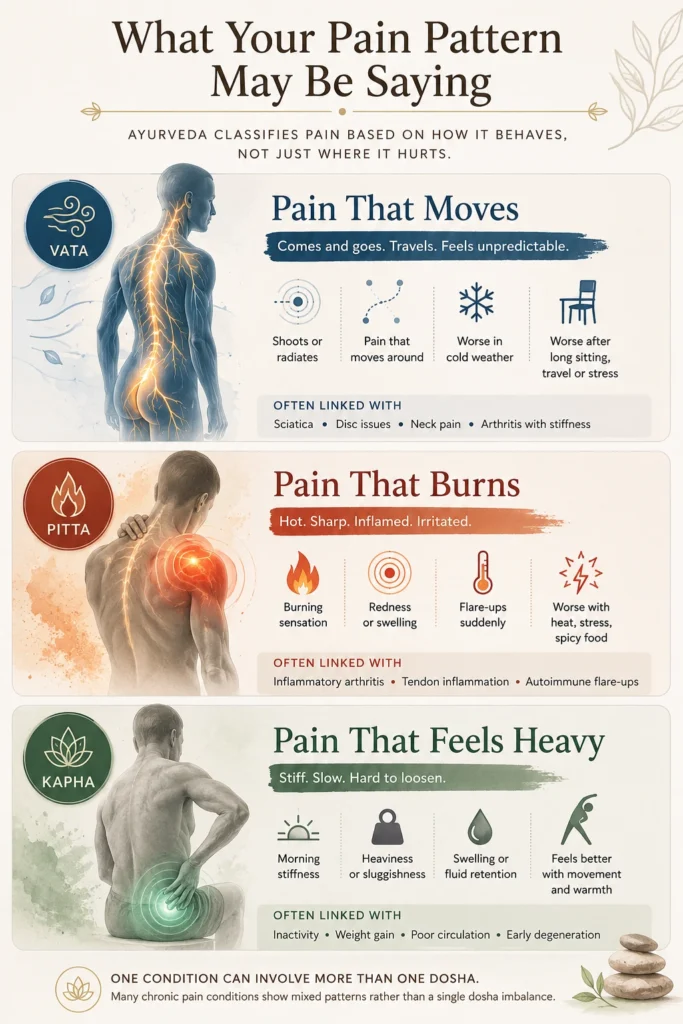
Vataja Shoola — Vata-Type Pain
Vata-related pain is one of the most common forms seen in clinical practice today. It is usually described as:
- Shooting
- Radiating
- Moving
- Cracking
- Spasmodic
- Colicky
- Associated with stiffness or numbness
This kind of pain is often linked with nerve irritation, degeneration, dryness, overuse, ageing, or prolonged strain. Conditions like sciatica, cervical spondylosis, lumbar disc issues, osteoarthritis, and chronic back pain frequently show Vata dominance.
Patients often say, “The pain moves.” “It shoots down the leg.” “It worsens in cold weather.” “It feels worse after travel, stress, or lack of sleep.”
These are classical Vata aggravation patterns. The modern lifestyle itself strongly aggravates Vata. Irregular food timings, long sitting hours, chronic stress, sleep disturbance, excessive screen exposure, travel, overwork, and lack of recovery all contribute to Vata imbalance. This is one reason why pain disorders are becoming increasingly common.
Pittaja Shoola — Pitta-Type Pain
Pitta pain is inflammatory in nature. There is usually heat, burning, redness, swelling, or irritation. This kind of pain is commonly seen in:
- inflammatory arthritis
- acute tendon inflammation
- autoimmune inflammatory conditions
- active inflammatory flare-ups
Patients may describe the pain as:
- Burning
- Hot
- Throbbing
- Intense
- inflamed
Pitta-related pain often worsens with inflammatory dietary patterns, excessive heat exposure, stress, anger, irregular eating habits, or poor digestion.
Kaphaja Shoola — Kapha-Type Pain
Kapha-related pain is usually dull, heavy, slow, and deeply stiff. Patients often complain of:
- Heaviness
- Sluggishness
- Restricted movement
- Morning stiffness
- Swelling
This type of pain is frequently associated with sedentary lifestyles, weight gain, reduced circulation, inactivity, fluid accumulation, or early degenerative changes. Unlike Vata pain, Kapha pain often improves gradually with movement and heat.
Many chronic pain conditions actually involve more than one dosha. This is why Precision Ayurveda does not follow a “one-treatment-fits-all” approach.
The Precision Ayurveda Approach to Pain Management
Ayurvedic pain management is not focused only on suppressing pain. It focuses on understanding:
- Why the pain developed – the root cause
- Why does it keep recurring
- Which tissues and doshas are involved
- Whether inflammation or degeneration is dominant
- Whether nerves are involved
- Whether recovery mechanisms are weakened
This broader understanding becomes especially important in chronic pain. In many recurrent cases, the issue is not simply inflammation. The issue is incomplete recovery due to a lack of focus on the root cause. This is where the Precision Ayurveda approach becomes valuable.
Ayurveda Pain Assessment
For pain management in Ayurveda, assessment is usually not limited to where the pain is present or how severe it feels. The pattern of pain, movement restriction, stiffness, sleep disturbance, recovery, and daily functional difficulty is assessed together.
The consultation generally includes understanding when the pain started, whether it developed gradually or suddenly, how long it has been present, and what aggravates or relieves it. In many chronic conditions, pain changes throughout the day. Some people feel it more while walking or climbing stairs. For others, sitting too long, travelling, bending, or getting up after rest becomes difficult. Morning stiffness is also common in long-standing joint and spine conditions.
Pain levels may be recorded using tools such as the Visual Analogue Scale (VAS). But the assessment is not based only on a number. Changes during activity, rest, movement, or flare-ups are also observed over time.
Physical function is an important part of Ayurvedic pain management assessment. Walking tolerance, bending, stair climbing, sitting for long periods, lifting weights, and routine daily activities are usually checked, especially in spine-, muscle-, joint-, and nerve-related disorders.
Nidana Parivarjana — Removing the Root Cause
This is one of Ayurveda’s most important principles. If the factors causing pain continue daily, discomfort often returns repeatedly despite treatment. This means treatment is not limited to medicines alone. In many cases, practical correction plays a major role. This may include:
- correcting sitting posture
- reducing prolonged inactivity
- improving sleep quality
- managing stress
- improving movement patterns
- correcting food habits
- supporting metabolic health
Ayurvedic pain management includes the understanding of the body as an interconnected system, not as isolated, painful parts.
Shamana — Herbal Pain Management
In pain management in Ayurveda, Shamana refers to treatment used to calm aggravated doshas through medicines, external therapies, diet, and lifestyle correction. Treatment is usually individualised, as pain does not present the same way in every person, even with the same condition.
Several herbs are traditionally used in Ayurvedic pain management. Ashwagandha (Indian ginseng) is commonly used when fatigue, stress, or poor recovery is associated with pain. Shallaki (Indian frankincense) and Guggulu (Commiphora mukul) are commonly used in joint and inflammatory conditions. Nirgundi (five-leaved chaste tree) is often used when stiffness and swelling are more prominent. Rasna (Pluchea lanceolata) is traditionally used in Vata-related muscle and joint pain, especially where movement feels restricted or difficult.
NOTE: Consuming these medicines without proper supervision from a qualified Ayurveda doctor can cause more harm than good. The dose, duration and selection of the herb are highly dependent on the patient and other factors.
Shodhana or Panchakarma in Pain Management in Ayurveda
In Ayurvedic pain management, ‘shodhana’ refers to cleansing and eliminative therapies used in long-standing or recurrent conditions where dosha imbalance, inflammation, stiffness, swelling, or restricted movement continue to persist. Ayurveda describes the role of Ama in many chronic disorders, especially where heaviness, poor recovery, inflammatory changes, or obstruction are present.
As part of chronic pain management, Ayurveda approaches, selected Panchakarma therapies may be included based on the patient’s condition, strength, tissue involvement, and stage of disease. Commonly used therapies include Kati Basti for lower back conditions, Janu Basti for knee disorders, Greeva Basti for neck and cervical issues, Basti therapies in Vata-dominant disorders, Nasya for head and cervical region involvement, and Agnikarma in selected musculoskeletal pain conditions. These therapies are usually combined with internal medicines, rehabilitation support, and other non-pharmacological pain management approaches as part of a broader holistic pain management framework.
Rasayana — Repair, Recovery, and Rejuvenation
Once inflammation reduces and pain stabilises, Ayurveda focuses heavily on nourishing the tissues. This phase is extremely important in chronic degenerative conditions. Rasayana therapies aim to support:
- Joint nourishment
- Muscle recovery
- Nerve health
- Mobility and strength
- Long-term resilience
Pain often returns when the body is not recovering properly between flare-ups. This is something commonly seen in osteoarthritis, chronic back and neck conditions, age-related joint wear, and even after old injuries or inflammation.
Because of this, pain management in Ayurveda usually goes beyond medicines alone. It also looks at sleep patterns, stress, digestion, posture, food habits, and daily routine since they can influence stiffness, recovery, and pain tolerance over time. Depending on the condition, healthcare providers may also advise simple yoga practices, Pranayama, and dietary adjustments to support movement and overall recovery. In inflammatory and Vata-dominant disorders, emphasis is often placed on warm, freshly prepared, easily digestible foods while reducing excessively processed, cold, irregular, or heavy meals. These measures are usually included as supportive parts of natural pain management and broader pain management natural remedies approaches.
Why Ayurveda Oils Matter in Pain Relief
Ayurveda oils are not simply massage oils. They are medicated preparations processed with herbs designed for specific therapeutic actions. Warm oil therapies help by:
- reducing stiffness
- improving local circulation
- supporting tissue lubrication
- calming aggravated Vata
- relaxing muscle spasm
This is one reason oil-based therapies remain central to natural pain management in Ayurveda. Many chronic pain conditions are associated with dryness, degeneration, stiffness, and reduced tissue nourishment — all classical Vata features. Oil therapies directly address these patterns.
Chronic Pain vs Acute Pain — Why Treatment Changes
Acute pain and chronic pain are managed differently. Acute pain often involves:
- active inflammation
- recent strain
- muscle spasm
- tissue irritation
Chronic pain is more complex. Over time, movement patterns change. Muscles compensate. Sleep gets affected. Fear of movement develops. Nerve sensitivity may increase. Degeneration and stiffness may gradually progress.
This is why chronic pain management Ayurveda approaches are usually longer-term and more comprehensive. The goal becomes:
- reducing recurrence
- improving movement
- improving function
- supporting recovery
- Reducing dependency on repeated medication
Living Pain-Free Naturally
References