What is Parkinson’s disease?
Parkinson’s disease is a progressive disorder of the brain caused by the loss of dopamine-producing neurones. Dopamine helps regulate movement, coordination, and smooth muscle activity. When dopamine levels fall, the body begins to move differently. Slowness, stiffness, imbalance, and tremors gradually emerge.
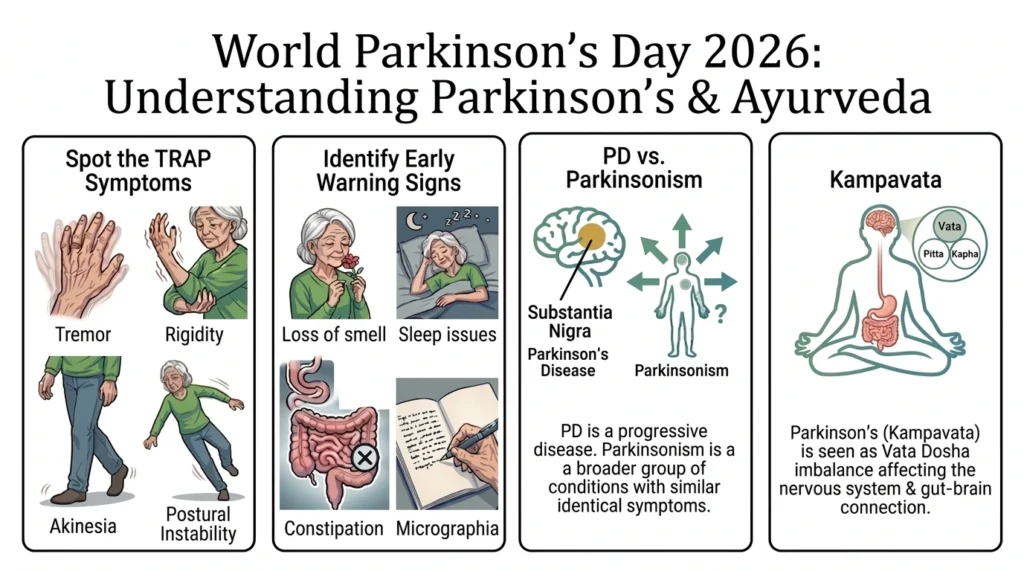
The classic parkinson’s disease symptoms are often remembered by the acronym TRAP:
- Tremor – involuntary shaking, often beginning in one hand
- Rigidity – stiffness in the muscles
- Akinesia/Bradykinesia – slowness or reduction of movement.
- Postural instability – difficulty maintaining balance
These symptoms may not appear all at once. In fact, the disease often begins long before a tremor becomes visible.
Early signs of parkinson's that should not be ignored
- Constipation, usually chronic and inexplicable
- Loss of smell sensation or decreased ability to recognise familiar odours
- Disturbances in sleep, including acting out dreams
- Micrographia, or writing small and cramped letters
- Speaking softly, having reduced facial expressions, or “masking”.

Stages and progression
The development of Parkinson’s is gradual and continuous. Stages include:
Stage 1 – mild symptoms, affecting one side of the body only
Stage 2 – bilateral symptoms; posture begins to change
Stage 3 – balance problems; independence is still possible
Stage 4 – difficulties with performing everyday activities; help is needed
Stage 5 – severe disability; bed rest or wheelchair use is necessary
People show great variability in symptom development and stage advancement because of differences in age, general health status, effectiveness of medication, physical therapy, quality of sleep, nutrition, and psychological conditions.
Parkinson’s Vs. Parkinsonism
“Parkinson’s” and “Parkinsonism” are frequently interchanged in usage, although not synonymous. Parkinson’s disease (PD) is a distinctively progressive neurological disorder and the most common type of Parkinsonism, making up to 80% of all cases.
Feature | Parkinson’s Disease (PD) | Parkinsonism |
What it means | A specific, progressive brain disorder | A broad term for conditions that cause similar movement problems |
Main cause | Loss of dopamine-producing nerve cells in the brain | May be caused by medicines, strokes, toxins, tumours, or other brain diseases |
Progression | Usually develops slowly over time | May appear suddenly or progress differently depending on the cause |
Pattern of symptoms | Often starts on one side of the body | May affect both sides early, depending on the cause |
Parkinsonism Types
Parkinsonism is a general term used for conditions that cause movement problems, such as slowness, stiffness, tremors, and balance difficulty.
Some forms are part of a primary brain disease, while others happen because of medicines, strokes, toxins, or other health problems.
1. Primary Parkinsonism
These are conditions in which the problem starts mainly with the brain itself.
Type | Explanation |
Parkinson’s Disease (Idiopathic) | The most common and classic form. In many patients, the exact cause is not known. Some cases may run in families. When it begins before age 50, it is called Young-Onset Parkinson’s Disease. |
Atypical Parkinsonism | These are less common conditions that look like Parkinson’s disease, but usually progress faster and may affect other brain functions too. This is further classified into Progressive Supranuclear Palsy (PSP), Multiple System Atrophy (MSA), Dementia with Lewy Bodies (DLB), and Corticobasal Degeneration (CBD) |
2. Secondary Parkinsonism
These symptoms happen because of another cause, not because of the primary Parkinson’s disease process. It is further classified into Drug-Induced, Vascular and Toxin-Induced.
In Ayurveda, these conditions are broadly understood under Kampavata, where Vata Dosha becomes disturbed and affects movement, stability, and the nervous system.
| Condition | Ayurveda understanding |
| Idiopathic Parkinson’s disease | Seen mainly as aggravated Vata with gradual tissue depletion, or Dhatukshaya |
| Atypical Parkinsonism or Parkinson Plus | Considered more complex, with involvement of multiple body systems |
| Secondary Parkinsonism | Often understood as Margavarodha, meaning blockage in the normal flow of Vata, due to external causes like medicines, toxins, or injury. |
The treatment approach is then planned according to whether the problem is due to dryness, depletion, obstruction, or a combination of these factors.
Kampavata: The Ayurveda perspective
The Ayurveda knowledge of Parkinson’s disease is well covered under Kampavata. Here, the word Kampa denotes shaking, while ‘Vata’ signifies motion, coordination, neurological activity, and communication in the body.
This condition reflects aggravated Vata Dosha, often involving Majja Dhatu and the nervous system. As Vata becomes disturbed due to age, stress, poor sleep, erratic food habits, or depletion, the body begins to show dryness, instability, stiffness, and involuntary movement.
Koshtha and gut health are central to Vata balance. This area is where Ayurveda and modern science begin to converge, as both now recognise the strong connection between the gut, the brain, and neurodegenerative disease.
Ayurvedic treatment for Parkinson's disease
The aim of Ayurvedic treatment for Parkinson’s disease is not only symptom relief.The goal is to balance Vata, support the nervous system, preserve function, and improve the patient’s quality of life through individualised care.
In Parkinson’s care, Ayurveda emphasises Vata balance through a fewkey therapies.Vasti is central, as it supports the main seat of Vata and helps restore steadiness and nourishment. Abhyanga with medicated oils may reduce stiffness, improve circulation, and promote relaxation. Shirodhara is especially helpful when anxiety, disturbed sleep, or mental fatigue are present. Nasya may support clarity, speech, and upper-body functions when used appropriately under supervision.
Together, these therapies form an integrative approach that addresses both body and mind.
Diet for parkinson
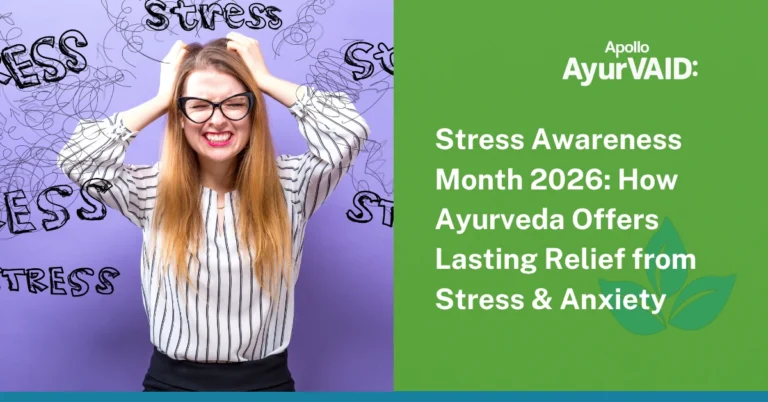
Stress often shows up before things get really bad. Some common signs are not getting enough sleep, tightness in the chest, tension in the muscles, upset stomach, being irritable, tiredness, not being able to focus, being emotionally reactive, and feeling “burnt out” even after taking a break.
If these signs don’t go away, it’s important to deal with the underlying problem instead of just the symptoms.
How Apollo AyurVAID helps people deal with stress
Caregiver support and daily living
- Observing a regular schedule and remaining calm
- Allowing gentle mobility and taking walks
- Performing relaxation and meditation exercises
- Creating a safer living environment, free of obstacles that lead to falls
- Fitting handrails and using adequate lighting
- Managing medication appropriately
A path toward moderation
While there is still no ultimate treatment for Parkinson’s disease, this does not necessarily mean that there is no way forward. Patients who are recognised and treated accordingly may live more dignified and independent lives.
That is the real message of World Parkinson’s Day 2026: awareness leads to action, and action leads to better care. By understanding parkinson’s disease symptoms, identifying early signs, and clarifying Parkinson’s vs Parkinsonism, we can offer a more compassionate and complete model of support.
Ayurveda teaches us to treat the person, not just the disease. In Parkinson’s care, that principle is more relevant than ever.
References
- Martínez-Martín P. Hoehn and Yahr Staging Scale. Encyclopedia of Movement Disorders. 2010. doi:10.1016/B978-0-12-374105-9.00034-4.
- Daalen JMJ, et al. Lifestyle Interventions for the Prevention of Parkinson Disease. Neurology. 2022;99:42–51. doi:10.1212/WNL.0000000000200787.
- Manyam BV, Kumar A. Ayurvedic constitution (prakruti) identifies risk factor of developing Parkinson’s disease. J Altern Complement Med. 2013;19(7):644-9. doi:10.1089/acm.2011.0809.
- Menon NM, et al. Understanding Parkinson’s Disease (PD) in Ayurvedic Perspective. Int J Ayurveda Pharma Res. 2021;9(6):86-92. doi:10.47070/ijapr.v9i6.1944.
- Castilla-Cortázar I, et al. Is insulin-like growth factor-1 involved in Parkinson’s disease development? J Transl Med. 2020;18(70). doi:10.1186/s12967-020-02251-w.