- AyurVAID Pharmacy
The word “Pitta” comes from the Sanskrit root “तप सन्तापे”, which means heat or burning. Think of it as your body’s own little fire. Just like a flame turns raw ingredients into a meal, Pitta transforms the food you eat into energy you can actually use. It keeps you warm, alert, and moving—fuelling everything from your morning coffee run to your late-night ideas.
Modern science splits these processes into digestion, metabolism, and hormones. Ayurveda sees them all as parts of one smart, interconnected system. When Pitta is balanced, life flows. Digestion works smoothly. Energy feels steady. The mind feels clear. But when it goes off track, too hot, too intense, or too weak, small annoyances start piling up. Heartburn. Sweaty palms. Skin flare-ups. Irritability. Feeling suddenly drained. Ayurveda calls these signs “imbalanced Pitta,” which means that even unrelated symptoms can come from the same place: your inner fire is out of balance.
Pitta isn’t only about digestion. It’s what keeps you going and thriving. You feel active, focused, and energised when you’re steady. When it falters, life feels heavier, messier. The good news? You can tend this fire. The food you eat, the way you handle stress, even how you rest—these are the sparks that feed it. Care for your Pitta, and your inner flame lights up everything: body, mind, and the little moments that make life feel alive.
In Ayurveda, the concept of ‘Guṇas’ refers to the fundamental qualities that determine how something behaves, expresses itself, and interacts with its surroundings. These qualities are not limited to physical attributes alone; they also reflect functional and physiological tendencies within the body and mind. In many ways, Guṇas help Ayurveda describe why a substance, food, environment, or even an emotional state produces a particular effect on human health.
When we examine Pitta Dosha through this lens, its behaviour becomes easier to understand. Pitta arises primarily from the Fire and Water elements, and together these elements express themselves through a distinct set of Guṇas that define how Pitta functions within the body.
Modern ways of living have unintentionally made it harder for the body to maintain a stable metabolism. Busy schedules, eating at odd times, too much screen time, competitive workplaces, and high-stress emotional states all keep the body’s internal regulatory systems busy.
| Acharya / Ayurveda Scholars | How Pitta is Described |
|---|---|
| Vagbhata | Snigdha (unctuous), Tikshna (sharp), Ushna (hot), Laghu (light), Visra (fleshy smelling), Sara (mobile), Drava (liquid) |
| Sushruta | Tikshna (sharp), Drava (liquid), Putigandha (fleshy smelling), Ushna (hot), Katu rasa (pungent taste), Amla rasa (sour taste) when vitiated |
| Charaka | Slightly Snigdha (unctuous), Tikshna (sharp), Ushna (hot), Drava (liquid), Sara (mobile), Katu rasa (pungent taste) |
When Pitta is balanced, it helps with important bodily functions like digestion, body temperature, vision, hunger, thirst, taste, skin glow, memory, thinking, strength, and the body’s softness. When Pitta stays naturally in balance, these functions work well and help keep the body and mind clear and efficient.
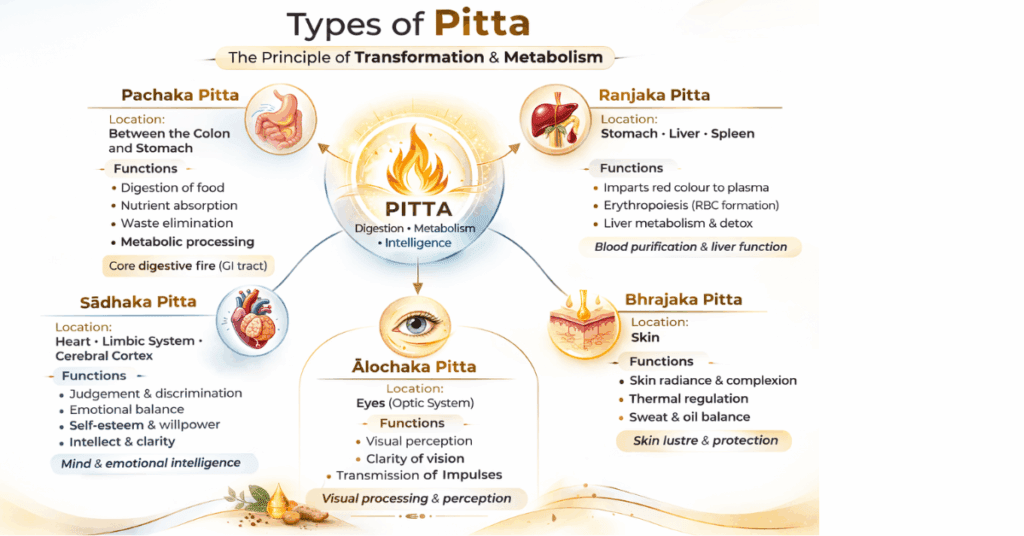
Pitta is closely associated with pāchana (digestion), dahana (oxidation), pariṇāma (transformation), rañjana (colour formation), prabhākaratva (providing lustre), and tāpana (heat production). In a more general sense, it can be seen as the overall expression of metabolic and enzymatic processes that happen in the body. Ayurveda describes five functional forms of Pitta:
| Type of Pitta | Primary Location | Main Functions |
|---|---|---|
| Pachaka Pitta | Between the colon and the stomach | All factors concerned with digestion – splitting up ingested food within the GI tract, absorbing nutrients and eliminating waste |
| Ranjaka Pitta | Located in the stomach, liver, and spleen | Imparts red colour to plasma, erythropoiesis |
| Sadhaka Pitta | Heart, limbic system, and cerebral cortex | Judgement, discriminative ability, self-esteem, emotions |
| Alochaka Pitta | Eyes | Visual perception, transmission of impulses via the optic tract |
| Bhrajaka Pitta | Skin | Helps achieve healthy radiance or lustre of the skin |
In the long term, Vata imbalance is associated in Ayurveda with conditions such as osteoarthritis and neurological disorders like stroke, Parkinson’s disease, neuropathy, sciatica, tremors, and paralysis.

Overstimulating Pitta can lead to excessive heat, tissue irritation, metabolic acceleration, and emotional reactivity. Patients often notice this shift subtly. Appetite becomes unpredictable. Heat intolerance develops. Emotional patience decreases. Over time, these small disturbances may evolve into clinically significant disorders if balance is not restored.
Clinical observation often reveals that Pitta imbalance begins gradually rather than suddenly. Patients frequently describe subtle but persistent changes before clear disease patterns emerge.
Common manifestations of increased Pitta include:
Common manifestations of reduced Pitta include:
| Stage | Ayurveda Term | Description | Typical Pitta Symptoms |
|---|---|---|---|
| 1 | Sanchaya (Accumulation) | Pitta accumulates in its normal sites | Burning sensations, slight increase in body temperature, aversion to heat-producing factors, desire for cold things |
| 2 | Prakopa (Aggravation) | Accumulated Pitta becomes provoked and spreads in the wrong channels (unmarga gamana) | Burning sensation, excessive body heat, redness, pus formation, sweating, slimy secretions, gangrene, tiredness, fainting, yellowish or reddish skin discolouration |
| 3 | Prasara (Spread) | Pitta overflows from its normal site to the whole body | Feeling of body boiling or squeezed, sensation of smoke from body, acidity, rashes, inflammation, strong anger or irritability |
| 4 | Sthāna-Saṁśraya (Localisation) | Pitta lodges in weak tissues producing disease | Inflammation of joints, rashes, acne, redness of skin or eyes, foul smell |
| 5 | Vyakti (Manifestation) | Clear disease manifestation | Well-exhibited symptoms such as sour/bitter belching in GERD |
| 6 | Bheda (Complication) | Chronicity and complications | Bleeding disorders, chronic ulcers |
Pitta rarely works alone. In Ayurveda, the body functions through constant teamwork between Vata, Pitta, and Kapha. Each dosha has its role, but they quietly influence one another all the time. When one shifts, the others usually respond in some way.
Pitta and Vata share a particularly sensitive relationship. Vata is all about movement and speed, while Pitta brings intensity and transformation. When Vata becomes disturbed, it can push Pitta out of its natural place. This sometimes shows up as sudden digestive irritation, unpredictable appetite, or emotional reactivity that seems to appear quickly and disappear just as fast. People often describe feeling both restless and overheated at the same time—like the body is running too fast while also being too hot.
Pitta and Kapha interact very differently. Kapha is naturally steady, cooling, and grounding. In many ways, it helps keep Pitta from becoming excessive. When Kapha is balanced, it can soften Pitta’s sharpness and help maintain emotional stability and digestive strength. But if Kapha becomes too dominant, it can slow down Pitta’s transformative ability. Digestion may start feeling heavy or sluggish. Metabolism may lose its efficiency. People sometimes notice reduced appetite or a feeling that food just sits without being processed properly.
What makes this relationship intriguing is that the imbalance rarely stays limited to just one dosha. For example, long-term stress may first disturb Vata. Over time, that disturbance can aggravate Pitta, leading to inflammation or digestive discomfort. Similarly, long periods of physical inactivity or heavy eating patterns may increase Kapha, which can gradually dull Pitta’s metabolic sharpness.
Ayurveda emphasises moderation and rhythm as essential principles for maintaining metabolic equilibrium.
Regular meal timings allow digestive enzymes to function predictably. Cooling and nourishing foods and adequate hydration with cooling drinks help stabilise metabolic heat. The intake ofghee and sweet, bitter, and astringent foods can help balance internal heat. Wearing pearls and applying paste made of camphor, sandalwood and cuscus grass also helps balance Pitta.
Emotionally, incorporating relaxation practices such as meditation, mindful breathing, or gentle yoga may help regulate stress-related metabolic activation. Exposure to natural cooling environments, balanced work schedules, listening to soothing music, and prioritising restorative sleep further support Pitta.
As we work hard to improve our services, your feedback is important to us. Please take a moment to help us serve you better.
Subscribe to our hospital newsletter for the latest health tips, updates on services, patient stories, and community events. Sign up today and stay informed!

Report Problem
Popular Searches: DiseasesTreatmentsDoctorsHospitalsWhole person careRefer a patientInsurance

