The word “Kapha” comes from the Sanskrit root “केन जलेन फ़लति इति”, or one which is produced from Jala. Think of Kapha as the body’s natural glue. If Pitta is the fire and Vata is the wind, Kapha is the earth and water that give everything form and stability.
Kapha builds you. It gives structure to your bones, softness to your skin, lubrication to your joints, and emotional steadiness to your heart. It is the reason your body feels grounded rather than scattered. It is what helps you wake up feeling rested and emotionally secure.
Modern science would divide this into immunity, structural tissues, fluid balance, and growth processes. Ayurveda sees it as one integrated intelligence. When Kapha is balanced, you feel calm, resilient, and steady. Your stamina is reliable. Your immunity is strong. Your emotions are stable.
But when Kapha becomes excessive or stagnant, things begin to feel heavy. Sluggish digestion. Water retention. Brain fog. Low motivation. Congestion. Weight gain persists and doesn’t seem to shift easily. Ayurveda calls this a “Kapha aggravation”, where the same stabilising force that once supported you now slows you down.
In Ayurveda, Guṇas describe the qualities that determine how something behaves in the body and mind. Kapha is formed from the Earth and Water elements, and its qualities reflect that combination.
| Acharya / Ayurveda Scholars | How Kapha is Described |
|---|---|
| Vagbhata | Snigdha (unctuous), Shita (cold), Guru (heavy), Manda (slow), Shlakshna (smooth), Sthira (stable), Mritsna (sticky) |
| Sushruta | Shweta (white), Guru (heavy), Shita (cold), Snigdha (unctuous), Picchila (slimy), Madhura (sweet), Lavana (salty) when vidagdha (incompletely formed) |
| Charaka | Snigdha (unctuous), Shita (cold), Guru (heavy), Picchila (slimy), Sthira (stable), Mrudu (soft), Madhura (sweet) |
When Kapha is balanced, it supports:
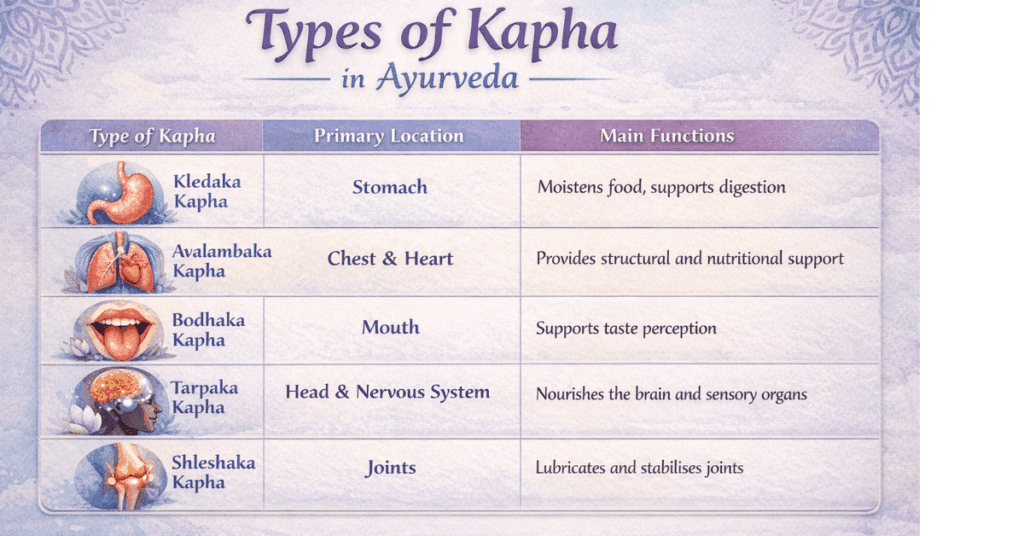
Charaka considers unvitiated Kapha to be ojas/bala, or strength, and its function to be visarga, or conservation of strength. It can be considered as the total of all anabolic activities in the body. The main seat of Kapha is uras, or thorax. Based on location and function, Ayurveda describes five forms of Kapha:
| Type of Kapha | Primary Location | Main Functions |
|---|---|---|
| Kledaka Kapha | Stomach | Moistens food and supports digestion |
| Avalambaka Kapha | Chest & Heart | Provides structural and nutritional support |
| Bodhaka Kapha | Mouth | Supports taste perception |
| Tarpaka Kapha | Head & Nervous System | Nourishes the brain and sensory organs |
| Shleshaka Kapha | Joints | Lubricates and stabilises joints |
Common Kapha aggravation causes include:
These factors slowly increase heaviness and fluid accumulation in the system.

When Kapha increases, the body feels weighed down.
Common manifestations of increased Kapha include:
Obstruction in pathways
Prolonged fasting, exertion, dry weather, and chronic diseases can cause Kapha Kshaya, or depletion. Common manifestations of reduced Kapha include:
| Stage | Ayurveda Term | Description | Typical Pitta Symptoms |
|---|---|---|---|
| 1 | Sanchaya (Accumulation) | Pitta accumulates in its normal sites | Burning sensations, slight increase in body temperature, aversion to heat-producing factors, desire for cold things |
| 2 | Prakopa (Aggravation) | Accumulated Pitta becomes provoked and spreads in the wrong channels (unmarga gamana) | Burning sensation, excessive body heat, redness, pus formation, sweating, slimy secretions, gangrene, tiredness, fainting, yellowish or reddish skin discolouration |
| 3 | Prasara (Spread) | Pitta overflows from its normal site to the whole body | Feeling of body boiling or squeezed, sensation of smoke from body, acidity, rashes, inflammation, strong anger or irritability |
| 4 | Sthāna-Saṁśraya (Localisation) | Pitta lodges in weak tissues producing disease | Inflammation of joints, rashes, acne, redness of skin or eyes, foul smell |
| 5 | Vyakti (Manifestation) | Clear disease manifestation | Well-exhibited symptoms such as sour/bitter belching in GERD |
| 6 | Bheda (Complication) | Chronicity and complications | Bleeding disorders, chronic ulcers |
Kapha interacts uniquely with Vata and Pitta. Kapha and Vata form opposite forces. Kapha stabilises Vata’s movements. When Kapha decreases, Vata may increase, leading to dryness and instability. When Kapha increases excessively, it can suppress Vata, leading to stagnation.
Kapha and Pitta balance each other through temperature and intensity. Kapha cools Pitta’s heat. But when Kapha becomes excessive, it can dull Pitta’s digestive fire, leading to slow metabolism.
In clinical observation, long-term inactivity increases Kapha first. Over time, reduced metabolic intensity may affect Pitta. Eventually, stagnation can disturb Vata circulation. The doshas rarely move alone.
Kapha Dosha represents the body’s stability and nourishment. It builds tissues, protects immunity, lubricates joints, and anchors emotional resilience.
Without Kapha, there would be no structure. But when its grounding force becomes excessive, stagnation replaces stability.
Understanding Kapha allows early recognition of metabolic slowing and fluid accumulation before disease manifests.
When balanced, Kapha provides endurance, calmness, loyalty, and deep strength — the quiet power that sustains life steadily and consistently.
As we work hard to improve our services, your feedback is important to us. Please take a moment to help us serve you better.
Subscribe to our hospital newsletter for the latest health tips, updates on services, patient stories, and community events. Sign up today and stay informed!

Report Problem
Popular Searches: DiseasesTreatmentsDoctorsHospitalsWhole person careRefer a patientInsurance

