Every year, World Health Day, April 7, reminds us that health is not only about treating disease after it appears. It is about creating conditions for people to live, stay well, and age well. In World Health Day 2026, this message feels especially relevant for India, where lifestyle disorders, mental stress, chronic illness, and environmental health concerns continue to rise.
The World Health Day theme 2026 is “Together for health. Stand with science.” This theme is important because it calls for evidence, collaboration, and a broader understanding of health. Ayurveda, when viewed through a preventive and integrative lens, fits beautifully into this vision. It offers practical, time-tested guidance for daily living, resilience, digestion, sleep, immunity, and mental balance — all of which support the thought of Ayurveda for good health.
What is World Health Day 2026 – Date, Theme & WHO Agenda
World Health Day 2026 is observed on April 7, the same day the World Health Organization came into force in 1948. The WHO uses this day to draw attention to a major health issue each year and to inspire global action.
The World Health Day theme 2026 highlights the importance of scientific collaboration and shared responsibility across human, animal, plant, and planetary health. The WHO agenda is not limited to treatment alone. It focuses on stronger public health systems, prevention, equitable care, and evidence-based solutions. This is where preventive healthcare Ayurveda becomes highly relevant.
India’s Health Challenges in 2026
India faces a complex health picture. Lifestyle health issues continue to grow, including diabetes, hypertension, obesity, cardiovascular disease, and stress-related problems. Simultaneously, infectious diseases, air pollution, road accidents, and mental health issues are major health concerns.A sedentary lifestyle, irregular eating habits, sleep deprivation, and a dependence on electronic gadgetry and processed foods are the root causes for these.
Many people do not become “sick” overnight; instead, health slowly declines through everyday imbalance. That is precisely where Ayurveda adds value. It does not wait for the disease to become severe. It encourages timely correction of habits, digestion, sleep, and stress before illness settles in.

How Ayurveda Addresses the WHO 2026 Health Theme
The WHO theme for World Health Day 2026 is rooted in science and collaboration. Ayurveda supports this vision by offering a structured system for prevention, personalised care, and lifestyle medicine.
स्वस्थस्य स्वास्थ्य रक्षणं, आतुरस्य विकार प्रशमनं च ॥
The very aim of Ayurveda is to maintain the health of the healthy (preventive care) and mitigate diseases. Ayurveda is not simply about herbs. It is a complete science of living. It considers humans, the season, food, the mind, sleeping patterns, work routines, and the environment. All this thinking is quite in tune with modern knowledge of how multiple factors contribute to our health. It can complement public health by strengthening routines, improving self-care, and reducing the long-term burden of preventable illness. In that sense, Ayurveda for good health is not just a tradition. It is a practical health philosophy for our times.
Preventive Healthcare – The Ayurveda Way (Swasthavritta)
In Ayurveda, the foundation of health lies in Swasthavritta. This means the science of maintaining health. The focus is not only on curing disease but also on preserving balance before disease begins. That is the heart of preventive healthcare Ayurveda.
Swasthavritta includes diet, daily routine, seasonal adaptation, mental discipline, cleanliness, and ethical living. It teaches that the body and mind function best when they follow nature’s rhythm. Modern medicine increasingly agrees with this principle. Healthy routines protect metabolism, immunity, mood, and long-term vitality.
Ayurveda, therefore, offers a simple but powerful message: prevention is not passive. It is an active daily choice.
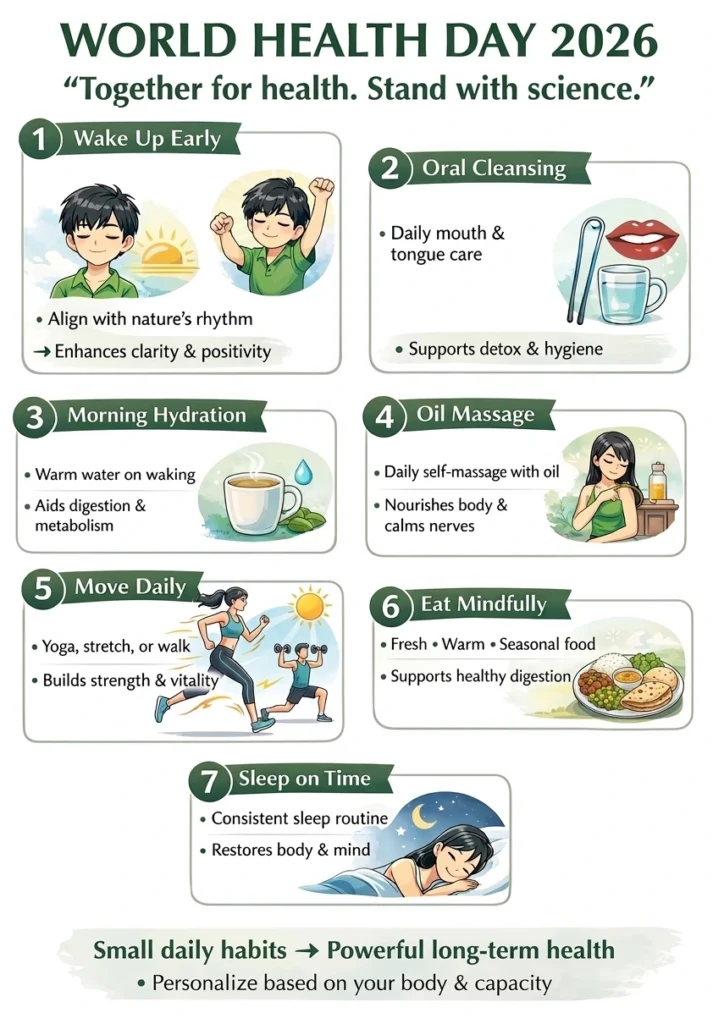
7 Ayurveda Daily Habits for Lifelong Health
Healthy living is a day-to-day process. Here are Ayurveda practices to help you achieve this goal –
- Wake Up Early (Bramha Muhurta)
Waking up early helps you sync your body with nature. It brings mental clarity and helps you face your day with positivity.
- Clean Your Tongue and Mouth (Danta Dhavana)
Proper oral hygiene is an essential part of your daily purification process.
- Drink Warm Water in the Morning (Usha pana)
This practice helps your body digest food properly. Avoid excessive water intake, as it can hamper your digestion.
- Practice Abhyanga
Massage your body with oil every day to nourish your skin, calm your nervous system, and boost your circulation. This practice is contraindicated in an unhealthy person.
- Move Your Body Daily (Vyayama)
Yoga, stretching, or simply taking a walk helps you stay physically fit.
- Eat Your Meals Properly
Eat fresh, warm, and seasonal food at regular intervals. It helps you digest your food properly.
- Sleep on Time
Sleeping at a regular time is crucial for your overall health.
These practices may be simple, but they have a profound impact on your overall health. These are the building blocks for healthy living. These should be practised based on your capacity and customised to the individual’s body condition.
Dinacharya & Ritucharya for Modern Life
Modern life often pushes people into irregular schedules, late nights, skipped meals, and seasonal neglect. Ayurveda offers two important correctives: Dinacharya and Ritucharya.
Dinacharya means daily regimen. It helps bring structure and steadiness into the day. In busy urban life, even a few Ayurveda anchors — waking early, eating on time, reducing screen time at night, and taking short pauses for breath or silence — can improve health significantly.
Ritucharya means seasonal regimen. This is especially relevant today, as weather changes, pollution, travel, and climate stress often disturb the body. Ayurveda advises adjusting food and habits according to the season so that digestion and energy remain stable.
Together, Dinacharya and Ritucharya reflect one of the most practical messages in preventive healthcare Ayurveda: live in rhythm with nature, not against it.
Mental Health, Gut Health & Immunity through Ayurveda
Ayurveda always treats the mind and body as one continuum. Poor digestion, disturbed sleep, chronic stress, and emotional overload are not separate problems; they are interconnected.
A strong digestive system supports nourishment, energy, and immunity. In Ayurveda, the gut is linked to balanced Agni. When digestion is weak, health becomes unstable. Likewise, stress and anxiety can affect digestion, appetite, sleep, and immunity. This is why Ayurveda recommends not only herbs and diet, but also breathing practices, meditation, and mindful routines.
For mental health, Ayurveda encourages steadiness, rest, and self-regulation. It emphasises simple, fresh, warm food and healthy eating practices for gut health. For immunity, it promotes strength through Ojas — the essence of vitality and resilience.
This integrated approach is one of the strongest expressions of Ayurveda for good health. It does not isolate a symptom. It restores the whole person.
AyurVAID’s Approach to Holistic Health
The approach that AyurVAID takes to health is a modern, evidence-based understanding of Ayurveda, and this is all about personalisation, prevention, and holistic care. This means that rather than just treating the symptoms, one also needs to think about the patient’s constitution, lifestyle, digestion, stress levels, sleep pattern, and health goals for the future.
The Ayurveda approach is relevant to the health scenario that is seen in modern India, where people are dealing with several health issues and also want to live a high-quality lifestyle. The holistic approach to Ayurveda is one that is all about wellness and health, and this is why preventive healthcare is still relevant today.
To Conclude,
World Health Day 2026 is a reminder that health must be built collectively, scientifically, and sustainably. The theme encourages collaboration, and Ayurveda contributes meaningfully by offering prevention, discipline, balance, and personalised care.
For India, the message is particularly important. If we wish to build a healthier nation, we must strengthen health from the ground up — through food, routine, sleep, emotional balance, and preventive wisdom. Ayurveda offers exactly that.
In a world where disease often begins quietly through neglect of daily habits, Ayurveda for good health gives us a way back to balance. And in that sense, preventive healthcare Ayurveda is not just traditional wisdom. It is a timely solution for modern India.
References