Introduction
The word ‘surgery’ is scary. For many patients, it brings uncertainty and a long list of questions about recovery, cost, risk, and quality of life. Yet not every painful condition needs to move directly from diagnosis to the operating table. In many cases, there is still room for a careful, evidence-informed, and deeply individualised approach.
That is where pain management without surgery through Ayurveda becomes meaningful. Ayurveda does not simply focus on suppressing pain. It looks at why pain has developed in the first place—whether due to Vata aggravation, tissue depletion, inflammation, impaired circulation, or long-standing degeneration. When approached properly, Ayurveda offers a practical non surgical pain treatment pathway for patients who want to explore healing before choosing an invasive procedure.
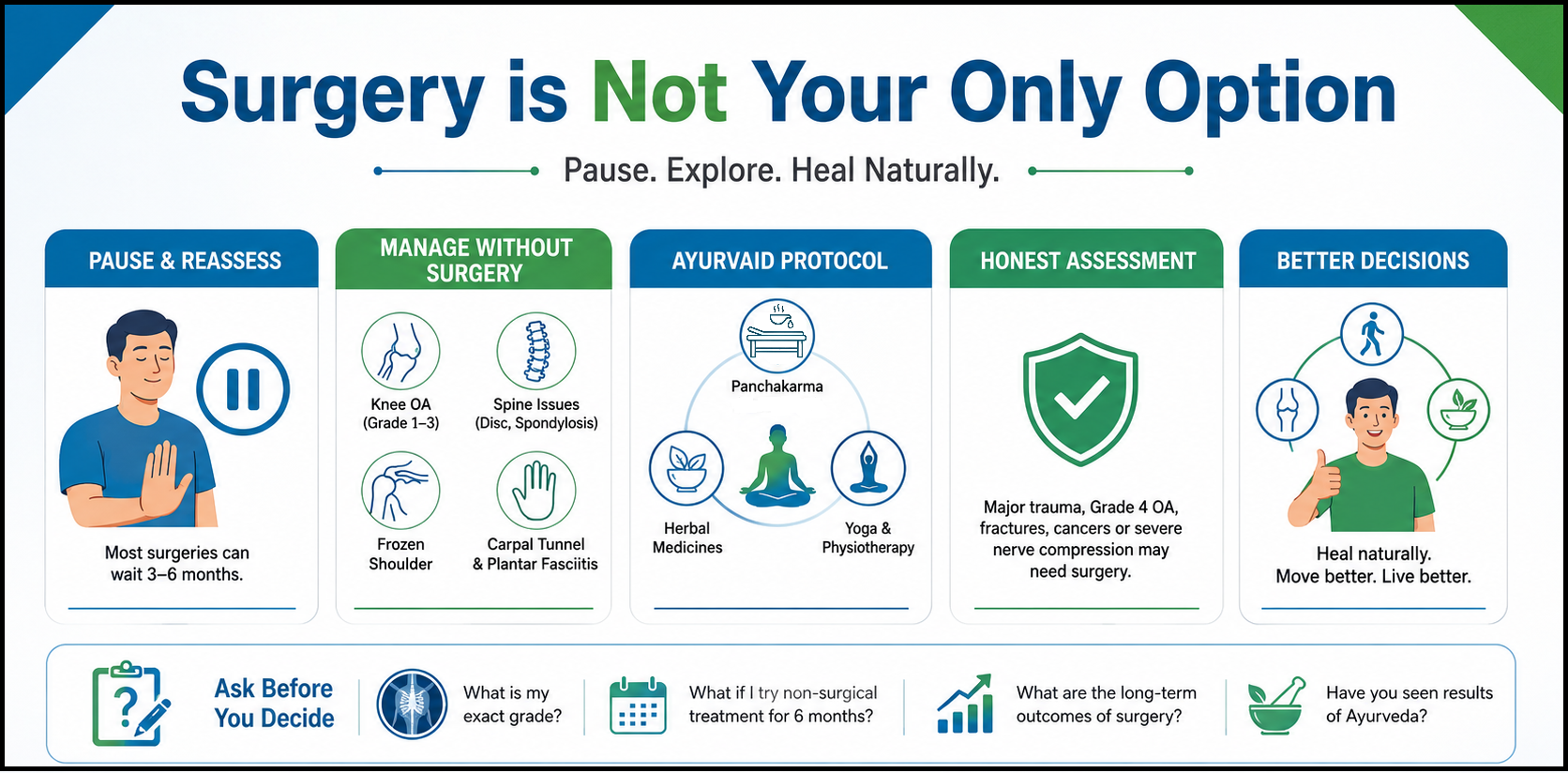
When Surgery Is Suggested, Pause and Reassess
A recommendation for surgery usually comes after symptoms have persisted for a while. By then, patients are often exhausted by pain and understandably ready for relief. But before taking the final step, it is worth asking a crucial question: have all conservative options truly been explored?
In modern care, “non-surgical” often means medications, injections, rest, or physiotherapy. Ayurveda expands that scope. It brings in personalised internal medicines, detoxification protocols, local therapies, restorative care, and lifestyle correction. This is why many patients consider Ayurveda alternative to surgery when they are looking for something deeper than symptom suppression.
For the right patient, timely intervention may help avoid surgery with Ayurveda or delay it significantly while improving pain, movement, and day-to-day function.

Which Pain Conditions May Respond to Ayurveda?
Ayurveda is often helpful in chronic, degenerative, and functional pain conditions where tissue support can still be improved. One of the most common examples is knee pain. Those individuals suffering from osteoarthritis in an initial to moderate phase usually try to find ways to relieve knee pain without surgery, as their goal is to keep the joint intact for a longer period.
Similarly, disc bulge, spondylosis, sciatica, or low back stiffness are other painful problems that do not always call for any surgical procedures right away, particularly where there is no serious structural damage. Spine therapy provided through Ayurveda can help achieve spine stability, provide pain relief, increase mobility, and ease nerve discomfort as a valuable option fornon-surgical spine treatment.
Shoulder pain is yet another important area to focus on. Conditions such as frozen shoulder, rotator cuff, or periarticular stiffness may create a lot of trouble when performing daily tasks, such as getting dressed, raising one’s hand, or lying down in bed, which become extremely difficult. For many such patients, shoulder pain without operation is not only possible but also often preferable when there is still room for functional recovery through targeted Ayurveda therapy and movement rehabilitation.
Other commonly seen concerns include carpal tunnel symptoms, plantar fasciitis, chronic neck pain, and repetitive strain conditions. In all these situations, the goal is not merely to mask discomfort. The goal isnon invasive pain management that addresses the underlying imbalance and supports long-term healing.
How Does Ayurveda Understand Pain?
According to Ayurveda, pain is considered an outcome of the disruption of Vata dosha, inadequate nourishment of tissues, and blockage in the process of nourishment and circulation. If pain persists over time, the body tends to go through a phase of dryness, rigidity, swelling, and deterioration. To break this cycle, something more than just taking pain medication is needed.
In the context of Ayurveda, the strategy might involve Shodhana (cleansing therapy), Shamana (pacification), Nidana Parivarjana (eliminating causative factors), and Rasayana (rejuvenation). This combination allows treatment to move beyond symptom control and toward restoration.
One of the central therapies is Vasti, which is especially valued in Vata-related disorders. Medicated enemas can be useful to relieve general pain, stiffness, and dryness in appropriate cases. Local treatment methods like Janu Basti, Kati Vasti, and Greeva Vasti can be employed for the knee, back, and neck respectively. Such treatments help nourish and reduce stiffness in specific areas.
Another parasurgical method, ‘Agnikarma‘,can also be helpful in selected painful situations. It uses controlled therapeutic heat and is traditionally used for localised, stubborn pain. In skilled hands, it can be especially helpful for certain chronic soft tissue problems and heel pain conditions.
Internal herbal formulations are also chosen carefully according to the patient’s constitution and the stage of disease. Herbs such as Shallaki, Guggulu, and Rasna are commonly used in Ayurveda practice for their pain-relieving and anti-inflammatory support. These are not meant to be generic remedies; they are prescribed as part of a structured protocol.
Why Ayurveda Appeals to Patients Who Want to Avoid Surgery
Many patients are not refusing surgery out of fear alone. They are looking for a more conservative path that gives their body a chance to respond before a major intervention. That is where pain management without surgery becomes especially valuable.
Ayurveda is selected by patients who seek treatment that is root cause oriented. These patients might have been taking medication, getting rest, or having physiotherapy treatments, yet they are restricted because of pain. For such individuals, non surgical pain treatment can offer a structured next step rather than a desperate last resort.
This is also why people increasingly seek an Ayurveda alternative to surgery for chronic musculoskeletal issues. The aim is not to promise miracles. The aim is to preserve function, reduce pain, support tissue health, and help the patient make a better-informed decision. In some cases, patients gain enough improvement toavoid surgery with Ayurveda entirely. In others, they become stronger, more mobile, and better prepared should surgery ever become necessary later.
When Surgery Should Not Be Delayed
An honest Ayurveda approach must also be responsible. Not every condition can or should be managed conservatively.
Advanced structural collapse, severe trauma, fractures, malignancy, or neurological emergencies may require urgent surgical or specialist intervention. Ayurveda is not a replacement for emergency care. Rather, it is a powerful option when there is still time to assess, stabilise, and support recovery in a non-operative way.
This distinction matters. The safest healing path is always the one that respects both the condition and the timing.
A Better Way to Decide
Patients facing surgery deserve clarity, not pressure. Before agreeing to an operation, it is wise to ask: What is the exact stage of degeneration? What are my realistic non-operative options? And what can happen if I spend a few more weeks or months on a structured plan?
For many people, the answer lies in a well-designed Ayurveda assessment. When combined with imaging, physical examination, and functional evaluation, Ayurveda can provide a valuable second opinion. In suitable cases, that second opinion may lead to knee pain without surgery, back pain without surgery, non-surgical spine treatment, shoulder pain without operation, and broadernon-invasive pain management strategies that restore confidence and mobility.
Healing Before the Knife
Choosing Ayurveda is not about rejecting modern medicine. It is about choosing the most appropriate path at the right time. For many chronic pain patients, the journey does not need to begin with surgery. It can begin with a careful evaluation, a personalised plan, and a commitment to healing the body from within.
When used wisely, pain management without surgery can help patients regain movement, reduce dependence on invasive procedures, and make decisions from a place of strength rather than fear. That is the real promise of non surgical pain treatment in Ayurveda: not just less pain, but a better quality of life.
References
- Bhardhwaj S, Dobhal A, Bagwari M. Agnikarma in Pain Management: Bridging Traditional Wisdom with Modern Therapeutics. World J Pharm Med Res. 2025;11(9):500-502.
- Kawalkar CS, et al. Clinical Utility Of Basti In Pain Management: From Dysmenorrhea To Post-Surgical Pain. IJCRT. 2021;9(3):148-151.
- Sharma M, Dwivedi AK. Basic Principles of Pain Management in Ayurveda. World J Pharm Life Sci. 2021;7(4):51-52.
- Meena S, et al. Conceptual Understanding of Vedana in Ayurveda: An Integrative Review of Pain. TPM. 2025;32(4):1846-1850.
- Dwivedi AP, Pathrikar A, Kulkarni A. Review of Concept of Pain Management in Ayurveda. IJRAPS. 2017;1(4):168-171.