Heel pain often becomes noticeable only when it starts affecting routines. Standing feels tiring. Walking feels restricted. In many cases, the condition is identified as Plantar Fasciitis, where the tissue under the foot is strained from repeated use.
Ayurveda describes a similar condition as ‘Vatakantaka’. The emphasis is not solely on the painful area but also on the underlying causes of this condition. This is where heel pain Ayurvedic treatment takes a different direction.

What is Heel Pain / Plantar Fasciitis? Causes & Types
Heel pain, most commonly linked to plantar fasciitis, refers to discomfort at the bottom of the heel due to strain in the plantar fascia, the tissue that supports the arch.
There is a pattern most people notice. The first few steps after getting up are the hardest. After walking a bit, it may ease. But if you stand for long again, the pain returns.
The causes are rarely sudden. It builds over time. Long hours of standing. Walking on hard floors, wearing footwear that does not support the foot. Even tight calf muscles can increase the pull on the heel. None of these alone may seem serious. But together, they increase stress on the foot. That is why plantar fasciitis is seen so often.
Not everyone feels it the same way. For some, the pain feels sharp and irritating. For others, it is more of a dull, constant discomfort. In a few cases, a small bony growth develops at the heel, which is often discussed under heel spur Ayurvedic treatment. The presentation may differ, but the underlying strain is usually similar.
Vatakantaka — Ayurveda’s Classical Understanding
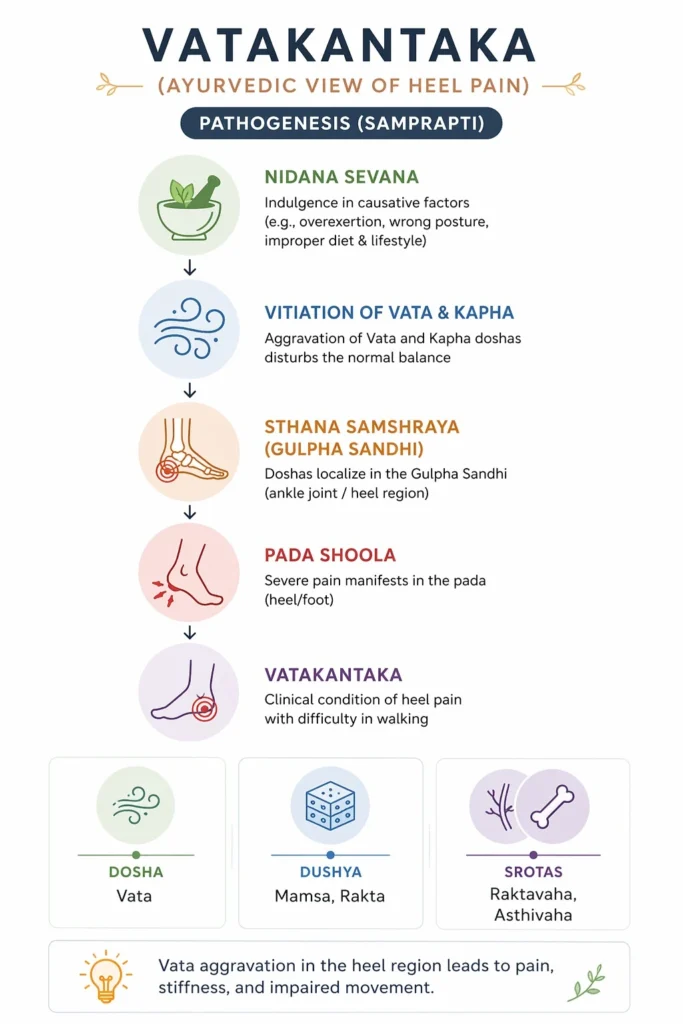
In Ayurveda, heel pain is understood as vatakantaka. It is mainly linked to an increase in Vata dosha, which governs movement and dryness in the body.
The word itself is quite telling. Kantaka refers to a thorn. Many people describe the pain in exactly that way. Sharp. Localised. It becomes noticeable when the foot touches the ground.
This kind of pain builds slowly with repeated strain. Walking on uneven surfaces, standing for long hours, or even the way the foot lands while walking can disturb Vata. These are considered nidana, or causes.
As this continues, Vata tends to settle in the heel. Over time, deeper structures are affected. This includes snayu (ligaments), asthi (bone), and sandhi (joints). The area begins to lose its natural ease of movement. It feels tight. Dry. Less flexible than before.
That is why the pain is worse after rest. Movement improves it slightly, but only for a while.

Why is Heel Pain So Common in India?
Heel pain shows up very often in daily practice.
Many people spend long hours on their feet. Floors are usually hard. Footwear is often flat and offers very little support.
Food habits play a role, too. Irregular meals or dry food can gradually increase Vata. Over time, tissues lose their resilience.
With all of this together, it is not surprising that people keep searching for heel pain reasons and ways to manage it without depending only on tablets.
Why Ayurveda Helps When Painkillers Do Not Last
In modern care, plantar fasciitis is usually managed with nonsteroidal anti-inflammatory drugs, corticosteroid injections, and sometimes therapies like iontophoresis. These can reduce pain for a while. Many people feel relief in the beginning. But the effect often does not last. The strain in the tissue is still there, so the pain tends to return.
Ayurveda takes a different route. The aim is to reduce aggravated Vata, improve nourishment of the tissues, and bring back flexibility. It takes time. But the results are usually more stable. That is why heel pain ayurvedic treatment is often considered when the problem keeps coming back.
Ayurveda Treatment Protocol
- Abhyanga or oil application involves applying medicated oil to the heel and the surrounding area. This helps reduce dryness and stiffness.
- Swedana or sweating therapy follows, with specific methods like Istika Sweda and Kanji Sweda, where heat is used to relax tissues. It improves movement and reduces tightness.
- Lepa is the application of a herbal paste. It works locally to reduce inflammation.
- Often, internal medicines and Panchakarma therapies are also considered to balance Vata from within, especially when the condition is long-standing.
- When pain is persistent, agni karma is considered.
Agni Karma for Heel Pain — How It Works
Agni karma for heel pain is used when the pain is not settling easily.
In simple terms, controlled heat is applied to specific points on the heel using a heated instrument called a shalaka. The application is brief and done carefully.
It is not about burning the skin. The aim is to create a focused effect at the exact point of pain. This heat helps counter the cold and dry nature of Vata. It reduces stiffness and allows the area to move more freely. When there is some swelling due to Kapha, it also helps clear that.
The procedure is done in sittings, depending on the condition. With each sitting, pain gradually reduces, especially the typical early morning discomfort. Because it works locally, it is often used in chronic cases and in heel spur Ayurvedic treatment.
Best Oils and Local Applications
Oils play an important role in recovery.
Mahanarayana Thailam is often used when stiffness is more noticeable.
Dhanwantharam Thailam supports muscle and joint strength.Kottamchukkadi Tailam is chosen when there is more irritation.
Murivenna for heel pain is commonly used when healing of tissues is needed.
Using the right Ayurvedic oil for heel pain regularly makes a difference over time.
Home Remedies That Support Healing
Simple things done at home can help.
- Warm sesame oil applied to the heel at night helps reduce stiffness. Adding a little salt and camphor gives a mild warming effect.
- Soaking the feet in warm water with rock salt is another easy practice. Many people follow this as a rock salt foot soak heel pain routine.
- If the area feels irritated, a cold pack can be used for a short time.
- A simple turmeric paste with warm oil can also be applied.
- Gentle stretching helps more than complete rest. Movements like pulling the toes towards you or stretching the calf reduce strain. These are often part of heel pain exercises yoga.
- Rest still matters. The foot needs time to recover.
When to Seek Medical Care
Home care works in the early stages. But not always. If the pain lasts more than a week, becomes severe, or affects walking, it should be checked. Swelling, colour changes, numbness, or wounds in the foot also need attention. If nothing seems to improve, it is better to get proper guidance.
Heel Pain Exercises and Gentle Movement
Too much rest can also make the heel stiff.
Gentle stretching of the calf helps reduce the pull on the heel. Pulling the toes towards the body stretches the plantar fascia.
Rolling the foot over a bottle can also help.
These simple practices, part of heel pain exercises yoga, help reduce recurrence.
Footwear and Daily Habits
Footwear matters more than people think.
Soft cushioning and some arch support help. Flat, hard slippers increase strain.
Regular meals and warm food help keep Vata in balance.
Allowing the heel to rest prevents overuse.
Footwear and Daily Habits
Heel pain takes time to develop. It also takes time to improve.
With vatakantaka Ayurveda, the focus is on correcting the cause, not just reducing pain.
With therapies like agni karma for heel pain, proper oils, and consistent care, the improvement tends to last.
References