There is a certain kind of exhaustion that comes with living in pain for a long time. Not just physical exhaustion. A deeper kind. The kind that comes from waking up every morning hoping the body will finally feel different, only to realise the stiffness is still there before your feet even touch the floor.
For many people, chronic pain does not begin dramatically. It starts quietly. A tight neck after work. A dull ache in the lower back after sitting too long. Knee pain while climbing stairs. At first, it feels manageable. You stretch, rest, take a painkiller, maybe apply a gel, and continue with life. But slowly, something shifts. The body doesn’t recover the way it used to. Pain begins returning more often. Recovery takes longer. Sleep becomes lighter. Even small activities start feeling heavier. Some days, the pain moves around. On others, stress alone is enough to bring it back. That is usually when a familiar question comes up in clinical practice:
“Why do I have chronic pain when nothing serious shows on my scans?”
It is an important question because by the time pain becomes chronic, it is rarely about one structure anymore. The nervous system, sleep, stress response, digestion, inflammation, muscle tension, and recovery capacity all begin influencing each other in a continuous loop.
This is where Precision Ayurveda approaches things differently. It doesn’t begin with the pain alone, but with understanding why the body has remained in a state where pain continues to repeat.
What Is Chronic Pain? Why Does It Keep Coming Back?
Clinically, chronic pain is defined as pain lasting longer than three months. But in real experience, it feels very different from normal pain. Normal pain follows a clear pattern – something gets strained, it hurts, and then it heals.
Chronic pain doesn’t behave that way. The body becomes more sensitive. Small triggers start producing stronger reactions. Recovery becomes inconsistent. Pain fades and then returns without a clear reason. Over time, many people begin to feel as if the body is no longer “resetting” properly.
This is where frustration builds. Treatments are taken, relief appears for a while, and then symptoms gradually return.
This doesn’t mean the treatments are wrong. They are often necessary, especially in acute phases. But most approaches focus on calming symptoms, not on understanding why the system has become unstable in the first place. That is why chronic pain Ayurvedic treatment focuses less on masking symptoms and more on understanding the body’s underlying patterns.

5 Root Causes of Chronic Pain in Ayurveda
Ayurveda approaches pain by asking a deeper question: “What is continuing to sustain this pain inside the body?” In long-standing cases, we commonly see five patterns.
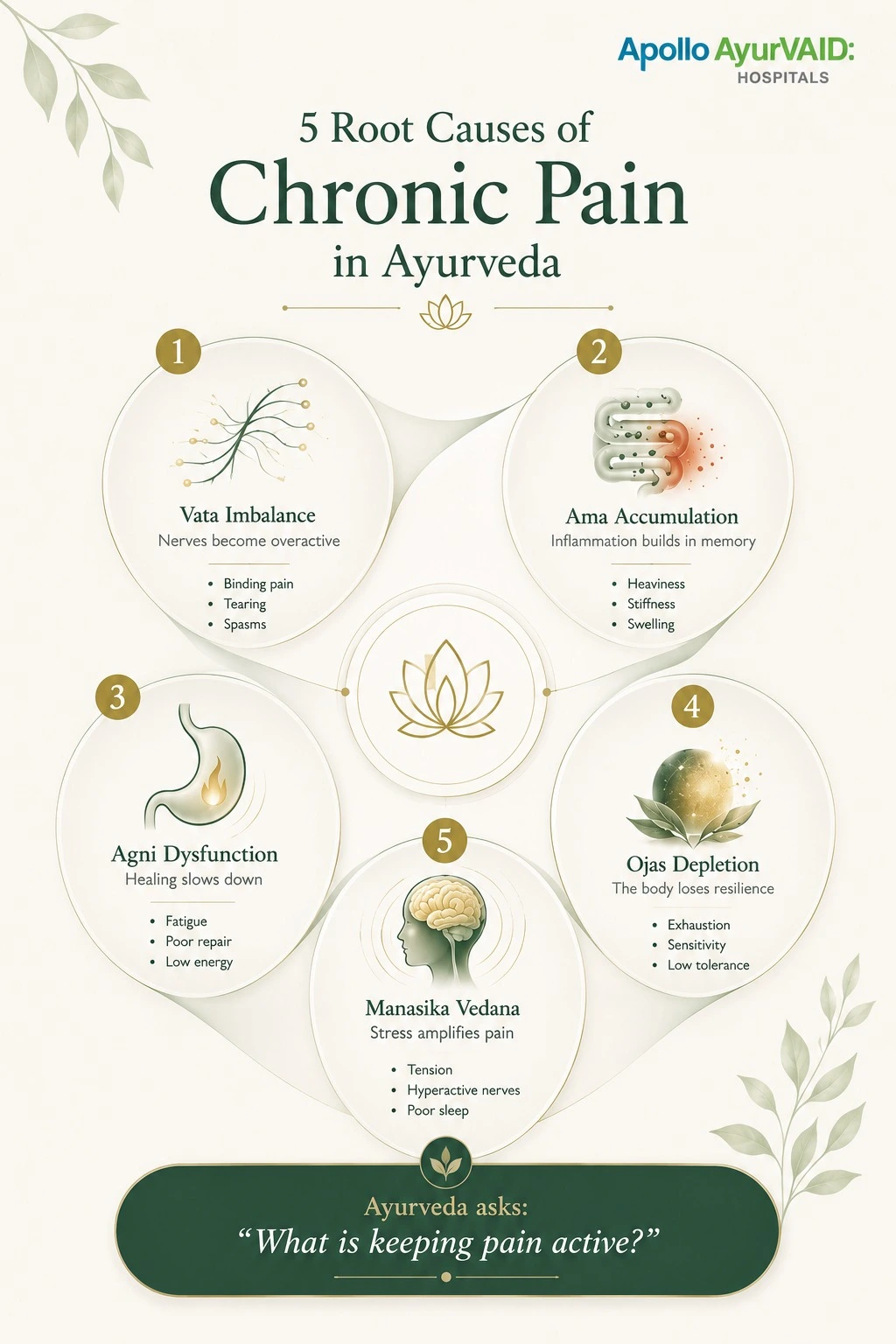
Vata Imbalance and Nerve Sensitisation
Among all Ayurveda concepts, the relationship between Vata and chronic pain is one of the most important.
Vata governs movement, nerve communication, circulation, muscular coordination, and sensory perception. When Vata becomes aggravated, the nervous system becomes more reactive. This often happens due to chronic stress, poor sleep, excessive work, irregular routines, ageing, emotional exhaustion, excessive travel, or prolonged illness.
The pain pattern then changes.
Instead of simple muscular discomfort, symptoms become more variable and sensitive. Pain may radiate, shift locations, feel sharp or shooting, or worsen unpredictably. Tingling, numbness, spasms, and disturbed sleep also become common. Many people with chronic neck pain, lower back pain, sciatica, migraine patterns, or fibromyalgia-like symptoms show strong signs of aggravated Vata.
This is one reason many back pain Ayurvedic treatments focus heavily on warmth, oil therapies, nourishment, nervous system regulation, and stabilising routines. Because the nervous system itself needs calming.
Ama Accumulation and Inflammatory Pain
One of the central Ayurveda explanations for long-standing pain is something called Ama.
‘Ama’ is often translated as ‘toxins’, but the idea is more complex than that. In Ayurveda, Ama refers to poorly processed metabolic waste that accumulates when digestion and tissue metabolism are not functioning efficiently.
When this happens over time, the body becomes less capable of repairing itself properly. Inflammation lingers longer. Circulation slows. Tissues become heavier and stiffer. Recovery becomes incomplete. This forms the basis of Ama and chronic pain.
People with Ama related pain often describe their symptoms in very familiar ways. The body feels heavy upon waking. Stiffness takes time to reduce. Fatigue remains even after rest. Digestion feels sluggish. Pain feels worse during cold weather, with inactivity, or after irregular eating habits. Clinically, these patients often say something important: “I do not just feel pain. I feel unwell overall.” That distinction matters. This pattern is commonly seen in inflammatory arthritis, recurrent joint pain, autoimmune inflammatory conditions, and chronic stiffness disorders.
Over time, Ama starts interfering with normal tissue nourishment and circulation. Once this combines with nervous system aggravation, pain becomes more persistent, unpredictable, and difficult to resolve completely.
Agni Dysfunction and Poor Tissue Repair
Agni refers to the body’s metabolic intelligence. Not only digestion, but also the ability to transform food into healthy tissue, energy, and recovery.
When Agni weakens, healing becomes inefficient. Inflammation persists longer. Recovery slows down. The body struggles to repair itself properly after physical or emotional strain. People with long-standing chronic pain causes also experience bloating, poor appetite, low energy, sluggish digestion, and prolonged fatigue after exertion.
From an Ayurveda perspective, tissues cannot heal efficiently if metabolism itself is under strain.
Ojas Depletion and Lower Pain Threshold
This is something many chronic pain patients understand immediately. After living in pain for months or years, the body begins feeling depleted. Small triggers feel overwhelming. Stress tolerance falls. Fatigue becomes constant.
In Ayurveda, this depletion is described as low Ojas.
Ojas is the body’s reserve strength. It is what helps you recover after a difficult week, handle stress a little better, bounce back from illness, and feel physically and emotionally steady.
When pain, stress, poor sleep, or ongoing inflammation continue for months or years, that reserve can slowly begin wearing down. People often describe it in basic ways. “I get tired more easily now.” “Small things feel harder than they used to.” “I do not seem to recover the way I used to.” The body starts feeling as though it has less capacity to absorb and adapt. Pain sensitivity increases. Recovery becomes slower. This becomes a major factor in long-term pain management.
Manasika Vedana and the Mind Pain Cycle
Pain rarely stays limited to the body alone. People who have been living with chronic pain for a long time often notice changes that are harder to explain. Patience becomes less. Concentration starts slipping. Small things feel more draining than they used to. Some even say, “I do not feel like myself anymore.”
At the same time, stress and anxiety can make muscles stay tense and keep the nervous system on high alert. Over time, the body can begin expecting pain before it even appears, creating a cycle that slowly becomes difficult to break. The nervous system becomes hyperalert. The body remains tense and guarded. This is one reason chronic pain and stress are so deeply connected.
Ayurveda recognised this relationship centuries ago through the concept of Manasika Vedana, the connection between emotional distress and physical suffering.
Why Stress Makes Everything Worse
One of the most common patterns we see clinically is this: stress increases, and pain increases with it. During emotionally difficult periods, people often notice worsening neck tightness, headaches, lower back pain, spasms, fatigue, and sleep disturbance. From a modern perspective, chronic stress affects cortisol regulation and nervous system sensitivity. According to Ayurveda, Vata is aggravated by stress.
Chronic pain rarely persists because of a single issue. By the time pain becomes chronic, several factors are often involved together. Poor sleep, stress, reduced movement, muscle tension, postural strain, ongoing inflammation, and nervous system sensitisation can gradually begin affecting one another. This is why many people experience temporary relief, only to find the symptoms returning.
The 4-Phase Precision Ayurveda Protocol for Chronic Pain
Chronic pain relief in Ayurveda usually happens step by step. People often expect pain to reduce first, but in practice, the body tends to show improvement in other ways before that happens. Sleep becomes deeper. Morning stiffness starts feeling lighter. The body may feel less heavy or less tired throughout the day.
The first phase usually focuses on settling inflammation and calming an overactive nervous system. Once the body becomes more settled, attention shifts toward improving digestion and metabolism and reducing Ama, which is considered one of the Ayurveda chronic pain root cause.
The next stage focuses on Rasayana treatment. This is where nourishment, tissue recovery, movement, and rehabilitation become important, especially for people who feel physically worn down after living with pain for a long time.
The final phase is about helping the improvements last. Everyday movements, posture, stress management, and routine become important because modern chronic pain management in India is not only about reducing pain. It is also about reducing the chances of repeatedly returning to the same cycle.
Precision Ayurveda in Clinical Practice: A Chronic Pain Case Example
When people live with pain for years, recovery often does not begin in the way they expect.
Many patients come hoping for one clear moment when the pain suddenly disappears. But in chronic pain conditions, improvement is usually more gradual than that. Sometimes the earliest changes are simple things that people almost overlook at first. Waking up feeling a little less stiff. Walking slightly longer without needing to stop. Feeling less tired by evening. Sleeping better after months of disturbed rest.
In clinical practice, these changes matter because they often tell us that the body is beginning to recover in a deeper way.
One such case at Apollo AyurVAID involved Mrs X, a 57-year-old woman, who had been living with pain for a long time.
She had pain in both knees for nearly ten years, with the left knee being more severe. Along with this, she also had chronic low back pain that radiated into both legs. Over time, it became increasingly difficult to carry out daily activities. Walking for even a few minutes was uncomfortable. Standing for longer periods became challenging. Persistent tiredness had also started affecting her overall quality of life. Her assessment showed moderate osteoarthritis changes in both knee joints, along with degenerative changes in the lower back.
The treatment approach did not focus only on the painful areas. Care was planned using a staged Precision Ayurveda approach. Attention was given to reducing inflammation, calming aggravated Vata, improving recovery capacity, supporting tissue nourishment, and gradually improving function.
Clinical outcomes observed during treatment
Outcome Parameter | At Start of Treatment | At Completion of Treatment |
Right knee pain | 6 to 7/10 | 1 to 2/10 |
Left knee pain | 9/10 | 3 to 4/10 |
Low back pain | 7 to 8/10 | 3/10 |
Radiating pain to both legs | 8/10 | 2 to 3/10 |
Walking tolerance | Less than 5 minutes | Around 15 minutes |
Left knee movement | Flexion 50° with pain | Flexion 80° with improved movement |
General tiredness | High | Mild |
Sleep quality | Fair | Improved |
Stationary cycling capacity | 3 minutes | 10 minutes |
Gait pattern | Moderate waddling gait | Mild waddling gait |
Clinical outcomes observed during treatment
What stands out in this case is that the changes were not limited to pain scores.
The patient was able to walk longer. Movement became easier. Radiating symptoms have reduced. Fatigue improved. Sleep quality became better. For someone who has been living with chronic pain for years, these changes may seem small from the outside, but they can make a meaningful difference in everyday life.
Realistic Recovery Timeline
One of the most important conversations we have with patients is about outcomes. Chronic pain recovery is usually gradual. And that is normal. When pain has existed for years, the nervous system, muscles, metabolism, and recovery mechanisms all need time to reset. Often, improvements happen in stages. Sleep improves first. Stiffness reduces. Energy slowly returns. Pain flare frequency decreases. Movement becomes easier. Then eventually, pain intensity begins to reduce more consistently. Functional improvement often appears before complete pain relief. This is why consistency matters far more than temporary intensity.
Final Thoughts
References