Back pain in your twenties is easy to ignore. Most people blame long hours of sitting, bad posture, or “one of those days”. But if that stiffness greets you every morning, takes time to loosen up, and somehow feels better only when you move around, it tells a different story.
For many, that story turns out to be Ankylosing Spondylitis.
It does not usually arrive dramatically. It builds slowly, quietly affecting the spine, energy levels, and eventually posture. And by the time it is clearly diagnosed, people often say the same thing that they wish they had understood earlier. This is where Ayurveda offers a different lens. Not just in treating pain, but in understanding why the body behaves this way in the first place. World Ankylosing Spondylitis Day, observed on May 2, brings attention to early recognition and better understanding of this often overlooked condition.
What is Ankylosing Spondylitis? Young Men's Arthritis Explained
Ankylosing spondylitis is a chronic inflammatory condition that mainly targets the spine and the sacroiliac joints. Over time, repeated inflammation can reduce flexibility and, in some cases, lead to the fusion of the vertebrae, also called the ‘bamboo spine’.
It tends to affect younger individuals, especially men, often before the age of forty. That is why the term ‘ankylosing spondylitis young men’ shows up so often in discussions around it.
There is also a genetic link through HLA B27. Many patients first hear about this marker after years of unexplained symptoms, which leads them to explore options like HLA-B27 Ayurvedic treatment alongside conventional care.
In India, the condition is still considered relatively uncommon, but that may be more about underdiagnosis than actual numbers. Conversations around ankylosing spondylitis India prevalence are slowly becoming more visible now.
Vishwachi — Ayurveda's Classical Understanding of Spinal Inflammation
Ayurveda does not box this condition into a single label. Instead, it understands it through patterns.
In most cases, it falls under Vatavyadhi, particularly Asthimajjagata Vata, where aggravated Vata dosha begins to affect deeper tissues like bone and marrow.
The term ‘Vishwachi’ appears in classical texts to describe pain and stiffness that affect movement pathways. Although it doesn’t match directly, it provides a framework for understanding the prevalence of stiffness and limited mobility in Ayurveda. This is where Vishwachi Ayurveda becomes relevant in modern interpretation.
What is important here is the process
- Irregular food and sleep habits disturb Vata
- Digestion weakens, leading to Ama
- This imbalance settles in the spine region
- Stiffness, pain, and restriction begin to show up
That is the foundation of how spine inflammation Ayurveda is approached.

Understanding the Pathogenesis
From an Ayurveda lens, this condition progresses through a clear mechanism.
Aggravated Vata dosha, with its dry (Ruksha) and cold (Sheeta) qualities, localises in the Asthi Dhatu (bone tissue), especially in the spine. Simultaneously, weak digestion leads to the formation ofAma (toxins), which obstructs the body’s channels (Srotas).
This creates a cycle of:
- Stiffness
- Pain
- Restricted movement
- Chronic inflammation
This presentation aligns with classical descriptions like Prushta Graha (dorsal stiffness) and Trika Graha (sacroiliac stiffness).
Ankylosing Spondylitis Symptoms
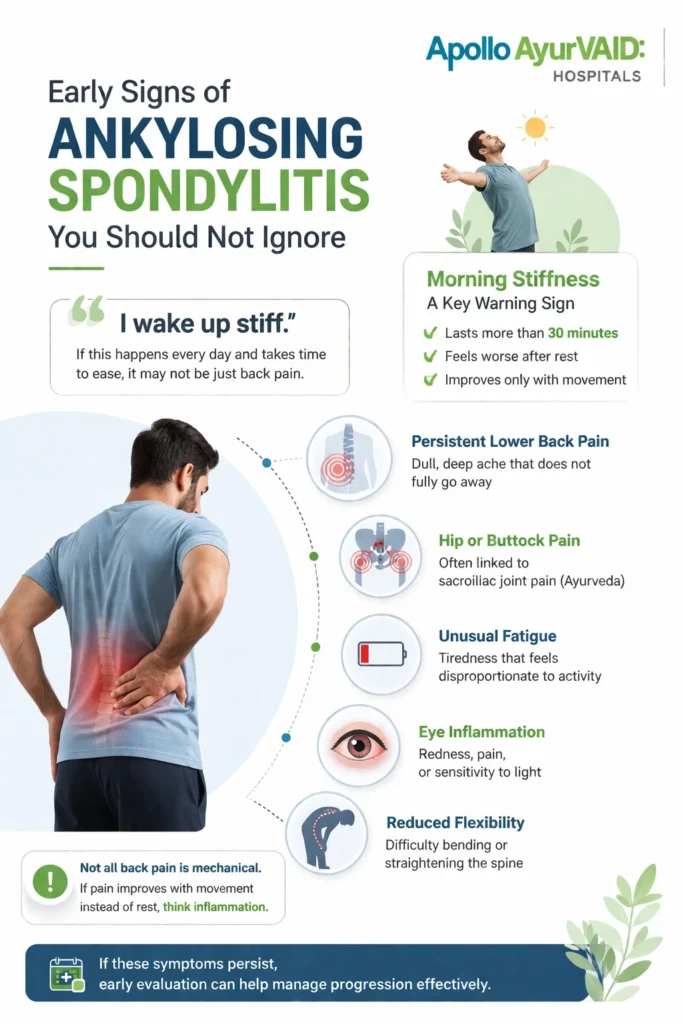
People often describe it in basic terms. “I wake up stiff.” But that stiffness is not brief. It lingers. Morning stiffness spine is one of the strongest indicators, especially when it lasts longer than 30 minutes and improves only after movement. Other common symptoms include:
- A dull but persistent lower back ache
- Pain around the hips or buttocks, often pointing to sacroiliac joint pain, Ayurveda
- Fatigue that does not match activity levels
- Occasional eye inflammation
- Gradual loss of flexibility
It is not just pain. It is a pattern.
How AS Is Different from Regular Back Pain
This distinction is where many people get delayed. Regular back pain usually has a trigger. You lift something heavy, sit too long, or sleep awkwardly. It improves with rest. Ankylosing Spondylitis behaves differently
- It starts slowly
- It prefers younger age groups
- It feels worse with rest
- It improves when you move
That last point is often the biggest clue.
Because of this difference, people who do not find lasting relief often begin exploring options like ankylosing spondylitis Ayurvedic treatment.
Ayurvedic Treatment Protocol for AS
Modern management typically includes NSAIDs, DMARDs, or surgery to reduce inflammation and manage symptoms. While effective in many cases, these treatments may not always provide complete long-term relief and can have side effects. This is why many people explore complementary approaches like Ayurveda.
At Apollo AyurVAID, the approach is not about applying a standard set of therapies. It is built on precision Ayurveda. That means understanding the individual first, not just the disease.
A detailed assessment looks at
- Body constitution or prakriti
- Stage of the condition
- Digestive strength
- Presence of Ama
- Degree of mobility restriction
Based on these findings, a treatment plan is created.
The intention behind AS treatment in Ayurveda is quite clear
- Calm the ongoing inflammation
- Improve movement and daily comfort
- Slow down long-term progression
The process usually unfolds step by step
- Deepana Pachana (digestive stimulation therapy) to correct digestion
- Snehana (oleation therapy) to reduce dryness and stiffness
- Swedana (sudation therapy) to ease rigidity
- Shodhana (purification therapy) where needed
- Followed by Shamana (palliative therapy) for maintenance
This is how Ayurvedic medicine for ankylosing spondylitis becomes structured and personalised rather than generic.
Panchakarma for Spinal Inflammation
Panchakarma is often misunderstood as a fixed detox package. In reality, especially in an evidence-based setup, it is carefully selected.
Vasti This is central to managingVata. In many cases, it becomes the backbone ofAyurvedic medicine for ankylosing spondylitis, working deeper than surface-level symptom relief.
Virechana Used when there is a clear need to reduce inflammatory load through the digestive route.
Kati Vasti A localised therapy that many patients find especially relieving for lower back stiffness and when sacroiliitis treatment, Ayurveda is needed.
Other therapies like Shalishastika Pinda Swedana or Patrapinda Swedana may be added depending on the condition.
At Apollo AyurVAID, none of these are applied uniformly. Timing, sequence, and intensity are always adjusted.
Anti-Inflammatory Diet for Ankylosing Spondylitis
Diet is not a side note in Ayurveda. It is part of the treatment. A practical ankylosing spondylitis diet India approach is simple and consistent
- Eat warm, freshly prepared food
- Include ghee in moderation
- Consume omega-3 fatty acid-rich foods
- Favour light and easy-to-digest meals
- Use anti-inflammatory spices like ginger and turmeric
And equally important
- Avoid cold and processed foods
- Reduce heavy, oily meals
- Stay away from alcohol and smoking
- Be cautious with curd, especially at night
The goal is not restriction. It is to support digestion, so inflammation reduces naturally.
Yoga and Physiotherapy for AS — Maintaining Spinal Flexibility
Can Ayurveda Slow AS Progression? Evidence and Clinical Experience
This is the question people really want answered.
Ayurveda may not reverse advanced structural fusion. But it can make a meaningful difference in how the disease behaves.
Clinical experience and published case observations suggest
- Noticeable reduction in pain and stiffness
- Better mobility
- Improvement in inflammatory markers
- Slower progression when managed early
Structured Ayurveda care can help improve function and reduce pain. That is where a precision Ayurveda approach becomes important.
Final Thoughts
References